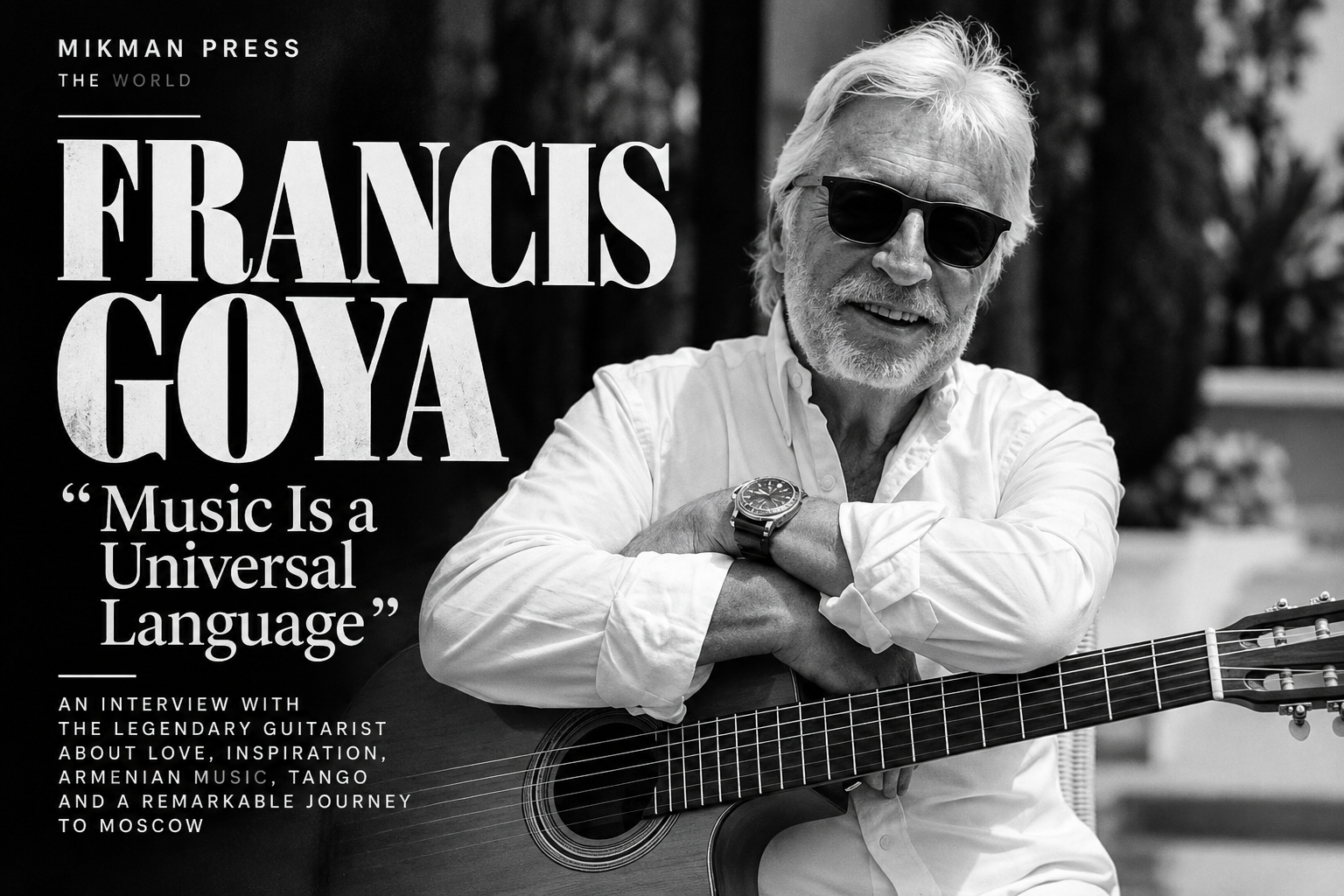
An interview with the legendary Belgian guitarist and composer about love, inspiration, Armenian music, tango, Latin America, his family, and the remarkable journey that once took him to Moscow to record traditional Russian songs.
— Mr. Goya, belated happy birthday! I wish you good health, continued creativity, and many more years of bringing joy to people through your music.
Thank you very much for the birthday wishes. I intend to continue making my art for as long as possible — until my last breath, if I can.
— When I was a child, I first heard one of your records, and it stayed with me forever.
I have met quite a few people in different countries who began learning to play the guitar when they were children because of my music and my records. That is very touching for me.
— Your music is often associated with love, strong emotions and romance. Is there a particular image or idea behind your compositions?
I need to be alone, in that special world that belongs to me.
It can happen when I am at home on the terrace, in my car or on an airplane. I close my eyes and think about beautiful things. Nature comes to mind, the stars, women, melodies.
I remember the notes and, as soon as I can, I write them down. Then I harmonise them and develop them with my guitar. When I am satisfied, I record the piece.
I have to say that everything depends on my state of mind and my mood.
— Your compositions make me think of love for a woman.
Women inspire me, and especially my wife. I am a very romantic person.
Love occupies a very important place in my life. I mean love in the broadest sense — love between two people, but also the love of my children and grandchildren, my friends and the people around me.
In my opinion, without all of that, life would not be worth living.
— You moved to Morocco and lived there for some time. Why Morocco?
My wife and children decided that they wanted to live in Morocco after several trips there.
One of the reasons was the language — French. Morocco is a wonderful country. You can travel a hundred kilometres and the landscape can change completely.
The culture is very different from ours, and that is precisely what makes the country so fascinating.
In April 2017, we left Morocco for Andalusia in Spain. We are very happy there.
— Gypsy music can be just as powerful as Latin American music, and in some places even more exciting.
I like Gypsy music. It is spontaneous music, full of improvisation and unexpected surprises.
But my heart is drawn more strongly to Latin American music.
Whether it is Cuban, Brazilian, Colombian or another Latin American tradition, I hear music rich in harmony and rhythm.
For me, it represents happiness, sunshine and celebration.
I adore it.
— Have you ever paid particular attention to Armenian music? It is extraordinary.
Traditional Armenian music is magnificent. It is an entire culture.
When I listen to it, images immediately appear in my mind. I can imagine the land, the mountains, the countryside, the people, their happiness and sadness, wealth and poverty.
It gives me a very strong emotional sensation.
One of the Armenian instruments I particularly love, among many others, is the duduk.
Its sound, its warmth and the feeling that a musician can draw from this wonderful little instrument are incomparable.
— How do you choose the music you will compose? What do you base it on?
I never prepare myself according to any particular criteria.
Inspiration comes naturally.
I am speaking, of course, about the pieces I perform on guitar for my own records.
If I am composing something to order, the approach is different. I am given a subject and I work according to that subject.
— What is music really about — love, or emotions in general?
Music is a universal language.
You do not necessarily have to speak in order to be understood.
Every style speaks in its own way.
There is love, tenderness, sadness, joy, happiness — and unfortunately, there is also suffering and tragedy.
Whatever we may think, without music the world would not be the world.
— Is there anything you regret in your life?
I regret only that I did not have the time and opportunity to perform in more countries around the world, including Armenia.
— Tango is fascinating. It is a dance of love in which two partners can feel each other intensely. Without tango, the world of dance would be poorer. Do you agree?
Yes.
Tango is a sensual and erotic dance. It brings men and women closer together. They look at each other, feel desire and experience that attraction.
It is one of the most beautiful dances that exists.
— Is tango more music or dance?
Obviously, it is both.
One cannot exist without the other.
— Jewish music is also extraordinary.
Jewish music is very distinctive in its melancholy and is often quite sad.
I have had the pleasure of recording several pieces, including Ma Yiddishe Momme, Dona Dona, and Hatikvah, the wonderful national anthem of Israel.
This music is so beautiful to perform precisely because of its melancholy.
The notes flow across the guitar strings with enormous feeling.
— And what music do you personally listen to?
I like many different styles.
I love Latin American music, especially bossa nova. I listen to a lot of flamenco guitar, and my favourite guitarist is Vicente Amigo.
When I was young, I was a member of several pop groups. I was a fan of Led Zeppelin, The Beatles, The Rolling Stones and others.
I was also a member of a soul group called The JJ Band. That group gave me the opportunity to become a professional musician.
As a result, I listened to a great deal of music — and I still do. I listen to Marvin Gaye, Sam & Dave and many others.
I love Gypsy jazz and Django Reinhardt, our great guitar master. Today I also listen to the Rosenberg Trio.
As for classical music, Maurice Ravel and Antonio Vivaldi bring me a great deal of peace when I listen to their works.
— The call of the heart or the call of the blood — which is stronger?
The call of the blood.
My entire family, on both my father’s and mother’s sides, were artists. They encouraged me to learn the guitar after noticing that I had some musical ability.
But the call of the heart is just as strong.
In my case, the two go hand in hand.
— Breaking into the Soviet music market was not easy. How did you manage to enter the Soviet Union?
The idea of performing traditional Russian songs had fascinated me for a long time.
My parents had fled Germany through Russia during the last war, and they introduced me to traditional Russian music.
One day, my producer at the time and I decided to embark on this great adventure.
In April 1980, we travelled to Moscow to record this wonderful project.
We had fifty singers and a balalaika orchestra. They were all exceptional musicians.
The Soviet state record company decided to release our project throughout the USSR.
The record was an incredible success, and it eventually allowed me to tour the former Soviet Union from the 2000s onward.
— Mr. Goya, thank you for such an interesting conversation. We love your music, we listen to it, and we remember it. I wish you all the best.
Thank you from the bottom of my heart.
Francis Goya
Michael Manukian