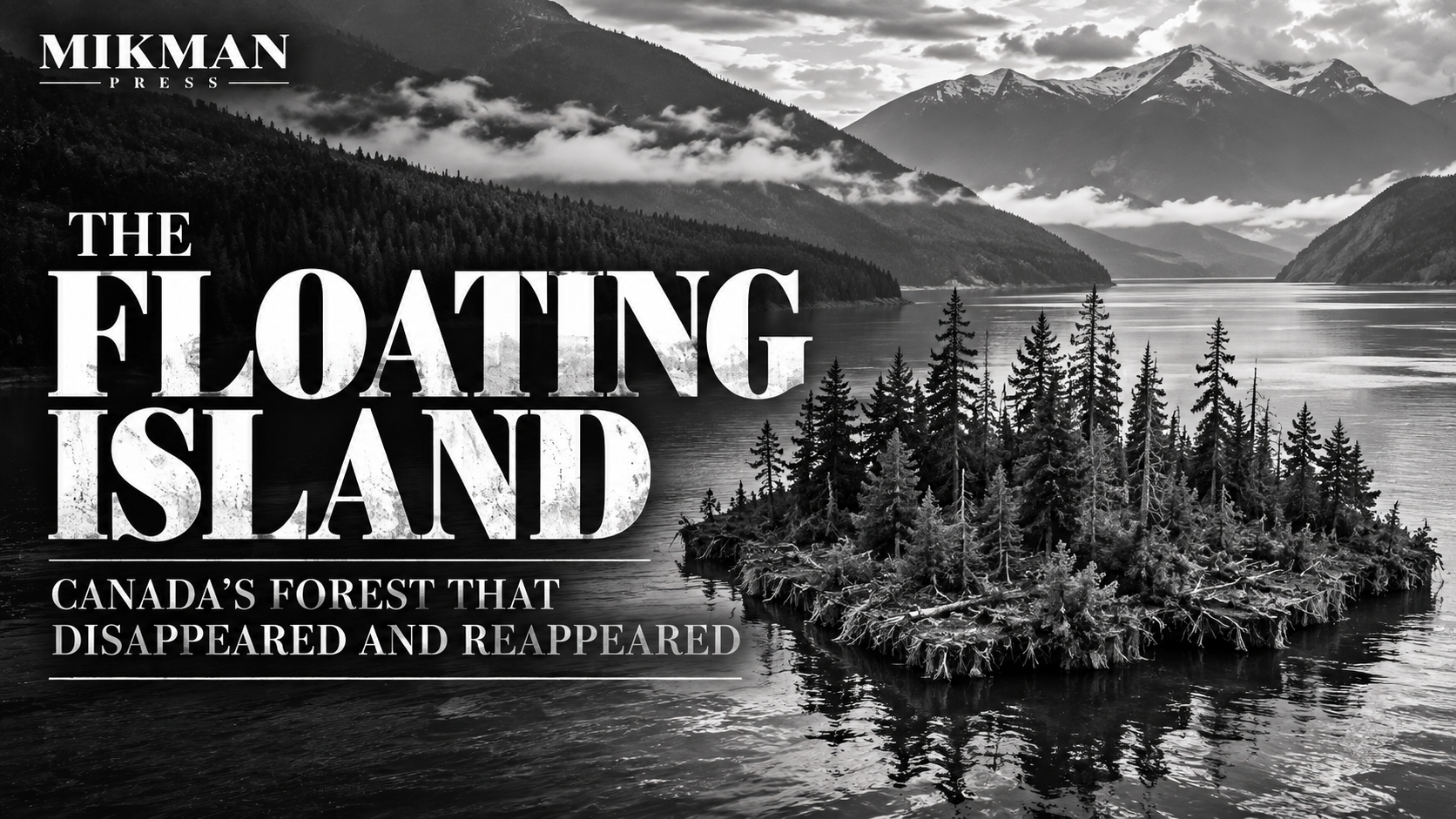
It looked like an ordinary island. Then it vanished. Weeks later, it was found 30 kilometres away — still carrying trees, roots and wildlife.
There are places on Earth that seem to belong to another world.
Deep in northern British Columbia, Williston Reservoir is one of them. Vast, remote and surrounded by forests and mountains, it is already an extraordinary landscape.
But this summer, something appeared on its surface that seemed almost impossible.
A forest was floating across the water.
Not a small piece of driftwood. Not a few branches gathered by the wind.
An entire mass of vegetation, with mature trees standing upright, appeared to be travelling across one of the largest reservoirs in the world.
Then it disappeared.
And for a while, nobody knew where it had gone.
A forest where no island should be
The first confirmed satellite imagery showing the strange landmass dates to July 21, 2026. Later, in August, local boaters began reporting that they had seen a large, tree-covered island near Finlay Bay.
The reports sounded so unusual that even people at BC Hydro, the utility operating the reservoir, initially had reason to doubt what they were hearing.
But the photographs were real.
And so was the island.
Satellite imagery confirmed a large green mass floating on the reservoir. By the time it was being reported publicly, estimates put it at approximately 140 metres long and 70 metres wide — roughly the size of two football fields. bchydro.com
From a distance, it looked like a piece of the Canadian wilderness had somehow broken away from the shore.
That was essentially what had happened.
But not in the way most people imagined.
Then the island vanished
The strange discovery quickly became a mystery.
The island was there.
Then it wasn’t.
It had not sunk in any obvious way. It had simply disappeared from the locations where people expected to find it.
The enormous size of Williston Reservoir made the search difficult. This is not a small recreational lake where someone can simply drive around the shoreline.
Williston Reservoir covers approximately 1,773 square kilometres at full pool and is the largest reservoir in British Columbia by volume. It was created after construction of the W.A.C. Bennett Dam and began filling in 1968. bchydro.com
Trying to find a moving island in that enormous body of water was therefore like trying to find a single drifting building in a small inland sea.
Boaters searched.
People reported sightings.
Satellite images were examined.
And then came the answer.
The island had not disappeared.
It had moved.
The island had travelled 30 kilometres
On August 15, satellite imagery captured the floating forest in another part of the reservoir.
By August 31, BC Hydro had enough information to confirm where it had gone.
The island had travelled approximately 30 kilometres from its original documented position.
It eventually came to rest along the shoreline of the Ospika Arm, northwest of where it had first been observed. bchydro.com
That discovery transformed the mystery.
The question was no longer:
Where did the island disappear to?
It became:
How does a forest float?
It isn’t really an island
Technically, calling it an island is misleading.
It is better described as a floating vegetated mass — a large raft of interconnected woody material, roots and vegetation.
BC Hydro believes the structure may have developed over many years in a sheltered area.
Logs and other woody debris accumulated.
Vegetation took root.
The organic material gradually became interconnected.
Trees grew.
Eventually, rising water and changing conditions may have helped detach the mass from the shoreline.
And suddenly, something that had been part of the shore became mobile. bchydro.com
It is nature behaving like an engineer — building a platform out of material that was never supposed to become a boat.
A forest with its own passengers
The strangest part may be what the floating island carries with it.
Photographs show numerous mature trees growing from the mass.
There are also reports of birds and other wildlife using it.
Underneath the surface, the tangled roots and submerged material may provide shelter for fish.
So this is not simply a pile of dead timber.
It is a functioning miniature ecosystem.
A piece of shoreline has effectively become a travelling habitat.
And because the island is covered in trees, wind may help push it across the reservoir. The trees themselves can act like a kind of sail, while currents and changing water conditions contribute to its movement. Гардиан
The result is something that sounds almost fictional:
A forest drifting across a lake.
Why did it happen now?
One of the important clues is water level.
Williston Reservoir experienced unusually high water levels, reaching its highest level in approximately 14 years, according to reporting on the phenomenon. Гардиан
That matters because the reservoir is not an ancient natural lake.
It was created by flooding an enormous landscape.
Beneath the water are forests, soil, sediment and huge quantities of drowned woody material.
For decades, much of that material has remained beneath the surface.
In a sheltered area, debris can accumulate.
Vegetation can grow.
Roots can bind material together.
And when water conditions change, a structure that has been attached to the shoreline can potentially break free.
That appears to be one of the leading explanations for what happened at Williston Reservoir.
But BC Hydro has been careful not to pretend that every detail is known.
The island’s exact formation and its ability to remain intact while travelling such a distance are still subjects of interest to researchers. bchydro.com
The island that became an international story
For a remote piece of northern British Columbia, the floating forest travelled remarkably far — not just physically, but through the internet.
Photographs circulated among boaters and local residents.
Then came satellite images.
Then television reports.
Then international newspapers.
Suddenly, an obscure corner of British Columbia became the setting for one of the strangest natural stories of the summer.
The Guardian, Smithsonian, ScienceAlert, the Canadian Press and other international outlets reported on the phenomenon. Гардиан
The reason is easy to understand.
People are accustomed to islands being permanent.
You find an island on a map.
You visit it.
You photograph it.
You leave.
The island stays where it is.
This one didn’t.
Don’t climb onto it
There is another reason the story has attracted attention from officials.
The floating forest may look solid.
It isn’t.
BC Hydro has warned people not to climb onto the island.
The structure contains logs and decaying woody material, making it unstable and potentially dangerous. People can approach by boat and photograph it, but stepping onto the mass is not considered safe. bchydro.com
From the water, it looks like land.
Underneath, however, there may be little more than an unstable web of logs, roots and organic material.
It is a forest without solid ground.
A young lake with an old forest underneath
There is something particularly fitting about the fact that this happened on Williston Reservoir.
The landscape looks ancient.
The mountains are enormous.
The forests surrounding the water have existed for generations.
But the reservoir itself is relatively young.
Its creation dramatically transformed the valleys of northern British Columbia.
The W.A.C. Bennett Dam began filling the reservoir in 1968, flooding a huge area and creating what is now the largest reservoir in British Columbia. bchydro.com
In a sense, the floating island is a reminder of what lies beneath the surface.
The forest did not suddenly appear from nowhere.
It was already there.
It simply found a way to return to the surface.
And now the mystery has changed again
By September 2, BC Hydro had officially announced that the island had been located.
It had travelled about 30 kilometres in 15 days before settling against the shoreline.
So the original mystery — Where did the island go? — has been solved.
But another mystery remains.
How exactly did a forest become a floating island in the first place?
Researchers are interested in the answer because floating vegetated islands of this size are uncommon.
BC Hydro says it will continue monitoring the structure and studying what can be learned from it. bchydro.com
And there is no guarantee that the story is finished.
If strong winds or changing water conditions break the island loose again, the forest could begin travelling across Williston Reservoir once more.
A forest that refuses to stay put
For now, the island is resting near the shore.
The mystery has lost some of its supernatural appearance.
There is no evidence that an unknown island suddenly rose from the bottom of the reservoir.
There is no geological miracle.
There is no hidden continent.
There is simply an extraordinary combination of water, drowned forest, vegetation, roots, wind and time.
And yet, seeing a mature forest moving across open water remains profoundly strange.
A tree belongs to the ground.
An island belongs to a place.
This one belongs to neither.
It is a piece of Canadian wilderness that broke free of the shore and went travelling.
And somewhere on the enormous waters of Williston Reservoir, it may not have finished its journey yet.
Michael Manukian