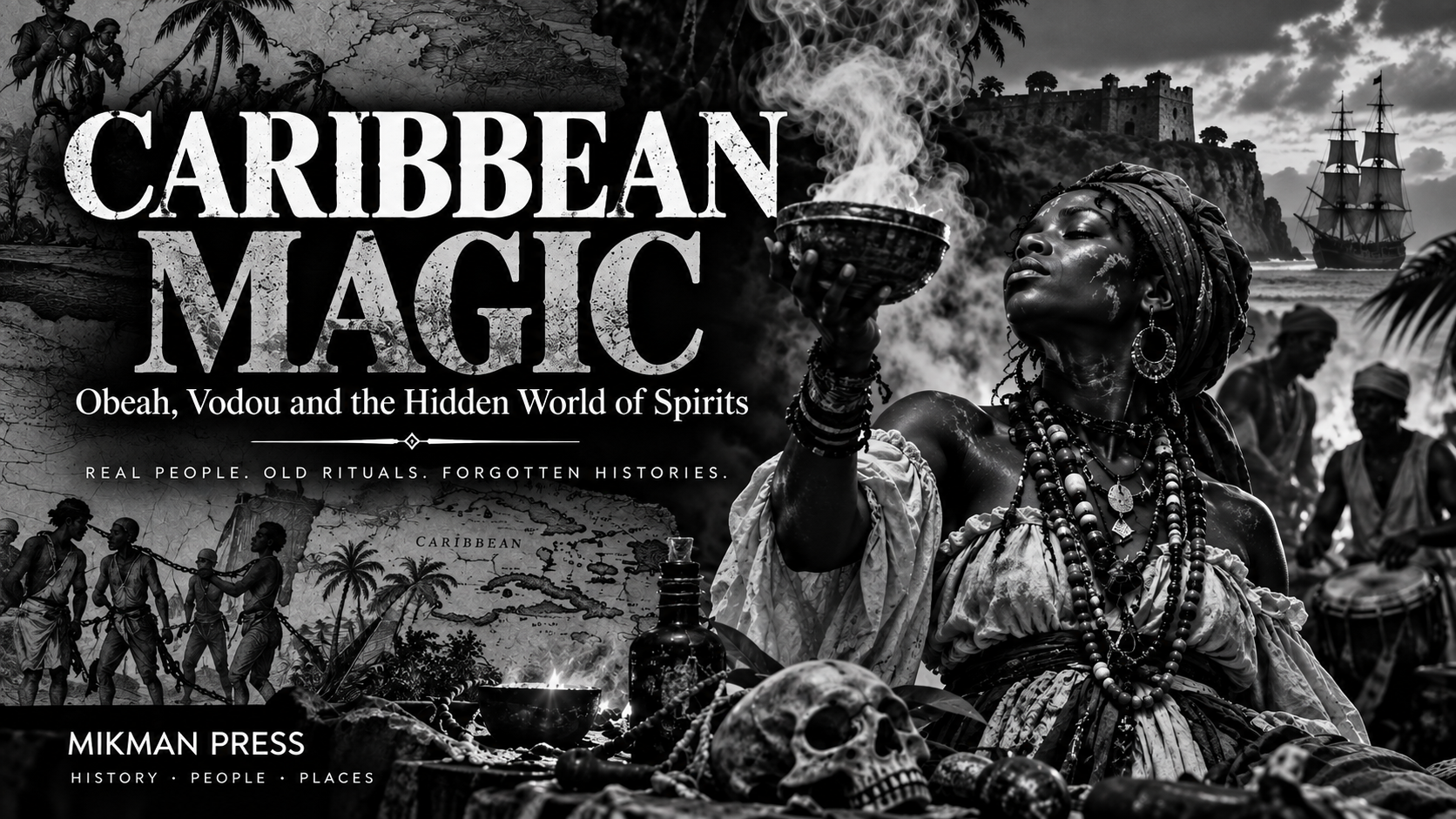
For centuries, the Caribbean was a place where people from different worlds were forced to meet.
Europeans arrived with Christianity, colonial governments and the institutions of slavery. Africans arrived against their will, carrying languages, memories, rituals and beliefs from societies stretching across West and Central Africa. Indigenous traditions survived in fragments, while later generations brought influences from India and other parts of the world.
Out of this violent encounter emerged something unique.
Across Jamaica, Haiti, Trinidad, Barbados and other Caribbean islands, people developed religious and spiritual traditions that Europeans often described with words such as magic, witchcraft, sorcery or superstition. But these labels often concealed something much more complicated.
There was Obeah in the English-speaking Caribbean. There was Vodou in Haiti. In Trinidad, Yoruba religious traditions developed into what became known as Orisha or Shango. Spiritual Baptist traditions combined African religious heritage with Christianity.
For colonial authorities, these practices could represent a threat.
For the people who practised them, they could represent healing, protection, communication with ancestors, religious identity and a connection with a past that slavery had attempted to destroy.
And sometimes, the line between documented history and legend became almost impossible to see.
The Woman from the Popo Country
One of the strangest stories connected with Caribbean spiritual traditions comes from Jamaica in the 1770s.
We do not even know the woman’s name.
She appears in historical material as the “Woman of the Popo Country,” a reference to the region of West Africa from which she was said to have originated. Her story was eventually presented to the British Parliament during an investigation into the slave trade in the late eighteenth century.
According to the account, a Jamaican plantation owner returned to the island in 1775 and discovered that many enslaved people on his plantation had become sick and died.
The deaths continued.
The plantation owner apparently attempted to provide medical treatment, but people continued to become ill. After approximately a year, suspicion turned toward Obeah.
An enslaved woman who had herself become seriously ill allegedly told the plantation owner that her stepmother, a woman from the “Popo country,” had caused the sickness through Obeah.
Other enslaved people reportedly supported the accusation.
The plantation owner then ordered six white servants to search the woman’s house.
According to the account, they found objects that were described as the “implements” of her trade.
The house was destroyed.
Her possessions were burned.
The woman herself was sold to Spanish slave traders and taken to Cuba.
And, according to the story presented to the British authorities, the sickness disappeared and the plantation subsequently prospered.
It sounds like a supernatural story.
But there is a second story hidden inside it.
The account was not simply a description of Jamaican spiritual beliefs. It was presented in the middle of a political argument about slavery.
Plantation owners were attempting to explain the terrible mortality rates among enslaved people. Instead of attributing deaths to overwork, violence, poor nutrition, exhaustion and brutal living conditions, some colonial accounts blamed Obeah.
The story therefore tells us two things at once.
It tells us about beliefs surrounding Obeah.
And it tells us about the fears and interests of the people who controlled the plantations.
The historical record cannot prove that the woman possessed supernatural powers. It cannot even establish every detail of the story.
What it can establish is that the story was considered important enough to be presented as evidence to British authorities.
And that is where the mystery begins.
What Was Obeah?
Obeah was not simply a Caribbean version of European witchcraft.
It developed within African and Caribbean societies and could involve spiritual practices, healing, protective objects, rituals, knowledge of plants and medicines, communication with supernatural forces and relationships between practitioners and their communities.
But there was never one single Obeah system.
Its practices varied between islands and communities.
The word itself became increasingly associated with danger in colonial societies. In Jamaica, Obeah became particularly associated with people who were believed to possess special spiritual powers.
Colonial governments eventually attempted to control it through law.
The result was extraordinary: something that had existed as a spiritual and cultural practice became a criminal category.
The Obeah Histories research project has documented numerous individual cases from the Caribbean. These include Polydore, an enslaved man prosecuted in Jamaica in 1831; Pierre, a free African convicted in Grenada; Charles Dolly, a spiritual worker in Montserrat who was repeatedly prosecuted between 1898 and 1908; Rose Ann Forbes and her husband George in Jamaica; and Daniel Young, a migrant from St Vincent who was convicted in Trinidad in 1931.
These were not legends.
They were people who appeared in courts.
Their cases reveal something that broad descriptions of Caribbean “magic” often miss.
The real story was not simply about supernatural beliefs.
It was also about power.
Who had the right to heal?
Who had the right to conduct ceremonies?
Who was allowed to possess spiritual knowledge?
And who decided when a religious practice became a crime?
When Magic Became a Crime
By the nineteenth century, accusations of Obeah could have serious consequences.
People could be imprisoned, flogged, transported or otherwise punished.
The colonial authorities often saw spiritual practitioners as dangerous because they operated outside the structures controlled by the colonial state.
A healer could have influence.
A spiritual worker could have followers.
A person believed to possess supernatural power could become an alternative source of authority.
In a society built around slavery, that could be frightening to those at the top.
The history of Obeah therefore belongs not only to the history of religion.
It belongs to the history of resistance.
That does not mean every person accused of Obeah was a political revolutionary. The surviving court records do not support such a simple conclusion.
But the colonial fear was real.
The authorities were dealing with populations whose languages, religions and social networks had developed largely outside European control.
Spiritual traditions helped preserve parts of African cultural life even when the institutions of African societies had been violently destroyed.
Haiti and the Mystery of Bois Caïman
If Jamaica gives us the mysterious Obeah woman, Haiti gives us one of the most famous stories in Caribbean history.
The year was 1791.
The French colony of Saint-Domingue was one of the richest plantation colonies in the world.
It was also one of the most brutal.
Thousands of enslaved Africans lived under an extremely violent plantation system.
In August 1791, a rebellion began that eventually became the Haitian Revolution.
Later generations associated the beginning of the uprising with a nighttime religious ceremony at a place known as Bois Caïman.
The traditional story is dramatic.
Enslaved people supposedly gathered secretly.
A religious ceremony took place.
Boukman Dutty, remembered as one of the leaders of the uprising, is traditionally associated with the gathering.
A priestess known as Cécile Fatiman became part of the later tradition.
A black pig is said to have been sacrificed.
Participants supposedly swore an oath to fight against slavery.
Soon afterward, the slave rebellion erupted.
The story became one of the founding narratives of Haiti.
But there is a problem.
Historians have never been able to establish the famous ceremony in the form in which it is usually told.
A detailed scholarly examination by Léon-François Hoffmann found that the earliest published account appeared decades after the supposed event, and that numerous contemporary documents describing the events of 1791 contain no mention of a Bois Caïman ceremony.
This does not necessarily mean that enslaved people did not gather or perform religious rituals.
It means that the famous version of the ceremony cannot be treated as an unquestionable eyewitness account.
That distinction matters.
The Haitian Revolution itself was real.
The uprising of 1791 was real.
The secret meetings of enslaved people were real.
The religious traditions of African-descended Haitians were real.
But the famous Bois Caïman narrative developed through later accounts and became part of Haiti’s national memory.
Some historians have therefore treated Bois Caïman as a historical mystery or a national founding legend rather than an event whose traditional details can all be proven.
And perhaps that makes the story even more fascinating.
Sometimes a legend tells us something that a document cannot.
It tells us how later generations understood their own past.
Vodou: Religion Behind the Legend
Vodou has often been presented in Western popular culture as something frightening.
Movies have given the world zombies, dolls, curses and mysterious ceremonies.
The real history is considerably more complicated.
Haitian Vodou developed from African religious traditions that survived among enslaved populations and interacted with Catholic Christianity and the particular social conditions of colonial Saint-Domingue and later Haiti.
The religion provided a framework through which people could understand spirits, ancestors, illness, protection and community.
Some practices could look mysterious or frightening to outsiders.
But the same could be said of many religious traditions when viewed from outside their cultural context.
The problem became particularly serious when European observers described African-derived religions through the vocabulary of witchcraft.
A spiritual practitioner became a “sorcerer.”
A ceremony became a “witchcraft ritual.”
A religious object became a “fetish.”
And a complex religious system was reduced to the word “magic.”
The history of Vodou is therefore also a history of representation.
Who tells the story determines what the reader sees.
The Spirits of Trinidad
Travel east from Haiti and another world appears.
In Trinidad, African religious traditions developed into what is now known as Orisha religion, historically also associated with the name Shango.
The tradition has Yoruba roots.
According to material published by Trinidad and Tobago’s National Archives, Orisha and Spiritual Baptist traditions became two important African-derived and syncretic religious traditions that survived through generations. Orisha worship includes ancestral veneration and festivals such as the Rain Festival.
The story of Trinidad is particularly interesting because these traditions survived despite periods of official suppression.
The Spiritual Baptist faith was prohibited by law in 1917.
The ban was eventually lifted in 1951.
In 1996, Trinidad and Tobago established a public holiday recognising the Spiritual Baptists, giving the tradition a very different position in society from the one it had possessed under colonial restrictions.
This transformation is extraordinary.
A religious practice once considered unacceptable by the authorities eventually became part of the recognised cultural heritage of the nation.
What was once treated as a threat became history.
Drums, Spirits and Possession
Orisha traditions in Trinidad are particularly associated with music, drumming and communal worship.
These traditions also preserve concepts of spirits and possession.
To someone unfamiliar with the religious context, a ceremony involving drums, dancing, altered states of consciousness and spiritual invocation might appear mysterious or even frightening.
But the participants understand it within a religious framework.
This is one reason why the word “magic” can be misleading.
Magic suggests an attempt to manipulate supernatural forces for personal purposes.
Religion suggests something broader: relationships between people, spirits, ancestors and a sacred order.
Caribbean traditions could contain elements that Europeans classified as magic, but their practitioners did not necessarily see themselves as magicians.
They were worshippers.
Healers.
Spiritual workers.
Priests and priestesses.
Keepers of traditions.
The Hidden Caribbean
For centuries, Europeans attempted to impose their own religious and cultural categories on the Caribbean.
Yet African traditions survived.
They survived in secret ceremonies.
In songs.
In drums.
In healing practices.
In stories about spirits.
In names.
In family traditions.
And sometimes in courtrooms.
The surviving legal records are particularly valuable because they reveal ordinary people who would otherwise have disappeared from history.
A person such as Polydore, prosecuted for Obeah in Jamaica in 1831, suddenly becomes more than a name.
Charles Dolly, repeatedly punished in Montserrat, becomes another fragment of a forgotten world.
The Woman of the Popo Country remains unnamed, but her story travelled from a Jamaican plantation into the records of the British Parliament.
Daniel Young, a migrant from St Vincent prosecuted in Trinidad, reminds us that these traditions moved with people across the Caribbean.
The islands were not isolated worlds.
People travelled.
Beliefs travelled with them.
And traditions changed.
Magic or Memory?
Perhaps the most interesting question is not whether Caribbean magic was “real.”
History cannot prove supernatural powers.
It can, however, prove that people believed in them, acted upon those beliefs and sometimes suffered punishment because of them.
It can prove that colonial governments considered spiritual practices important enough to regulate.
It can show how African traditions survived slavery.
And it can reveal how legends were created.
The story of the Woman from the Popo Country may contain real events mixed with exaggeration.
The Bois Caïman ceremony may have a historical core that later became surrounded by legend.
Obeah practitioners certainly existed, even though the supernatural abilities attributed to them cannot be historically verified.
Orisha and Spiritual Baptist traditions survived generations of pressure and suppression.
That is the real mystery of Caribbean spiritual history.
Not whether a coffin moved by itself.
Not whether a curse could kill a plantation owner.
Not whether a spirit appeared in the darkness.
The deeper mystery is how people managed to preserve an entire spiritual world after being forcibly removed from their original societies.
They crossed the Atlantic in chains.
Their languages were attacked.
Their religions were condemned.
Their ceremonies were sometimes criminalised.
Their spiritual leaders were punished.
And yet the traditions survived.
They changed.
They merged.
They hid.
They resurfaced.
And eventually, in places such as Trinidad and Tobago, some of those traditions moved from the margins of society into official national history.
The Caribbean therefore has another history beneath the familiar history of plantations, pirates and colonial empires.
It is a history of spirits, healers, ceremonies and forbidden knowledge.
Some of it is documented.
Some of it is legend.
Some of it remains impossible to explain.
And perhaps that is precisely why the old stories have survived.
Because in the Caribbean, the past never completely disappeared.
It simply learned how to hide.