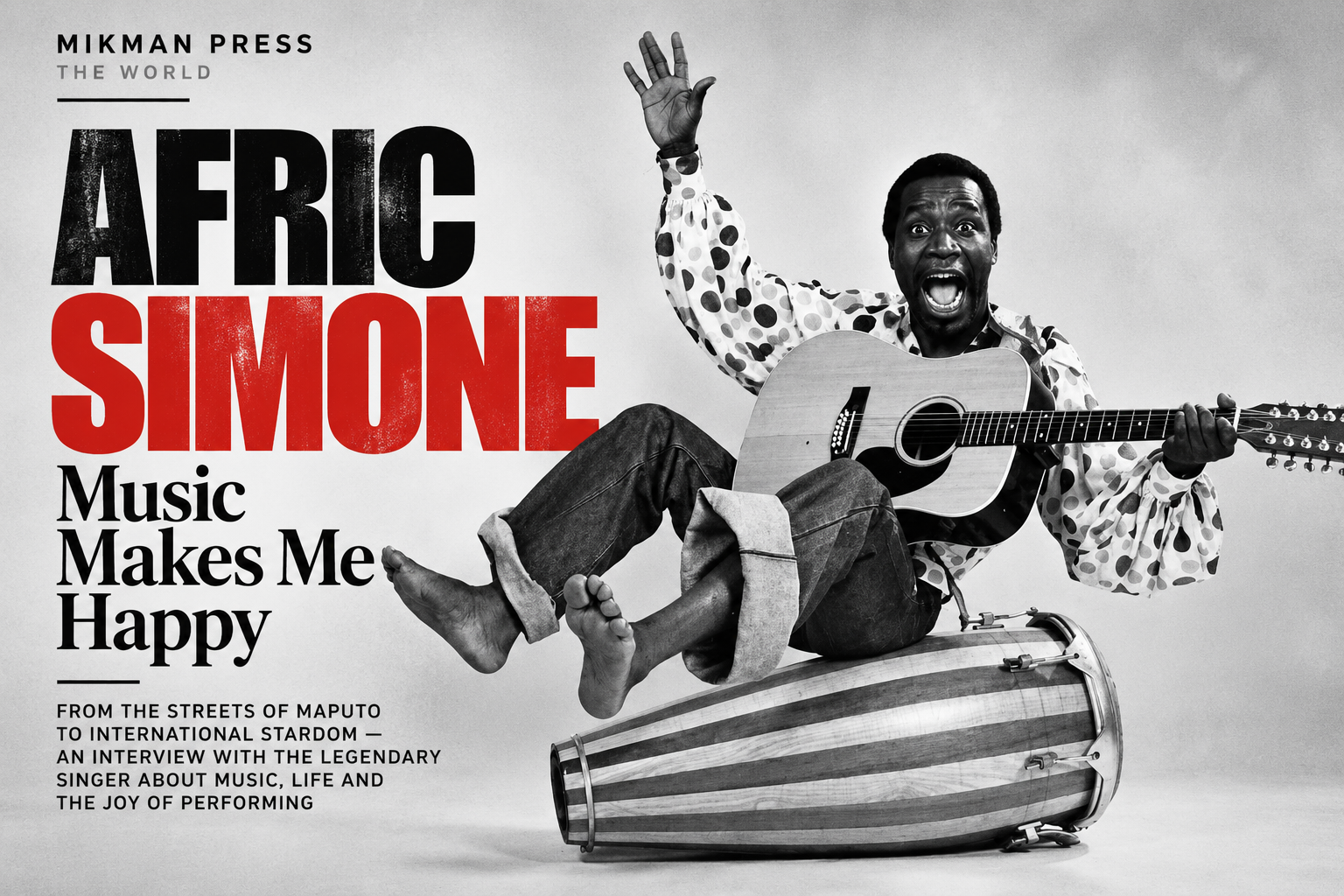
From playing on the streets of Maputo as a teenager to becoming an international star, Afric Simone has spent a lifetime bringing music, humour and energy to audiences around the world. In this interview, the Mozambican-born singer talks about his beginnings, his greatest memories, music, fame, ageing, and why he still wants to perform.
Afric Simone was born in Mozambique on July 17, 1956. His career began when he was only 14, playing music on the streets of Maputo while training as a bricklayer.
A hotel owner noticed the young musician and invited him to perform in the evenings at the hotel’s restaurant. Two years later, a South African manager working with African artists in the European market discovered him.
In 1972, Simone moved to Germany.
His first single, “Mr. Barracuda,” was released soon afterwards and became successful in Spanish-speaking South America. Then came “Ramaya” in 1974, followed in 1975 by the song that made his name known around the world: “Hafanana.”
The song, performed in Tsonga, became an international hit even though most of its listeners could not understand the language.
Decades later, Afric Simone continues to perform and create music.
You left Mozambique when you were very young. Do you ever feel nostalgic for your homeland?
I don’t really feel homesick because I left Mozambique when I was very young.
Although I do sometimes miss the beautiful sea and the palm trees.
What kind of music do you personally listen to?
I listen to all kinds of music if I like the melody.
Pop music, jazz, rock and roll, boogie, cha-cha, bachata, rumba, bolero — I enjoy many different styles.
What qualities do you value most in people?
I have learned a lot throughout my life.
I have met many famous people, including Joe Dassin, Dalida, Michel Sardou, Mireille Mathieu, Adriano Celentano, Toto Cutugno, Pupo and many others.
I get along well with people.
I don’t have prejudices or preconceived ideas about people — including about the colour of their skin.
If people accept me as I am, I can communicate with anyone.
Do people still recognise you in the street?
If I am wearing my famous performance hat, many people recognise me because of the hat.
If I don’t want to be recognised, I simply don’t wear it.
Then I can walk peacefully through the streets, go shopping or go to the park.
Describe yourself in three words.
I am quite temperamental.
I love making music. I also enjoy cycling and walking quickly for my health.
And I like communicating with other people.
At home, I enjoy cooking.
I rarely feel sad.
Is there an age limit to having dreams and desires?
Of course not.
You can have desires at any age.
My wish for myself is simply to have good health so that I can continue performing and bringing joy to my audience.
Tell us about the funniest or most unusual episode of your career.
When I was young, after living in Germany for about ten years, I went to Spain for a holiday by the sea.
I swam for a while, then lay down in the sun and fell asleep.
When I woke up, my entire skin was hurting.
I had been badly sunburned, even though I have dark skin.
I went to a doctor and asked him why I had been burned by the sun.
He explained that I had been living in Germany for a long time rather than in Africa, so although my skin was still dark, it had changed.
It could no longer protect me from the sun in the same way.
What are your plans for the near future?
I will continue composing music.
And I hope that some more great songs will come.
Music is my life.
If you could meet yourself as a little boy, what would you tell him?
I would tell him:
“Learn to read music, little Afric.”
Because you can write musical notes on paper and continue composing later.
I compose songs without writing notes down, so the whole process takes place in my head.
It would also have been useful to learn to play the piano.
I play the guitar and drums very well.
What never fails to make you happy?
Music.
Music always makes me happy.
And, of course, performing in front of an audience gives me enormous pleasure.
When people respond so warmly to my performances, it gives me something back and makes me happy.
What is the most important quality a person can have?
For me, it is important that people treat one another without prejudice.
Every person is different.
Black, white, yellow or brown — above all, a person is a human being.
What are you most grateful for?
I am very grateful that I have lived this long and that I can still do everything I want, even if I cannot do things as quickly as I once could.
Many of my colleagues are no longer alive.
What is your most precious memory?
I often remember how my musical career began in Mozambique.
Three young men used to play music in the streets, and I would sing as well.
That was how I earned my living.
One day, while I was playing and singing in the street, a European man approached me.
He asked:
“Would you like to go to Europe — to London — and play and sing there?”
That moment has stayed with me.
Do you still have an unfulfilled dream?
I don’t have any particular dream.
I simply want to remain healthy.
I want to continue bringing happiness to my audience.
Who do you admire most?
Of course, I admire famous people such as Louis Armstrong, Chuck Berry, James Brown and Elvis Presley.
Later, I also became famous through my own songs and dancing.
I am not only a singer.
I am also an entertainer.
I don’t simply sing — I entertain the audience in every way I can.
You originally trained as a bricklayer. Did that experience help you later in life?
Yes.
At the beginning, I trained as a bricklayer.
That allowed me to earn a living.
When I was working, I would sing or whistle while I worked.
It made the time pass much faster.
And in its own way, that also helped me move further toward music.
You began your career by performing in the streets of Maputo. Did you ever imagine that those performances would lead to an international career?
No, I don’t think I could have imagined what was going to happen.
At the time, I was simply a young man who loved music and needed to earn a living.
I played.
I sang.
And then someone noticed me.
Sometimes you don’t know where a road will lead until you take the first step.
You have performed for audiences in many countries. What does an audience mean to you today?
The audience gives me energy.
When people sing along, dance and smile, I feel that the music has done what it is supposed to do.
That is why I still love performing.
What would you like to say to the people who still listen to your music?
I would like to thank them.
I hope they continue listening to my songs.
And I hope the music continues to bring them pleasure and happiness.
Music is my life.
Afric Simone
Michael Manukian