Fiji is known around the world for its beaches, reefs and turquoise water. But behind the image of a Pacific paradise, the country is facing a rapidly growing HIV epidemic — and some of its youngest victims are paying the price.
There is a strange contradiction in Fiji.
From a distance, it looks like paradise: more than 300 islands scattered across the South Pacific, tropical beaches, palm trees and a tourism industry built around the idea of escape.
But inside hospitals, clinics and communities, another story is unfolding.
Fiji has declared a national health emergency over HIV, after new diagnoses reached their highest recorded level. In 2025, the country registered 2,016 new HIV cases, according to Fiji’s Ministry of Health. The figure was the highest since national surveillance began.
Government estimates now suggest that one in every 60 adults in Fiji is living with HIV, compared with one in 167 five years earlier.
For a country with a population of less than one million, the numbers are impossible to ignore.
But statistics tell only part of the story.
The children behind the numbers
Earlier this year, international reporting from Fiji brought the human consequences of the epidemic into focus.
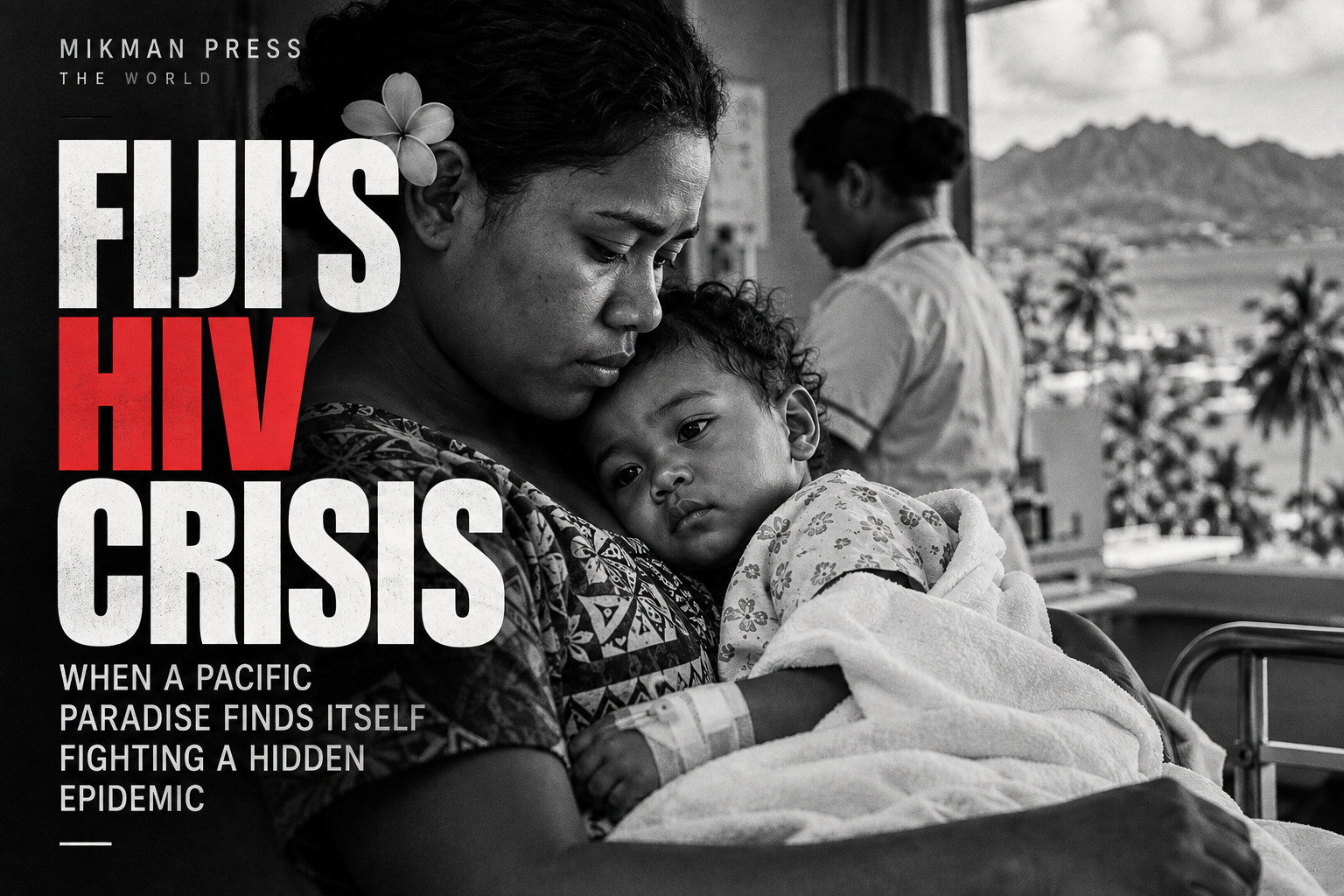
One young mother, identified by The Guardian under the pseudonym Clare, took her month-old daughter to hospital after the baby became critically ill.
Doctors eventually tested the child for HIV.
The result changed the family’s life.
The baby was HIV positive. So were both parents. The infection had been transmitted from mother to child during pregnancy or breastfeeding.
The child spent months on life support.
She survived.
But she will live with HIV for the rest of her life.
Her story is not an isolated tragedy. Fiji’s health authorities have reported a worrying rise in mother-to-child transmission. The Fiji Times reported that 59 babies were born with HIV in 2025, with 18 dying before their first birthday.
Behind every number is a family that has to learn how to live with a disease that, with timely testing and treatment, can be managed.
A crisis that changed quickly
Fiji’s HIV epidemic did not emerge overnight.
But its acceleration has been dramatic.
According to UNAIDS and Fiji’s health authorities, the country recorded a twelve-fold increase in new infections between 2010 and 2025. The government says the number of new diagnoses reached 2,060 in 2025 in its emergency announcement, while the Ministry of Health’s detailed surveillance report records 2,016 newly registered cases. The difference reflects different reporting measures.
The causes are complex.
Unsafe injecting practices have become an important factor. Fiji has also increasingly been used as a transit point in regional drug trafficking, while methamphetamine use has grown inside the country.
In the Ministry of Health’s 2025 data, 362 newly diagnosed cases with a known recorded transmission mode were associated with injecting drug use. But more than half of all newly registered cases had an unknown recorded mode of transmission, illustrating how incomplete the picture remains.
That uncertainty matters.
The official numbers may describe the epidemic — but they cannot completely describe the people living inside it.
The most dangerous thing may be silence
HIV is treatable.
Modern antiretroviral therapy can allow people living with HIV to live long lives and, when the virus is suppressed, prevents sexual transmission.
Yet knowledge, access and stigma remain major obstacles in Fiji.
The Guardian reported that only 39% of people estimated to be living with HIV knew their status in 2025, while only 22% were accessing antiretroviral treatment.
That means thousands of people may not know that they have the virus.
And some people who do know are afraid to be seen seeking treatment.
Christopher Lutukivuya, an HIV activist who has lived with HIV since 2013, told The Guardian that stigma can be so severe that some people avoid hospitals or hide their condition from their families. He has helped people collect medication and driven them to medical appointments so they do not have to face clinics alone.
This is where the epidemic becomes more than a medical problem.
It becomes a social one.
The teenagers on the streets of Suva
In Fiji’s capital, Suva, some of the most vulnerable people are young.
Social workers told The Guardian about teenagers living on the streets who became involved with methamphetamine and, in some cases, contracted HIV through shared needles.
One of them, identified as Isac, was 17.
He described losing weight after becoming addicted to drugs and eventually contracting HIV.
Then something changed.
With help from social workers, he stopped using drugs, returned to school and began training in athletics. He told the Guardian that he wanted to change his life and become an accountant.
That small detail is easy to miss among the statistics.
A boy who had become another number in an epidemic was thinking about his future again.
Fiji is now changing its response
The government has acknowledged that the previous response is no longer enough.
After declaring the national emergency, authorities announced plans to expand testing and treatment, improve access to PrEP and introduce needle and syringe services. Legislative changes are being considered to allow the needle programme to operate.
The World Health Organization had already warned that Fiji needed stronger harm-reduction services, including access to sterile injecting equipment and stigma-free healthcare.
The challenge is enormous.
Public-health programmes can provide medication.
They can open testing centres.
They can distribute sterile needles.
But they cannot change fear overnight.
They cannot instantly remove the shame surrounding HIV.
And they cannot rebuild trust between patients, families, religious communities and the healthcare system with one government announcement.
A different picture of paradise
Fiji’s HIV emergency is a reminder of how misleading the image of a country can sometimes be.
The outside world sees the beaches.
Tourists see resorts.
Travel advertisements show blue water and sunsets.
But ordinary life continues behind that picture — in hospitals, schools, villages, streets and family homes.
There are mothers frightened for their babies.
Teenagers trying to escape addiction.
Doctors trying to identify infections before it is too late.
Activists driving people to clinics because they are afraid to go alone.
And there are people who have discovered that an HIV diagnosis does not have to mean the end of their lives.
Edwina Biyau, who runs a safe house for women, transgender people and children affected by drugs, HIV and violence, told The Guardian that people living with HIV can still write a new chapter of their lives.
That may be the most important story inside Fiji’s emergency.
The country is fighting an epidemic.
But it is also fighting the silence surrounding it.
And for the people living there, the difference between those two battles could be the difference between being diagnosed in time — and becoming another number that arrives too late.