In 1978, a Ferrari was found buried beneath the backyard of a house in Los Angeles.
That alone would have been strange enough.
But the deeper investigators went into the story, the stranger it became.
The car was a 1974 Ferrari Dino 246 GTS, painted dark metallic green. It had been reported stolen more than three years earlier. Nobody living at the house knew how it had got there, and at first there was no obvious explanation for why anyone would go to the trouble of burying a Ferrari in the first place.
The discovery made headlines across the United States.
Decades later, the story would acquire an even darker explanation — one involving an insurance claim, an informant and a version of events that was never fully established in court.
A Ferrari Under the Ground
The discovery was made in Los Angeles in early 1978.
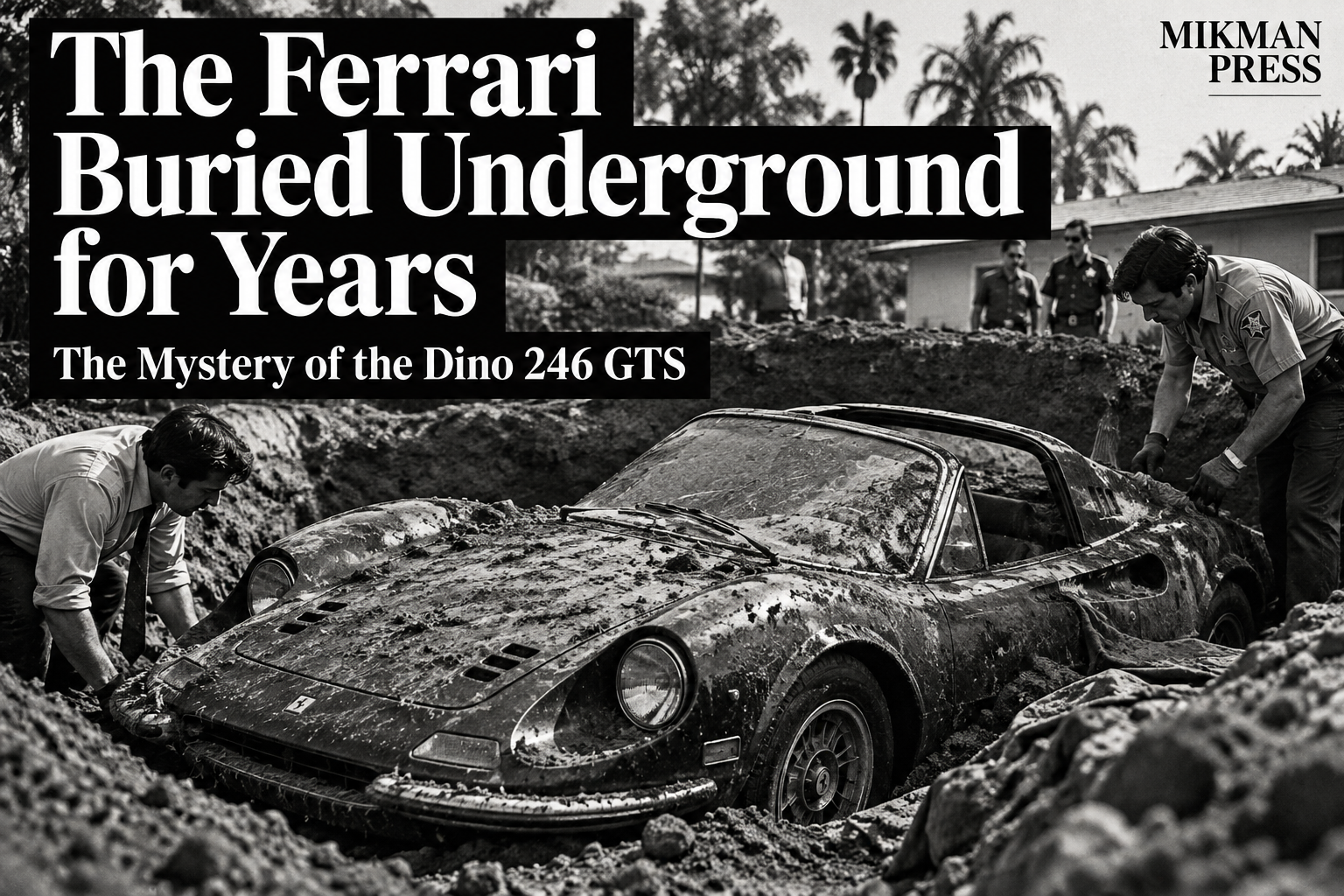
According to the story reported at the time, children playing in the yard noticed something beneath the surface. Sheriff’s deputies were called, and detectives Joe Sabas and Dennis Carroll began excavating the site.
The shape beneath the earth soon became unmistakable.
It was a sports car.
As more soil was removed, the distinctive outline of a Ferrari emerged.
The car was covered with rugs and other material, apparently in an attempt to protect it from the earth. Detectives checked the interior and trunk, looking for bodies, drugs or other evidence.
There was nothing of the sort.
Then they checked the license plate.
The Ferrari was on the stolen-vehicle list.
Its plate was 832 LJQ.
The car had been identified as a 1974 Dino 246 GTS, serial number 07862.
Suddenly, the buried Ferrari was no longer just an extraordinary discovery.
It was a crime scene.
The Car Had Disappeared in 1974
The investigation traced the Ferrari back to Rosendo Cruz of Alhambra, California, who had purchased it in October 1974.
Only two months later, on December 7, Cruz reported the car stolen.
The Ferrari subsequently disappeared from public view.
The insurance company paid the claim, and the case eventually became another unresolved vehicle-theft case.
Until the day someone found the car underground.
The people living in the house at the time had reportedly been there for only a few months. They had no explanation for the Ferrari beneath their property, while neighbors apparently had no useful information about who had buried it or when.
The obvious question was almost absurd:
Who buries a Ferrari?
And why?
Someone Had Not Simply Dumped It
There was another detail that made the discovery even more unusual.
The Ferrari had apparently been deliberately protected before it was buried.
Rugs, plastic and other materials had been placed around parts of the car. Whoever put it underground had made at least some effort to shield it from the soil.
That suggested that the Ferrari was not necessarily meant to be destroyed.
Perhaps someone intended to come back.
Perhaps the car was supposed to remain hidden temporarily.
But whoever buried it never returned.
At least, that was the assumption for years.
The Story Behind the Story
The original newspaper reports presented a remarkable but relatively simple mystery: a stolen Ferrari had somehow ended up buried in a Los Angeles backyard.
Years later, however, former Sheriff’s detective Dennis Carroll gave a very different account.
In a 2012 interview with journalist Mike Spinelli, Carroll claimed that the police had actually learned about the Ferrari from an informant.
According to Carroll, the story that children had discovered the car was used to protect the informant’s identity.
If his recollection is correct, the Ferrari had not been discovered purely by chance.
Someone had told police where to look.
And that was only the beginning.
The Insurance-Fraud Theory
Carroll said the informant had provided investigators with a theory involving insurance fraud.
According to that version, Rosendo Cruz had allegedly arranged for the Ferrari to be stolen so that he could collect the insurance money.
The supposed thieves were reportedly meant to take the car to a chop shop and have it dismantled for parts.
But something went wrong.
Instead of destroying the Ferrari, the men allegedly hid it underground, intending to return for it later.
They never did.
The car remained buried until its discovery in 1978.
It is an extraordinary explanation — but it is important to distinguish the later account from the facts established at the time.
The insurance-fraud theory was based largely on information from an informant and Carroll’s later recollection. It was never established in court as a definitive account of what happened. Some later sources have repeated the theory as fact, but the historical record is more complicated.
That uncertainty is part of what makes the story so interesting.
There is a Ferrari.
There is a theft report.
There is an insurance payout.
There is a buried car.
And there is still no complete, uncontested explanation of exactly what happened.
The Ferrari Became a Sensation
Once news of the discovery spread, the Ferrari attracted enormous public attention.
The insurance company, Farmers Insurance, eventually decided to sell it.
The car was placed on display in a private warehouse in Pasadena for potential buyers to inspect.
That turned out to be a mistake.
During the display period, people began removing parts from the Ferrari — reportedly almost everything that was not firmly bolted down.
Even the oil dipstick disappeared.
The insurance company also discovered problems with some of the bids and had to reorganize the sale.
Eventually, the battered Dino found a new owner.
His name was Brad Howard.
From Buried Wreck to Classic Ferrari
Howard saw something others apparently did not.
He saw a Ferrari worth saving.
The car was restored with the help of Ferrari specialist Giuseppe Cappalonga. Its engine was rebuilt, the bodywork repaired and its original appearance brought back.
The restoration story itself became part of the legend.
There were conflicting assessments of just how badly the Ferrari had been damaged by its years underground. Some contemporary and later accounts described extensive deterioration, while Howard maintained that much of the car remained surprisingly intact.
One factor may have helped: California was experiencing drought conditions during the period when the Ferrari was underground, limiting the amount of moisture surrounding it.
Eventually, the green Ferrari returned to the road.
But Howard did not allow its history to disappear.
He gave it a new license plate.
DUG UP.
Two words that told the entire story.
A Mystery That Never Completely Went Away
The buried Ferrari has been written about many times since its discovery.
There are now several versions of the story.
The first is the simple one: a stolen Ferrari somehow ended up buried in a Los Angeles backyard.
The second is the police version that emerged later: the car may have been deliberately hidden as part of an insurance scheme.
And then there is the question of the informant, whose information may have been the real reason investigators found the Ferrari in the first place.
Some parts of the story are documented.
Others come from recollections and later investigations.
And the precise sequence of events has never become completely uncontested.
That may be why the story has survived for nearly half a century.
A Ferrari is supposed to be seen.
It is supposed to be driven.
It is supposed to attract attention.
This one did the opposite.
It disappeared.
It was buried.
And for more than three years, one of Italy’s most recognizable sports cars sat beneath the soil of an ordinary Los Angeles backyard.
Then someone found it.
And instead of becoming a forgotten wreck, the Ferrari was restored and returned to the road.
Its name says it all.
DUG UP.