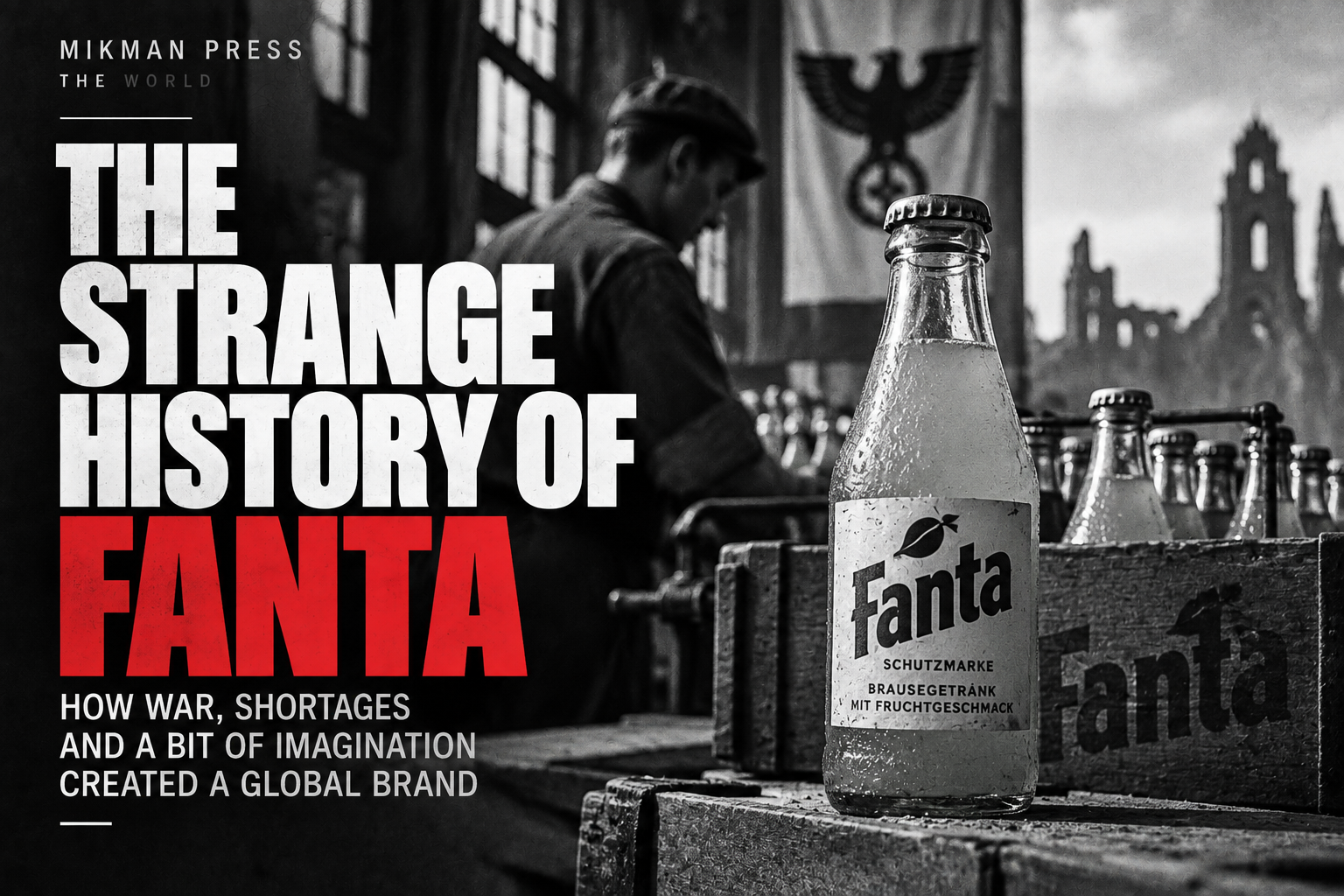
Today, Fanta is sold in more than 170 countries. Few people know that its story began not on a sunny beach or in an American laboratory, but in wartime Germany — when Coca-Cola could no longer get the ingredients it needed.
Pick up a bottle of Fanta almost anywhere in the world and its identity seems obvious.
Orange. Bubbles. Bright colours. A drink associated with summer, youth and an almost exaggerated sense of fun.
The name itself sounds cheerful.
But the history behind that name is considerably darker and stranger.
The first Fanta was created in Germany in 1940, during the Second World War. It was born because Coca-Cola’s German operation could no longer obtain the Coca-Cola concentrate it needed from the United States.
What happened next was not the invention of the drink we know today.
It was something much more improvised.
And it began with a problem: what do you make when you cannot make Coca-Cola?
Before the war, Coca-Cola had established a significant business in Germany.
But the outbreak of the Second World War transformed the situation. International trade became increasingly difficult, and in 1940 the German Coca-Cola operation could no longer receive the concentrate required to produce the company’s familiar drink.
The person responsible for the German operation was Max Keith, managing director of Coca-Cola GmbH in Essen.
Keith had a choice.
He could allow the business to stop functioning.
Or he could find something else to sell.
He chose the second option.
The ingredients available to him were nothing like the ingredients associated with a modern soft drink.
There were shortages everywhere.
So the company began experimenting with whatever food materials could be obtained.
The result was a strange new drink made largely from whey and apple pulp — materials that were available as by-products of other food production.
It was not orange.
It was not the bright drink that millions of people know today.
And it certainly did not taste like modern Fanta Orange.
But it had one thing that the company desperately needed:
It could be produced.
A drink made from leftovers
The wartime Fanta was a product of scarcity.
Whey was a by-product of cheese production. Apple pulp was left after apples had been pressed for cider and other products.
The formula could also change depending on what ingredients were available.
This was not a carefully designed global beverage created under perfect laboratory conditions.
It was an exercise in improvisation.
The modern language of food production might describe it as using by-products.
In wartime Germany, it was simply a practical necessity.
And that is one reason the original Fanta story is so fascinating.
A product that would eventually become associated with colourful advertising and childhood memories began as a solution to a supply problem.
Where did the name come from?
The drink still needed a name.
Keith reportedly asked employees to use their imagination and suggest names for the new product.
The winning idea was Fanta, derived from the German word Fantasie, meaning imagination.
The name was registered as a German trademark in 1941.
There is an appealing irony here.
A drink born from a shortage was given a name associated with imagination.
The company could not reproduce the product it had built its business around.
So it imagined something else.
Was Fanta a Nazi invention?
This is where the story is often distorted.
Because the first Fanta was created in Germany during the Second World War, claims have circulated for years that Fanta was somehow invented by the Nazi regime.
That is not supported by Coca-Cola’s historical records.
Coca-Cola explicitly states that the claim is false and that Max Keith and the German bottling company were not affiliated with the Nazi regime.
The historical reality is more complicated than the myth.
Fanta was developed by Coca-Cola’s German operation because the company could no longer obtain Coca-Cola concentrate during the war.
That makes its origin undeniably connected to wartime conditions.
It does not make the drink a Nazi invention.
The distinction matters.
History is often more interesting when the myth is removed.
Then the war ended
In 1945, the war was over.
The German Coca-Cola operation could once again produce Coca-Cola.
And the original wartime Fanta disappeared.
For several years, the name survived without becoming the worldwide brand we know today. Coca-Cola says that between 1945 and 1955 the Fanta trademark was used only enough to preserve its registration.
Then something unexpected happened.
The name came back.
But the drink changed completely.
The Fanta we know was born in Italy
In the early 1950s, Coca-Cola began looking at the possibility of creating a fruit-flavoured drink for European consumers.
In Italy, orange juice was readily available.
An Italian Coca-Cola bottler in Naples, Ermelino Matarazzo di Licosa, proposed developing a local orange-flavoured beverage. Coca-Cola initially approached the idea cautiously, but research suggested that consumers could drink a fruit beverage alongside Coca-Cola rather than instead of it.
In 1955, Coca-Cola developed the formula for Fanta Orange in Atlanta, using the old Fanta name.
This was effectively the beginning of the Fanta that the world recognizes today.
The connection between the two drinks is therefore unusual.
The name was German.
The original drink was created during wartime scarcity.
The modern orange version emerged in Italy in the 1950s.
And the formula that became the global brand was developed later by Coca-Cola in the United States.
From survival drink to global brand
The transformation was remarkable.
By 1960, Fanta was already being sold in 36 countries. Over the following decades, the brand spread across Europe, Latin America, Africa and eventually the rest of the world.
Today, Coca-Cola says Fanta is sold in more than 170 countries.
And there is another curious part of its evolution.
There is no single universal Fanta experience.
The flavours differ from country to country.
Orange remains the best-known version, but Fanta products around the world have included pineapple, apple, grape, lemon, raspberry, passion fruit, mango and many other flavours.
In other words, the brand that began with whatever ingredients happened to be available eventually became famous for variety.
The irony of Fanta
There is something almost perfectly circular about the story.
The original Fanta was created because Coca-Cola could not obtain what it needed.
The company had to improvise.
Seventy-five years later, the name had become a global brand in its own right.
The wartime drink was gone.
The formula had changed.
The country had changed.
The world had changed.
But the name survived.
And today, most people drinking Fanta have no reason to think about whey, apple pulp, wartime shortages or a Coca-Cola manager in Essen trying to keep a factory operating.
They simply open the bottle.
Orange bubbles rise.
The drink is cold.
The label is familiar.
And almost nobody thinks about the strange chain of events that brought it there.
That may be the most surprising part of Fanta’s history.
One of the world’s most cheerful-looking drinks began with a company that could no longer make the drink it was famous for.
Fanta was not born from abundance.
It was born from having almost nothing — and trying to make something work.