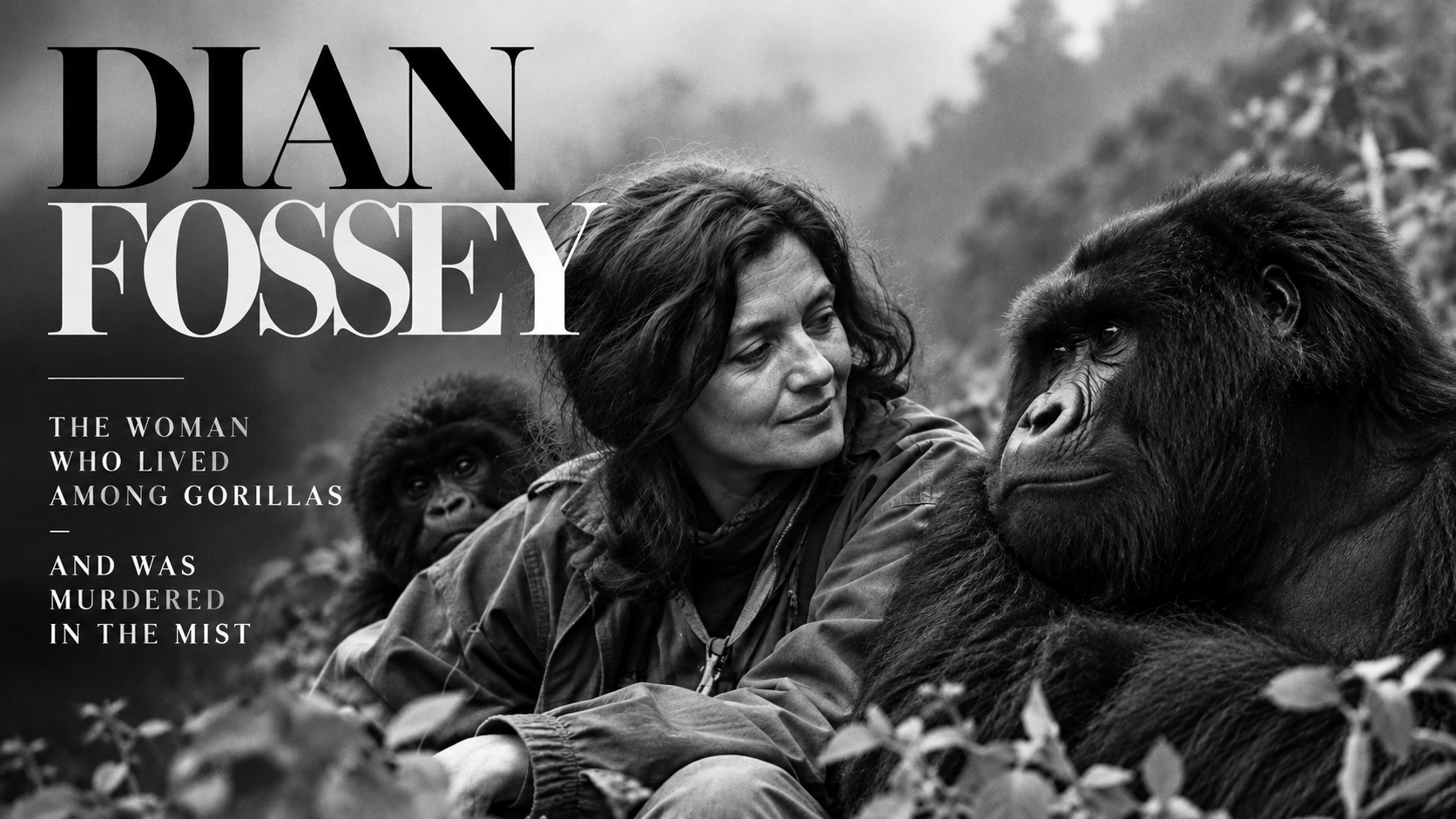
She came to Africa to study mountain gorillas.
Instead, she spent almost two decades living among them, fighting the people who threatened them — and eventually losing her own life in the same mountains she had chosen to protect.
Her name was Dian Fossey.
And her story is one of the strangest and most tragic chapters in the history of wildlife conservation.
A woman who chose the mountains
In 1963, Dian Fossey travelled to Africa for the first time.
She was not yet the world-famous primatologist she would later become. Her background was in occupational therapy, but she had developed a powerful interest in the lives of mountain gorillas.
After meeting the legendary anthropologist Louis Leakey, Fossey became determined to study gorillas in their natural environment.
Several years later, in 1967, she established what became the Karisoke Research Centre in the mountains of Rwanda.
It was an extraordinary place to conduct scientific research.
It was also a dangerous one.
Fossey lived in a small cabin in the forest, surrounded by steep mountains, mist and dense vegetation. Her closest neighbours were not people.
They were gorillas.
Learning to live with gorillas
Fossey did not simply observe the animals from a distance.
She spent years gradually gaining their trust.
She studied their movements, sounds and social behaviour. She learned to imitate their gestures and vocalisations and developed individual relationships with members of several gorilla groups.
Eventually, some of the animals accepted her presence so completely that she could sit near them while they behaved naturally.
This was revolutionary.
At the time, relatively little was known about mountain gorillas in the wild.
Fossey discovered that they were not the brutal, primitive creatures often imagined by popular culture.
They had complex social relationships, individual personalities and remarkably sophisticated family structures.
Among them was a gorilla who would become particularly important in her life.
His name was Digit.
Digit
Digit was a young male mountain gorilla whom Fossey knew well.
Over the years, their relationship became one of the most famous examples of the bond she developed with individual gorillas.
But in 1977, tragedy struck.
Digit was killed by poachers while defending his group.
His death devastated Fossey.
It also changed her.
She became even more aggressive in her campaign against poaching and the illegal exploitation of gorillas.
For Fossey, the animals were no longer simply subjects of scientific research.
She regarded them as individuals who needed protection.
The war against poachers
Mountain gorillas were already under enormous pressure.
Poachers set traps in the forest. Young gorillas could also be captured for illegal trade, while other animals were killed in the process.
Fossey began destroying traps and organising anti-poaching patrols.
She confronted hunters and became increasingly involved in direct action.
Her methods were controversial.
She could be uncompromising, confrontational and, by modern standards, extremely aggressive.
Some people admired her determination.
Others considered her methods excessive.
But there was little doubt about one thing:
Fossey had made the survival of the gorillas her life’s central mission.
And the more aggressively she fought poaching, the more enemies she created.
A difficult woman
The image of Dian Fossey as a gentle woman sitting peacefully among gorillas is only part of the story.
In reality, she was a complicated and often difficult personality.
She could be fiercely protective of her research and her animals. She argued with officials, local people and other researchers.
There are also documented accounts of extremely controversial actions she took against people she believed were involved in harming gorillas.
Some of the more dramatic stories later told about her — including claims that she systematically kidnapped local children — are much less certain and should not be presented as established fact.
The real story is already dramatic enough.
Fossey was becoming a powerful and increasingly controversial figure in the struggle over the future of the mountain gorillas.
A life without an ordinary ending
Fossey’s dedication to gorillas also shaped her personal life.
She never built the conventional family life that many people expected of her.
She did have romantic relationships, but her work remained at the centre of her existence.
During her time in Britain in the early 1970s, she became pregnant and eventually had an abortion.
The event had nothing to do with gorillas or with some mysterious disappearance of a child, as later sensational accounts sometimes suggest.
Fossey simply chose a life that was extraordinarily different from the one most people around her were living.
Her world was the forest.
Her work was the gorillas.
And increasingly, her enemies were people.
The murder
On December 27, 1985, Dian Fossey was found dead inside her cabin at Karisoke.
She had been brutally murdered with a machete.
She was 53 years old.
The murder shocked the scientific community and attracted international attention.
But the central question remains:
Who killed Dian Fossey?
Several theories have been proposed.
Poachers were an obvious possibility. Fossey had spent years disrupting their activities and had made powerful enemies.
Other theories focused on conflicts surrounding the research centre and the complicated political and economic interests surrounding the gorillas.
An American researcher, Wayne McGuire, was convicted in absentia by a Rwandan court, but he has always denied responsibility and fled Rwanda before he could be arrested.
The exact circumstances of Fossey’s murder remain disputed.
What is certain is that the woman who had spent years fighting to protect the gorillas was ultimately killed inside the isolated mountain camp she had made her home.
Gorillas in the Mist
Fossey had already become an important scientific figure before her death.
In 1983, she published Gorillas in the Mist, an account of her years studying mountain gorillas.
The book became internationally famous.
Three years after her murder, it became the basis for the 1988 film Gorillas in the Mist, starring Sigourney Weaver as Fossey.
The film introduced her story to millions of people who had never heard of the woman behind the research.
But cinema also simplified her.
The real Dian Fossey was much more complicated than the heroic character on the screen.
She was brilliant, obsessive, difficult, courageous and sometimes deeply controversial.
Perhaps that is precisely what makes her story so fascinating.
What happened to the gorillas?
Fossey’s death did not end the struggle she had begun.
Mountain gorillas remained critically threatened, but conservation efforts continued.
And eventually, something remarkable happened.
Their population began to recover.
Today, more than 1,000 mountain gorillas are estimated to survive in the Virunga Massif and Bwindi region.
The species is still endangered, and the threats have not disappeared.
But the numbers are dramatically better than they were during Fossey’s lifetime.
Her scientific observations also transformed our understanding of gorilla behaviour.
A strange legacy
Dian Fossey wanted people to understand that gorillas were not monsters.
They were individuals.
They had families, relationships, rivalries, fears and loyalties.
She spent nearly twenty years trying to prove it.
In doing so, she became one of the most famous conservationists of the twentieth century.
She also became one of its most controversial.
Her life cannot be reduced to a simple story about a woman who “lived with gorillas.”
It was a story about obsession, science, violence, conservation and the complicated relationship between humans and the natural world.
Fossey entered the mountains to study gorillas.
She stayed because she believed they needed someone to fight for them.
And she died there.
More than forty years later, the mist has not completely lifted from the story of Dian Fossey.
But one thing is clear.
The gorillas she devoted her life to are still there.