In the 1950s, a pack of cigarettes, a quarter and two pennies became a small lesson in convenience, pricing and customer psychology.
By MikManPress
Some of the best business stories start with a problem too small for anyone to bother with. No big investment, no new technology, no grand strategy. Just a vending machine, a pack of cigarettes and two cents.
The problem
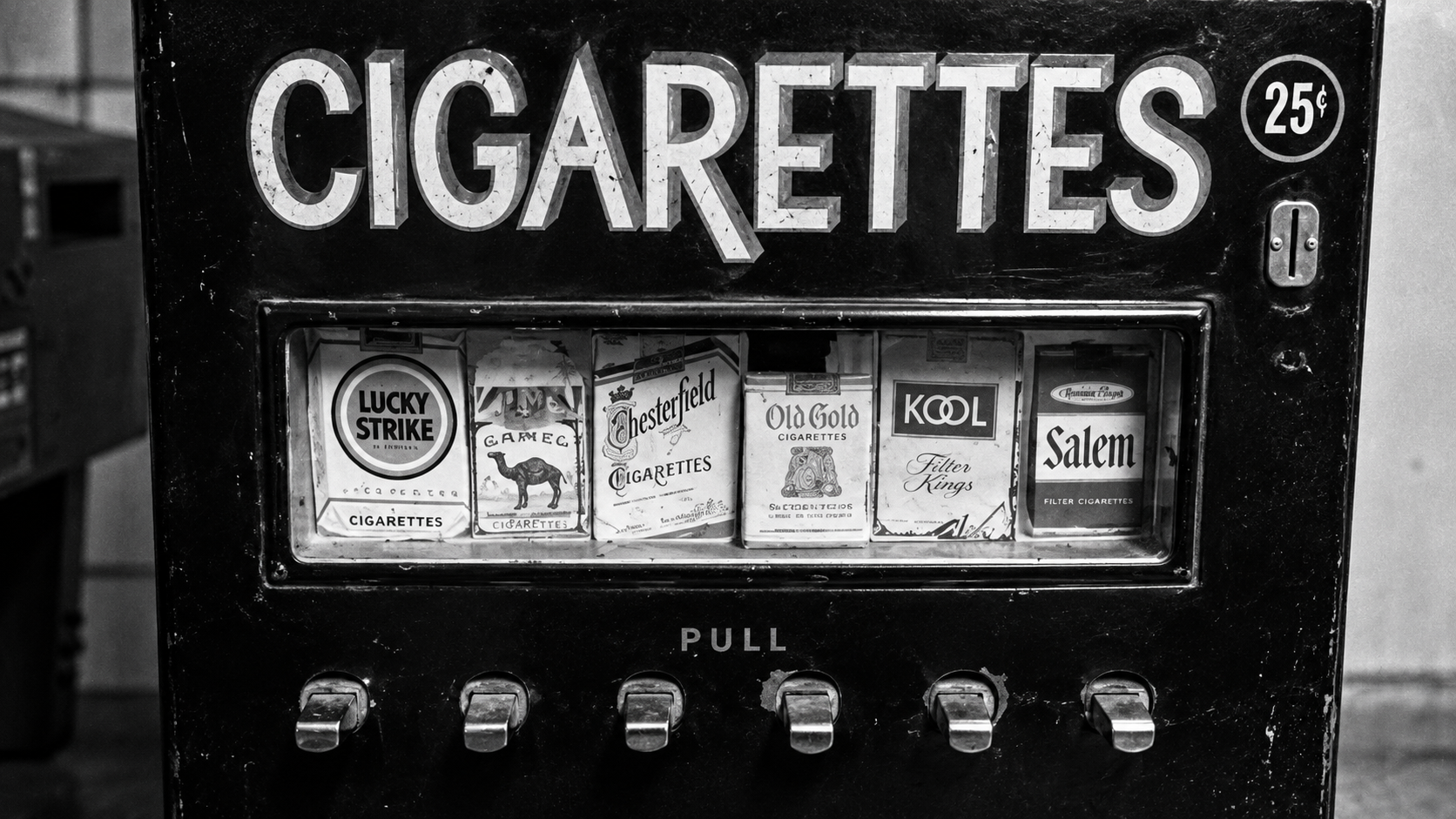
America, mid-1950s. Cigarette vending machines were everywhere: you put in coins, pulled a knob, took your pack. But the machines were crude. They took only certain coins and couldn’t give change.
According to the story that has been retold for decades, a pack cost 23 cents and the machine wanted a quarter. A customer paid 25 for a 23-cent product. The two cents in between had nowhere to go.
For a shopkeeper that’s pocket change. For a manufacturer selling millions of packs, it’s a real question. Raise the price to 25 cents and the product gets more expensive. Rebuild the machines and you pay for it. Or you can leave everything as it is and solve the problem some other way.
The workaround
The reported answer was almost comically simple: two pennies were attached to the pack. The customer put in a quarter, got the cigarettes and got his two cents back in the same motion.
The price stayed at 23 cents, the machines stayed where they were, and nobody had to explain anything. The product was adapted to the system instead of the other way round.
A caveat: this is an anecdote, not an industry-wide policy. Vending machines and their coin limits were real, and so were pennies packed with cigarettes. But we can’t say that every manufacturer did this or that they all consciously refused to raise prices. Treat it as an illustration, not a case study.
What the story is really about
It isn’t about two cents. It’s about friction.
Customers don’t judge a purchase only by the number on the package. They judge how hard it was to complete: whether they had the right coin, whether the price they saw is the price they paid, whether anything felt awkward. Every extra step is a chance to walk away irritated.
The customer doesn’t care that the obstacle is cheap to fix for the business. They only know it’s there. Today we pay for the same thing with one-click checkout, saved cards and shorter forms. The technology is new, the problem is old: the easier it is to pay, the less reason you give people to quit halfway.
Why not just raise the price?
On paper, adding two cents is the obvious move. In practice, a price is also a signal. People compare it, remember it and decide whether it feels fair. Changing it can affect how a product is perceived in ways the spreadsheet doesn’t show.
We can’t claim that a two-cent increase would have hurt sales, and the anecdote proves nothing about whether keeping the price was the more profitable choice. The useful point is narrower: before you raise prices to cover an operational headache, ask whether you can remove the headache instead. Sometimes you can’t, and a price increase is the right call. But it should be a decision, not a reflex.
Small things at scale
Two cents is nothing. Two cents times millions of transactions is a different matter. That’s why serious companies argue over packaging weight, delivery routes and payment fees.
It cuts both ways, though. Taping two coins to every pack costs something too: handling, materials, logistics. We don’t know whether it was actually the cheaper option. The lesson isn’t “this was cheap”. It’s that recurring little details deserve a calculator, not a shrug.
The 1955 penny
Now the part that makes the story fun. 1955 is also the year of the famous Doubled Die Lincoln cent, a coin with a clearly visible doubling of the date and lettering on the front. It was a minting error, and the coins got into circulation. Collectors pay serious money for them today.
By a popular account, some of these coins turned up as change from cigarette machines, mostly in the Northeast. That would make a very ordinary purchase a lottery ticket: you buy cigarettes and get a rare coin in your hand.
The coin itself is well documented. How much of it came through cigarette packs is much less certain, and the story is more often repeated than proven. Still, it’s a nice reminder that the same object can be worth one cent to one person and a lot more to another. Value depends on who’s holding it.
What to take from it
Three quick examples.
An online shop loses customers at checkout. It could spend more on ads and bigger discounts, or it could cut the checkout from six steps to three.
A manufacturer’s product is good but hard to open. It could write copy about how great it is, or fix the packaging.
A service company gets the same questions again and again. It could hire more support people, or rewrite the instructions that cause the questions.
In each case the visible problem isn’t the real one. The shop thinks it has a traffic problem and has a checkout problem. The manufacturer thinks it has a marketing problem and has a packaging problem. Finding the real source of friction is worth more than paying for its symptoms.
So the useful questions are plain ones. What makes the customer’s life harder than it needs to be? What can we change without rebuilding everything? Is there a fix that works for both sides?
Not every innovation looks like one
Business culture loves disruption: new platforms, new industries, big launches. But a lot of progress is quiet. A packaging tweak. One payment step removed. A clearer instruction that heads off a mistake. Nobody writes headlines about these, yet they often decide whether a product annoys people or becomes a habit.
That’s why the two-cent story sticks. It’s innovation on a human scale: a small obstacle and a solution that’s no bigger than the obstacle.
A clever workaround isn’t a business model, of course. It still has to be checked against cost, reliability, legal rules and what customers actually think. A good story doesn’t replace evidence. But it can start you asking the right question: where does my customer get stuck, and what would it take to fix it?
Sometimes the distance between an ordinary sale and a story people still tell seventy years later is just two cents.