Monday, August 19. A high-school girl named Dorothy Dennison leaves home to buy steak for her mother’s hamburgers. She never comes back. Her mother calls the neighbor, the butcher, then the police. Days later the girl is found in the house of a pastor who is away on vacation, in a dark room with the shutters closed and the furniture under dust covers.
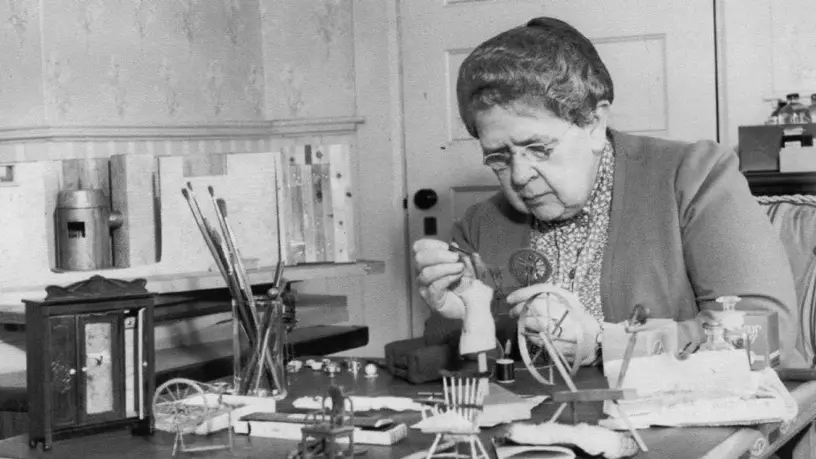
Dorothy was never a real victim. She is a doll, and the scene is a model about a foot and a half wide. It is one of the miniature crime scenes built by Frances Glessner Lee, a woman who helped change how American police and medical examiners investigate death.
A lonely girl in a fortress
Frances was born in Chicago in 1878. Her father, John Jacob Glessner, was a vice president of International Harvester. The family lived in a fortress-like mansion on Prairie Avenue, and the girl everyone called Fanny was lonely there. Her brother went off to Harvard. She was kept at home, because “ladies don’t go to school.”
She wanted to study medicine or law. Instead, around the age of twenty, she married a lawyer, Blewett Lee, and had three children. They divorced in 1914, which was a scandal in those days. Frances had no profession and little independence, and her life stayed tightly controlled by her family.
The bright spot was her brother’s Harvard classmate, George Burgess Magrath, who later became the medical examiner of Suffolk County, Massachusetts. He told her about real cases, about evidence, and about how often killers walked free. Detectives trampled crime scenes, misread what they found, and in many places death was investigated by coroners with no medical training.
Money and a mission
After her parents and brother died in the early 1930s, Frances inherited the family fortune. She was in her fifties and, for the first time, answerable to no one. She spent the money on what she cared about. In 1931 she endowed a Department of Legal Medicine at Harvard, the first of its kind in the United States. In 1934 she gave it Magrath’s library, and in 1936 she added a gift of $250,000. Magrath filled the chair her money paid for.
Then she began the work she is remembered for.
The Nutshell Studies
Lee turned a hobby of upper-class women, dollhouse-making, into a training tool. Her Nutshell Studies of Unexplained Death are miniature crime scenes. Each comes with invented witness statements and a police report. Students had to study the scene and work out what happened. Lee drew on real cases but wrote every scenario herself, so nobody could look up the answer.
The detail is startling. Tiny keys turn in locks, pencils write, and cigarette butts sit in ashtrays. Fingerprints are visible on door handles and light switches, and the cans in the pantry carry period labels. Blood spatter on the wallpaper follows the physics of the blow. Lee studied real autopsies to get the bodies right, and she sewed and knitted the dolls’ clothes herself. The flood of detail was the point. Investigators had to learn which clues matter and which are noise.
She built about twenty scenes, and 18 survive. She donated them to Harvard in 1945, the same year she launched the Harvard Seminars in Homicide Investigation, later the Harvard Associates in Police Science. Detectives and medical examiners came to study the models, and Lee, the only woman in the room, ran the program. In time she was named an honorary captain of the New Hampshire State Police.
Who the victims were
Most of Lee’s victims are women, and many are poor, marginalized or overlooked: tenants in shabby rooms, people on the fringes. Police often investigated such deaths half-heartedly. Lee’s message to future detectives was that every death deserves a real investigation. Her famous motto was to “convict the guilty, clear the innocent and find the truth in a nutshell.”
After Lee
Lee died in 1962 at 83. The dioramas ended up with the Maryland Office of the Chief Medical Examiner in Baltimore, were restored, and are still used in police training. In 2017–2018 the Smithsonian’s Renwick Gallery showed them in the exhibition Murder Is Her Hobby.
She did not invent forensic science. Others had been building it for decades. But she built much of the training that taught investigators to look before they touched, and that was her real contribution.