He was born with a twisted spine and legs that bent in opposite directions. He won two World Cups. He died at 49, ill and broke.
By MikManPress | SPORT
Pau Grande, a textile town outside Rio, 1953. A skinny winger from the factory team turns up for a trial at Botafogo.
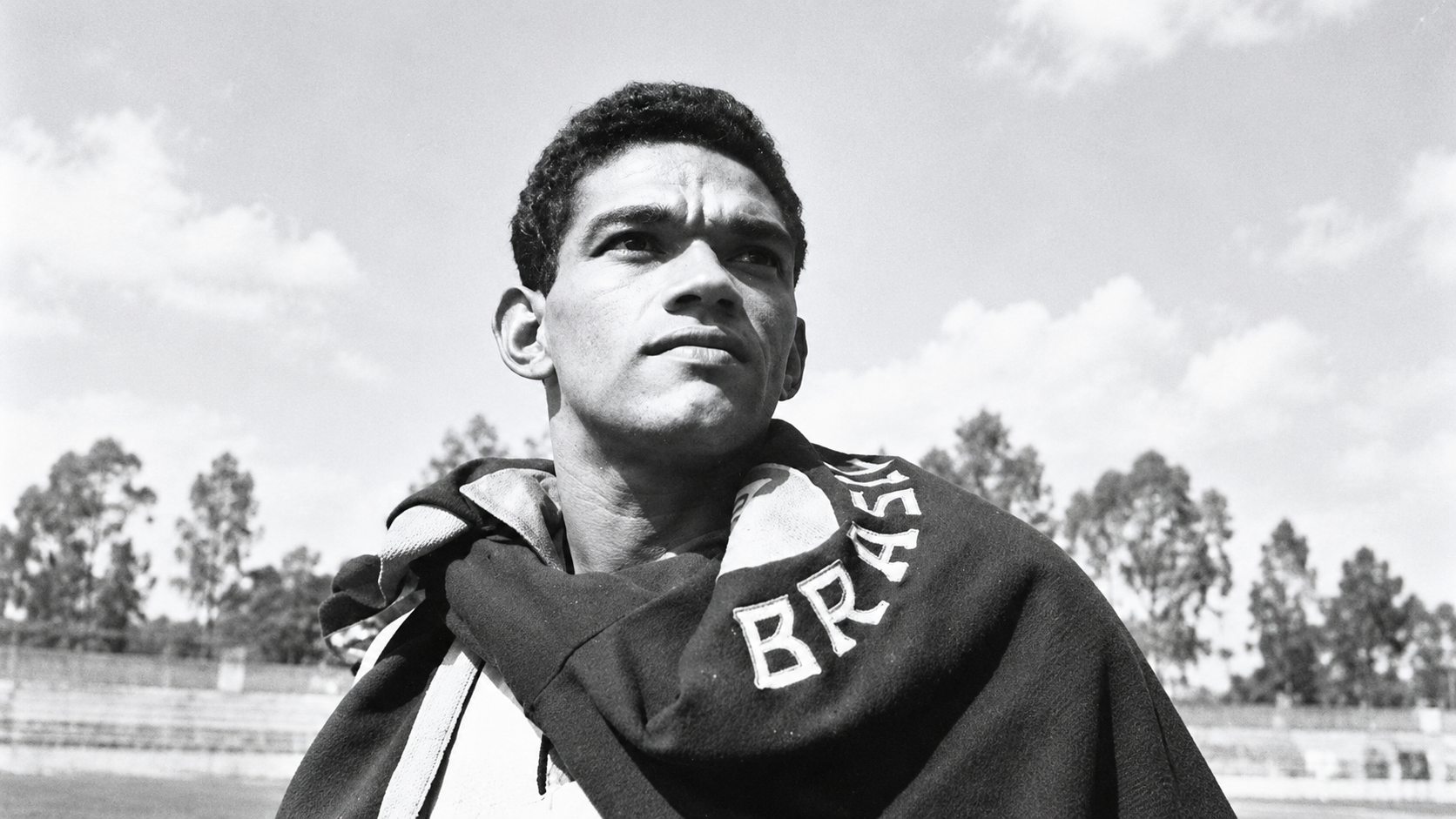
Look at his legs first. The right one curves inward, the left one outward, and the left is about six centimetres shorter. Nobody would have picked this body for professional sport.
The trial was against Nílton Santos, Botafogo’s left-back and already a Brazil international. The story goes that the kid made him look like an amateur, and that Santos walked up to the club officials afterwards and told them to sign him. Better to have him on his side than to face him again.
True or polished by retelling, the club signed him.
The bird
His name was Manuel Francisco dos Santos. Everybody called him Garrincha, after a small, scruffy bird he used to hunt as a boy. Family lore says his sister gave him the name.
On the pitch he was not a bird. He was a problem.
Defenders read hips and shoulders. That’s how you survive against a winger. Garrincha’s hips lied. He would stand still, rock one way, and go the other, and the crooked legs made the rocking impossible to read. He did it to the same man twice in a row, then a third time, and grinned.
He called every opponent “João”. It saved him learning names.
Sweden, 1958
Before the World Cup, Brazil’s team psychologist tested the squad. Garrincha reportedly scored 38 out of 123 and was judged unfit for top-level football. Pelé, 17, got a bad report too.
The coach, Vicente Feola, left both out of the first two games. The senior players went to him and demanded they play against the USSR.
Before that match, the legend goes, Feola explained the tactical plan to Garrincha at length. Garrincha listened and asked: “Have you told the Russians?”
Then the whistle went. Brazil hit the post twice and scored inside three minutes, with Garrincha tearing at the Soviet defence from the first touch. People still call it the best opening three minutes in World Cup history.
Brazil won the tournament. In the 5–2 final against Sweden, Garrincha set up both of Vavá’s goals.
Chile, 1962
Four years later Pelé tore a muscle in the second game and was gone for the tournament. Brazil needed someone to carry the team.
Garrincha carried it.
Against England in the quarter-final he scored twice, a header and a swerving shot from distance. Brazil won 3–1. In the semi-final against Chile he scored two more, then got sent off for kicking Eladio Rojas. Brazil won 4–2.
A red card should have meant a ban. After heavy lobbying, he was allowed to play the final. He reportedly played it with a fever. Brazil beat Czechoslovakia 3–1.
He finished with four goals, shared the Golden Boot, and was named the best player of the tournament.
And the record: from 1958 to 1966, Brazil never lost a match in which both Garrincha and Pelé played.
After
It went wrong slowly, then fast.
His knees gave out. He drifted from Botafogo to Corinthians, then Junior in Colombia, then Flamengo, then Olaria, each club lower down the ladder. He drank heavily. He had a large family and little money. In 1969 he crashed a car while drunk, and the mother of his partner, the singer Elza Soares, died.
On 20 January 1983 he died in a Rio clinic, aged 49. The cause was complications of chronic alcoholism, usually reported as cirrhosis.
The funeral
His coffin, wrapped in the Botafogo flag, left the Maracanã and travelled to Pau Grande, the town where he was born. Thousands lined the road. People threw flowers and chanted his name. The procession kept stopping because the crowd would not let it pass.
His gravestone reads: Here rests in peace the one who was the joy of the people.
Brazil gave him a great funeral.It was far worse at looking after him alive.
FIFA, Chile bows to glorious Garrincha:
FIFA, When Brazil gave Garrincha a mind-blowing farewell:
United Press International, contemporary funeral report, 21 January 1983:
Academic research on psychologist João Carvalhaes and Brazil’s 1958 squad