Behind the polished image of one of Germany’s best-known brands lies a history of working with the Nazi regime, making military uniforms, and using forced labor. But did Hugo Boss really design the famous black SS uniform?
Today the name Hugo Boss means expensive suits, sharp tailoring, and German quality. But the company’s story began long before it became an international fashion label, in a Germany shaken by economic collapse, political crisis, and the rise of Nazism.
In 1924, Hugo Ferdinand Boss founded a small clothing factory in Metzingen, in southwestern Germany. It made workwear, shirts, jackets, and other basic garments. It was an ordinary business, nowhere near the world of high fashion. The company struggled financially, and its survival depended on finding orders.
The Nazis’ rise to power changed the factory’s prospects. The regime needed huge quantities of uniforms for its many organizations: the SA (Storm Troopers), the SS, youth groups, and other party bodies. Making uniforms became a major part of the factory’s business.
The Uniform That Became a Symbol of Terror
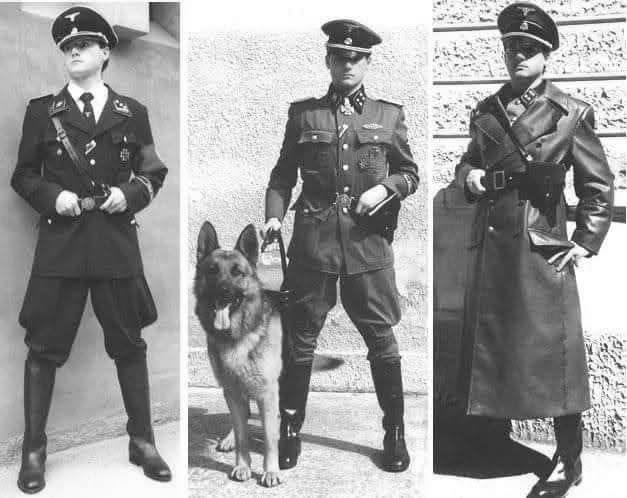
The black SS uniform is one of the most recognizable visual symbols of Nazi Germany. Its severe silhouette, contrasting insignia, and emblems projected discipline, hierarchy, and absolute power. That aesthetic gave rise to a persistent myth: that Hugo Boss himself designed the famous uniform.
The historical record doesn’t support this. Boss was a businessman and clothing manufacturer, not a uniform designer. The design of the black outfit is usually credited to Karl Diebitsch, an artist and SS officer, and the graphic designer Walter Heck.
Heck is also known for creating the SS emblem, made of two stylized runes. These symbols became part of the visual language of an organization that served as one of the main instruments of repression under the Nazi regime.
One more point matters here: the black dress uniform was never standard combat wear for every SS unit. As the war went on, other versions were used, including field uniforms in gray and camouflage-style colors.
So Hugo Boss’s connection to this history lies not in designing the uniform but in manufacturing it. The company was one of the firms that filled uniform orders for Nazi organizations.
How Politics Became Business
A popular version of the story says that one giant military order instantly saved Boss’s factory and turned it into a thriving company. The reality was more complicated.
The business really was struggling in its early years. As the Nazi regime consolidated power, uniform production helped it stabilize and expand. But pointing to a single miraculous order that decided the company’s fate is an oversimplification.
In 1931, Hugo Ferdinand Boss joined the Nazi Party (NSDAP). Historical research confirms this. His business developed in close connection with the economic structures of Nazi Germany, and uniform production became an important part of it.
That said, Boss’s factory was not the regime’s only clothing supplier. Many German companies produced military and party uniforms. Hugo Boss was one manufacturer within a large supply system serving Nazi organizations.
This is where the line between myth and history runs. Boss did not single-handedly outfit the Third Reich, and he was not Hitler’s personal tailor. But his company did take part in making clothing for a regime that started a war in Europe and organized mass persecution and murder.
The Human Cost
The hardest chapter of the company’s history is not about how the uniforms looked. It’s about the people who made them.
During World War II, the Hugo Boss factory used forced labor. According to the historical study by Roman Köster, commissioned by the company, the factory employed 140 forced laborers, mostly women, along with 40 French prisoners of war.
Their situation cannot be described as ordinary employment. Forced labor was part of a system that exploited people who had been stripped of their freedom under the Nazi regime. Behind the production figures were people far from home who had no control over their own lives.
In the public mind, the Hugo Boss story is often boiled down to a catchy line: a fashion brand sewed SS uniforms. But that is only the most visible part of the past. What matters more is understanding how an ordinary business could profit from a political system built on dictatorship, war, and coercion.
The company’s historical study, written by Roman Köster and published in 2011, covers precisely this period, from the factory’s founding to the end of the Third Reich. The company stated that it did not interfere with the independent researchers’ work and expressed deep regret to those who suffered at its factory. Hugo Boss also contributed to an international compensation fund for former forced laborers.
After the War: A New Story
Hugo Ferdinand Boss died in 1948. After the war the company carried on, gradually changing direction. The international fashion brand the world knows today took shape much later, especially in the second half of the 20th century.
It would therefore be wrong to picture the 1930s factory as an already finished empire of luxury menswear. Under the Nazi regime it was a manufacturing business whose opportunities were largely determined by uniform orders. The brand’s present scale and standing are the product of later development.
Hugo Boss’s story is not unique. Many German companies cooperated with the Nazi regime, produced goods for the war effort, and used forced labor. Volkswagen, Siemens, and BMW are among the firms whose history is tied to the Third Reich’s economy. But their stories differ, and lumping them together with uniform makers would be inaccurate.
The question is not only what companies did decades ago, but how they talk about that past today. Acknowledging the facts, commissioning independent historical research, and treating the victims properly matter as much as any public statement.
What Remains Behind the Beautiful Suit
The Hugo Boss story shows how dangerous it is to judge the past by the look of things. A uniform can be perfectly cut, a suit flawless, a brand synonymous with success and good taste. But aesthetics alone say nothing about the moral side of production.
Hugo Boss did not invent the black SS uniform, but his factory helped make it and produced uniforms for other Nazi organizations. The business profited from the system and, during the war, used forced labor.
Today Hugo Boss is an international corporation, not the small factory it was a hundred years ago. But its history is a reminder that commercial success doesn’t exist in a vacuum. Sometimes it rests on decisions that can’t be excused by the demands of the time, the quality of the product, or later achievements.
The darkest part of this story isn’t the black of the uniform. It’s the people whose freedom and dignity were sacrificed to a system that valued production and power above human life.
Michael Manukian