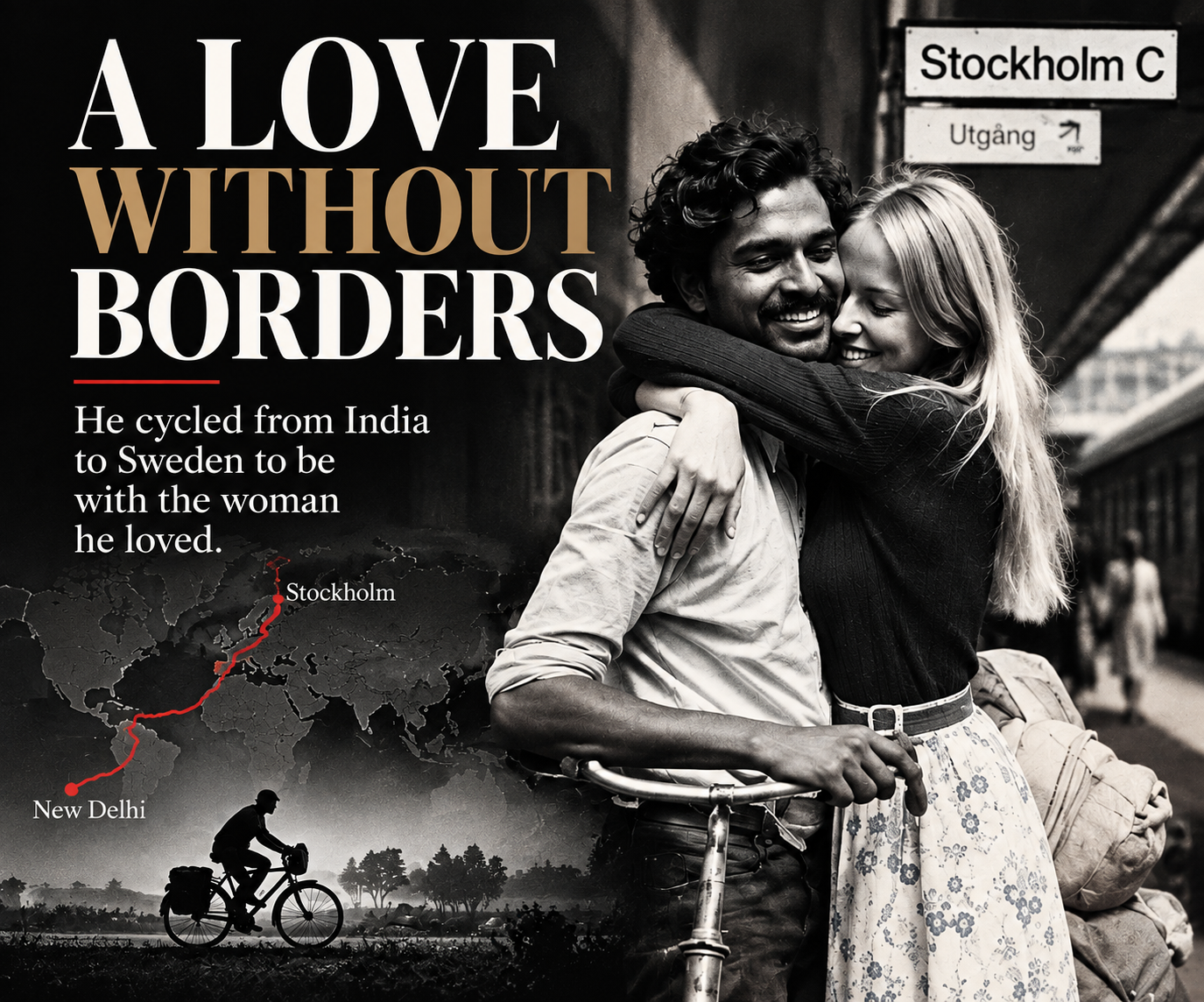
In 1977, an Indian artist with almost no money set out from New Delhi on a second-hand bicycle. His destination was Sweden. Waiting there was the woman he loved.
How far would you go for someone you loved?
Today, when a message can cross the world in a second and a flight can take us from one continent to another in a few hours, we sometimes let relationships fade simply because distance feels inconvenient.
Then there is the story of Pradyumna Kumar Mahanandia.
An Indian artist from a socially marginalised Dalit background fell in love with a young Swedish woman from a noble family. When she returned home, he could not afford a plane ticket to Sweden.
So he bought a bicycle.
And rode after her.
New Delhi, 1975
Pradyumna Kumar Mahanandia, known as PK, was born in 1949 in Odisha, eastern India. He grew up in a poor family and belonged to the Pano community, a Dalit group that faced severe discrimination under India’s caste system.
As a child, he experienced humiliation that would be difficult for many people today to imagine.
Yet art became his way out.
He studied at several art institutions before moving to Delhi, where he became known for portraiture. To make money, he sat in Connaught Place and drew portraits of passers-by and visitors.
Then, on 17 December 1975, a young Swedish woman sat down in front of him.
Her name was Charlotte von Schedvin, known as Lotta.
She had travelled to India and wanted her portrait painted.
According to Mahanandia, something extraordinary happened during that meeting.
He remembered a prediction that had been made about him when he was a child.
The prophecy
According to Mahanandia’s own recollection, an astrologer had predicted that he would one day marry a woman from a distant land.
She would be born under the sign of Taurus.
She would be musical and play the flute.
And her family would own forest land.
So, while he was drawing Charlotte, he began asking questions.
Where was she from?
When was she born?
Did she play music?
Did her family own forest?
The answers astonished him.
She was Swedish.
She was a Taurus.
She played the flute and piano.
And her family had connections to forest land.
Mahanandia later recalled that he immediately felt she was the woman described in the prophecy.
He told her that they were destined to meet.
Whether one believes in astrology or not, the coincidence was remarkable.
But the real story was only beginning.
A love that crossed a social boundary
The two quickly fell in love.
Charlotte travelled with PK to his home region in Odisha and met his family. They married in India according to local traditions.
But their happiness had an immediate problem.
Charlotte eventually had to return to Sweden.
She asked PK to come with her.
The problem was money.
He could not afford an airline ticket.
According to his own accounts, he refused to simply accept the money and decided that he would find his own way to Sweden.
For the next months, they remained connected through letters.
Sixteen months passed.
And PK began thinking about the impossible.
If he could not fly to Sweden, he would go overland.
The bicycle
On 22 January 1977, Mahanandia left New Delhi.
He had very little money and a second-hand bicycle.
He carried his artistic supplies and relied partly on his ability to draw portraits along the way.
Art became his travelling currency.
A stranger might give him food.
Someone else might offer a place to sleep.
Another person might pay him for a portrait.
His route took him through the Indian subcontinent and onward through Afghanistan, Iran and Turkey, before he reached Europe.
This was long before smartphones, GPS, online hotel bookings or international banking apps.
There was no digital map telling him where to go.
No airline app waiting to rescue him.
No easy way to call Sweden.
There was only the road — and the promise he had made.
Mahanandia later said that he never particularly loved cycling.
He was cycling because he had to meet Charlotte.
As he put it: he had no money, but he had to see her.
More than 6,000 miles
The journey lasted four months and three weeks.
By the time he reached Europe, he had travelled thousands of kilometres across continents.
On 28 May 1977, he reached Europe via Istanbul and Vienna. From there, he continued toward Sweden by train.
Eventually he reached Borås.
Charlotte was waiting.
After nearly two years apart, they were together again.
The journey was over.
The love story was not.
The second wedding
Their relationship did not suddenly become easy.
Mahanandia was entering a completely different society and culture. Charlotte’s family also had to accept a man whose background was radically different from theirs.
But they stayed together.
In 1979, they married again, this time under Swedish law.
They went on to have two children, Siddharth and Emelie.
More than four decades later, the couple were still together.
The poor Indian street artist had become an established artist in Sweden, while the woman whose portrait he once drew in New Delhi remained beside him.
The real obstacle was never the distance
The most remarkable thing about this story is not actually the bicycle.
It is what the bicycle represents.
Mahanandia was born into a society where his caste could determine how other people treated him before they knew anything about him.
Charlotte came from a completely different social and cultural world.
They lived thousands of kilometres apart.
They spoke different languages.
They came from different traditions.
And yet none of those differences proved stronger than their decision to remain together.
Their story has since been told in books, interviews and films. In 2026, it reached a new audience through The Cycle of Love, a documentary directed by Orlando von Einsiedel and featuring the real couple.
The story sounds almost too perfect to be true.
But it is true.
And perhaps that is why it continues to fascinate people.
We live in a world where contacting someone on the other side of the planet takes seconds.
Mahanandia lived in a world where a letter could take weeks and a journey to Sweden could take months.
He had no GPS.
No credit card.
No booking confirmation.
No guarantee that anyone would help him.
He had a bicycle, a few possessions, his artistic talent — and a promise.
He simply decided that the distance between India and Sweden was not a reason to abandon the woman he loved.
Sometimes the most extraordinary journeys begin with a very simple thought:
I have to get there.
And sometimes, apparently, a bicycle is enough.