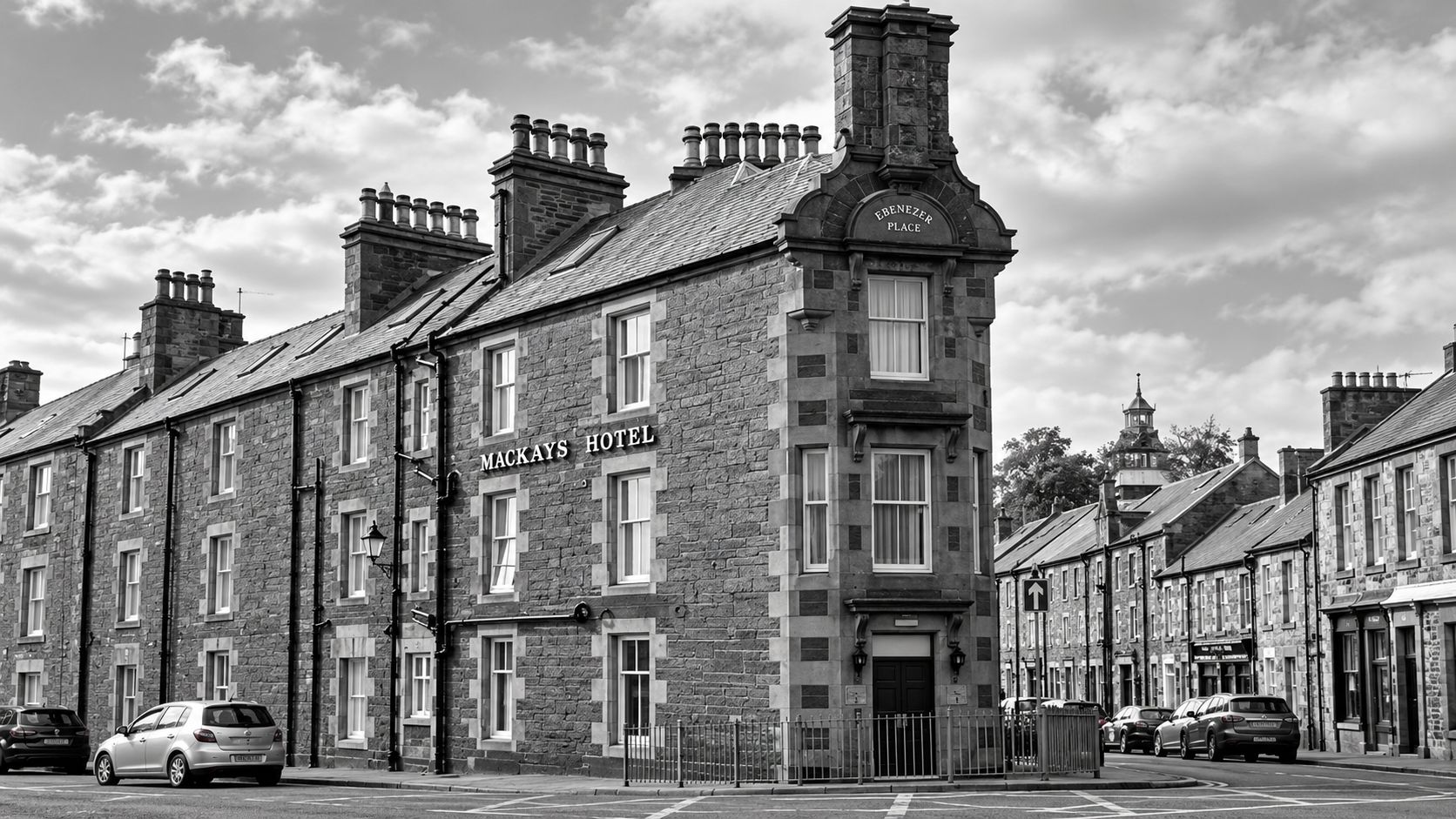
Walk along Union Street in Wick, Scotland, with your eyes on the pavement, and you can easily miss Ebenezer Place. It begins and ends before you notice it. The street is 2.05 meters long, or six feet nine inches. That’s a single step. Still, since 2006 Guinness World Records has recognized it as the shortest street in the world. The story behind the record is a mix of building-code formality, municipal bureaucracy, and one very persistent hotel man.
A building on the corner
The story starts in 1883. Alexander Sinclair, who by the account of guidebook writers had made his fortune in America, came back to Wick, in Caithness. At the junction of Union Street and River Street he built the building that now houses the Mackays Hotel. It was a corner building: the main entrance faced Union Street, another facade looked onto River Street, and the third, much shorter side ran into a tiny strip between the two.
The town authorities told the owner to give that side of the building a name. Sinclair complied and called it Ebenezer Place. Four years later the name made it into the town’s records: Guinness says the street first appears in the valuation roll in 1886–87, and it was officially declared a street in 1887. So an ordinary formality produced a street that, for more than a hundred years afterward, almost nobody paid any attention to.
A hundred years of being ignored
Through all that time, Ebenezer Place was just a line in the paperwork. It is maintained by Highland Council as the road authority, and nobody saw anything remarkable in it. That changed when Murray Lamont, who was connected with the Mackays Hotel, took up the cause. He researched the street’s history and started a long process of getting it recognized as a record holder. Without his persistence, the street would most likely have stayed a local curiosity known only to the people of Wick.
The door that made it a street
What made the difference was a practical decision. The owner of the building put an entrance on the short side for a new bistro, No. 1 Bistro. That gave Ebenezer Place its one and only doorway, and with it a real reason to take the street seriously. Only after that did Guinness recognize it as a record holder.
From there things played out like an adventure story. Craig Glenday, editor-in-chief of Guinness World Records, set off for Wick. By the telling, the journey took about fifty hours and ran through gale-force winds. An hour after he arrived, Glenday declared that the record belonged to Ebenezer Place. The measurement was taken on October 28, 2006, and came out at 2.05 meters. The certificate went to the man from the Mackays Hotel, Lamont.
Who lost the title
Before Wick, the title belonged to Elgin Street in Bacup, a town in Lancashire, England. It was 5.2 meters (17 feet) long, more than two and a half times the length of Ebenezer Place. Bacup took pride in its record, and a plaque below the street sign even advertised the title. In 2006 the crown went north to Scotland, and the local paper, the Rossendale Free Press, ran a headline about the town losing its record.
There are rivals across the ocean as well. Bridge Street in Bellefontaine, Ohio, which is only about twice as long as it is wide, once held the title of shortest street in the world too. Today it’s known for a different distinction: the shortest St. Patrick’s Day parade in the world. So even in the contest for the smallest street, the record isn’t the only consolation prize.
What you can see today
Today Ebenezer Place still has a single address: the entrance to No. 1 Bistro, which is part of the Mackays Hotel. The hotel’s main entrance is on Union Street, so the street itself is, in effect, a side door with a sign on it. You can walk it in one step. Whether the bistro is open now is worth checking before you travel; we haven’t verified that.
Where the sources disagree
If you’re going to quote this story, watch for three places where the sources don’t line up.
First, the length. Guinness gives 2.05 meters, while Wikipedia and a number of publications say 2.06. The official record figure is 2.05.
Second, Murray Lamont’s role. Some accounts call him the manager of the hotel; others call him the owner.
Third, the dates. 1883 refers to the construction of the building, and 1887 to the street’s official status. In the valuation roll, according to Guinness, the street appears in 1886–87. These are different events, and it’s best not to blur them together.
A record built on a formality
There’s a good lesson in this story for anyone who writes about local subjects. Records aren’t always built. Sometimes they just sit in the paperwork until somebody notices them. Nineteenth-century officials demanded that a wall be given a name, and a street was the result. A hundred and twenty years later, a man from the hotel saw a tourist attraction in that wall. All it took was a door, a tape measure, and persistence.
The rest was done by a detail we rarely look at: the name on the corner of a building. In Wick, that detail turned out to be two meters long, and it earned a place in world history.