There are love stories that end with a wedding.
And there are love stories that become part of history.
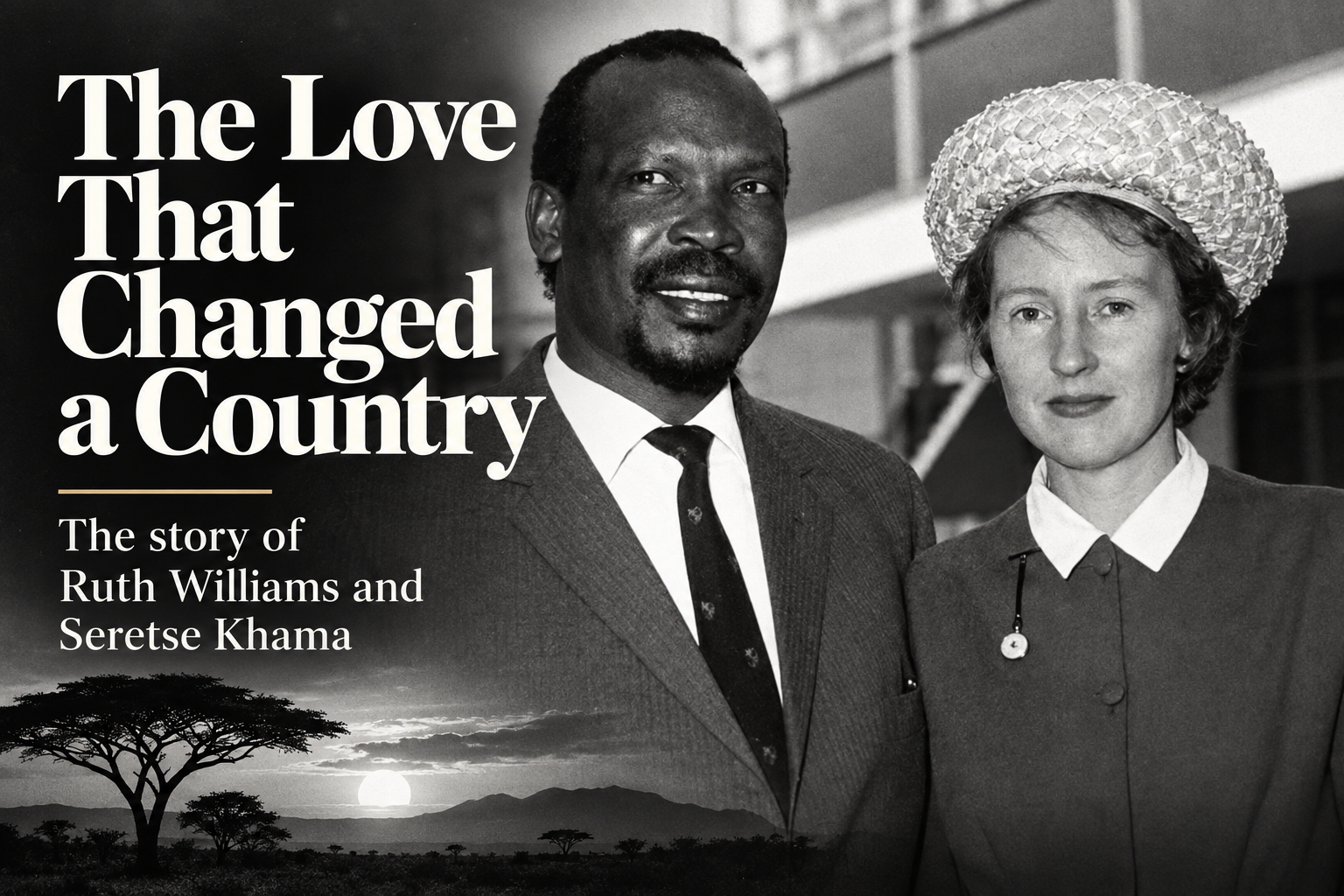
The story of Ruth Williams and Seretse Khama belongs to the second kind.
In 1947, in post-war London, two people from completely different worlds met almost by accident. Ruth Williams was a young Englishwoman working as a confidential clerk for Lloyd’s. Seretse Khama was a young African prince and heir to the leadership of the Bamangwato people of Bechuanaland, the British protectorate that would later become Botswana.
They met at a dance organized by the London Missionary Society.
They were both interested in jazz. They talked. They met again.
And, slowly, they fell in love.
At the time, however, their relationship was almost impossible to imagine.
Seretse was not simply a young man studying law in London. He was heir to the chieftainship of one of the most important Tswana communities in southern Africa. Ruth was a white Englishwoman whose marriage to a Black African man was considered unacceptable by much of British and southern African society.
Their decision to marry therefore became much more than a private family matter.
It became a political crisis.
A Wedding Against the World
Seretse and Ruth decided to marry in 1948.
The opposition came from several directions.
Seretse’s uncle, Tshekedi Khama, who had acted as regent while Seretse was growing up, strongly opposed the marriage. In the Bamangwato tradition, the marriage of their future leader was not simply a personal choice.
There was also intense opposition in neighbouring South Africa, where the apartheid government regarded an interracial marriage involving an African leader as deeply threatening.
And then there was the British government.
The couple had hoped for a church wedding, but the political controversy surrounding their relationship made that impossible. Eventually, they married in a civil ceremony at the Kensington Register Office in London on 29 September 1948.
It was a simple ceremony.
But its consequences were anything but simple.
Newspapers followed the story. Politicians became involved. Traditional leaders debated the marriage. Governments worried about its consequences.
Two people had decided to marry.
An entire political establishment reacted.
Ruth Goes to Africa
After their wedding, Ruth went with Seretse to Bechuanaland.
The reaction there was more complicated than the simple story of a community rejecting the marriage.
Seretse faced opposition from his uncle and some traditional leaders, but he also received significant support from members of the Bamangwato community.
In 1949, a series of traditional public meetings, known as kgotlas, took place in Serowe. Seretse’s position was reaffirmed by the people gathered there. Even Ruth, a British woman entering an unfamiliar society, found that the reality was far more complicated than the opposition predicted.
The crisis, however, had moved beyond the village and beyond the family.
It had reached London.
The Exile
In 1950, Seretse was summoned to Britain for discussions with British officials.
He expected to return home.
He did not.
Instead, the British government prevented him from returning to Bechuanaland.
The decision effectively forced Seretse into exile.
Ruth was pregnant at the time. Their daughter Jacqueline was born in Bechuanaland in 1950, but eventually Ruth joined Seretse in Britain. For several years, the couple lived away from the country that Seretse had expected to lead.
The British government later made Seretse’s exclusion from the chieftainship permanent.
But something unexpected happened.
The attempt to remove Seretse from Bechuanaland did not erase his popularity.
It strengthened the political movement around him.
People continued to demand his return.
The controversy that had begun with a marriage had become a question of political rights, colonial power and the future of Bechuanaland.
Six Years Away
For Ruth, exile was not simply a political story.
It was her life.
She had left Britain, married a man whose country she barely knew, faced hostility from parts of both societies and then found herself living with her husband in exile.
They eventually built a family of four children.
For years, they waited.
Then, in 1956, the Bamangwato people appealed directly to Queen Elizabeth II for Seretse’s return. After negotiations, Seretse and his uncle agreed to renounce their claims to the traditional chieftainship. The couple were finally allowed to return to Bechuanaland as private citizens.
Seretse returned not as the traditional ruler he had once expected to become, but as a man who had lost a title and gained something else: a political cause.
He entered modern politics.
And Ruth stayed beside him.
From Exile to Independence
The story could have ended there.
It didn’t.
Seretse became increasingly involved in the political development of Bechuanaland. In 1962, he helped establish the Bechuanaland Democratic Party. His party won the 1965 election, and Seretse became prime minister as the territory moved toward independence.
On 30 September 1966, Bechuanaland became the independent Republic of Botswana.
Seretse Khama became its first president.
The man once prevented from returning to his own country was now the leader of a new independent state.
And beside him stood Ruth.
The Englishwoman whose marriage had once been treated as a political crisis was now the First Lady of Botswana.
More Than a Love Story
Seretse remained president until his death in 1980.
Ruth remained at his side throughout his political life and later devoted herself to charitable and community work in Botswana. She died in 2002.
Their story is often described as a great romance, and it certainly was.
But it was also something larger.
Their marriage exposed the contradictions of a colonial world in which private relationships could become political acts. It brought questions of race, tradition, colonial authority and self-determination into the same story.
Yet it is important not to reduce Ruth and Seretse to symbols.
Before they became historical figures, they were simply two people who met at a dance, discovered that they loved the same music, fell in love and decided that other people’s expectations would not determine whom they married.
They paid a heavy price for that decision.
They spent years separated from the country they wanted to call home.
But eventually, they returned.
And the country they returned to became Botswana.
Perhaps that is why their story has survived for so long.
Not because love magically changes history.
But because sometimes a personal decision can collide with history — and change the course of both.