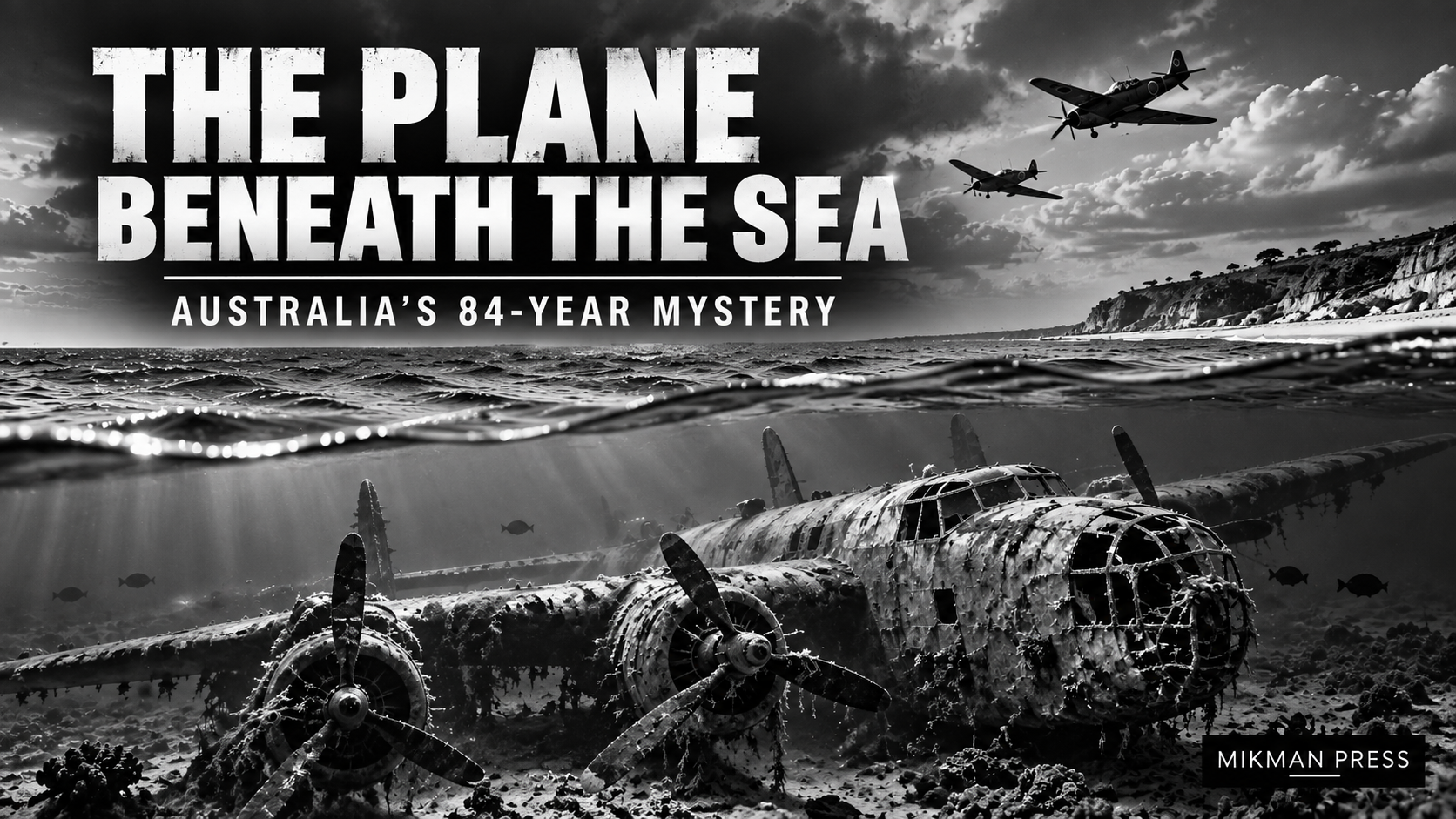
Twenty American servicemen disappeared into the waters off Western Australia in 1942. For more than eight decades, their families have had no final resting place. Now, the search has begun again.
On the morning of March 3, 1942, the small Australian town of Broome was suddenly thrown into war.
Japanese fighter planes appeared over the remote Western Australian coast. Within minutes, aircraft were burning on the ground and in the waters of Roebuck Bay. Refugees fleeing the Japanese advance in Southeast Asia were trapped among burning aircraft and fuel-covered water.
The attack lasted less than an hour.
But for some families, it never ended.
Among the aircraft caught in the attack was an American B-24A Liberator.
It had only recently taken off.
Seven minutes later, Japanese fighters shot it down.
The aircraft crashed into the sea.
And almost everyone aboard disappeared with it.
More than 80 years later, the wreck has still not been found. Австралийский военный мемориал
Seven minutes into the flight
The Liberator was carrying American servicemen who were being evacuated from Java.
They were wounded or sick men being moved toward Australia as Japanese forces rapidly advanced across Southeast Asia.
The aircraft took off from Broome during the Japanese attack.
It never got far.
Japanese fighters intercepted it and opened fire.
The Liberator went down approximately ten kilometres offshore from Cable Beach.
There was only one known survivor.
His name was Melvin Donoho, a young American serviceman from Oklahoma.
What happened next sounds almost impossible.
Donoho survived the crash and somehow reached the shore after swimming for approximately 33 hours.
Two days after the aircraft went down, he staggered into the Broome airbase.
He was naked.
He was severely sunburned.
He was close to collapse.
He had survived something that almost nobody else aboard the aircraft did. ABC Новости
Then the ocean closed over the plane
The exact number of people aboard has been complicated by incomplete wartime records, but investigators believe around 20 American servicemen died.
Their bodies were never recovered.
The aircraft disappeared beneath the water.
And there it remained.
Somewhere off the coast of Broome.
For decades, there was no precise location.
No wreckage.
No grave.
No final confirmation.
Only records, photographs, survivor testimony and a narrowing circle on a map.
For the families, that meant something profoundly different from a conventional military death.
There was no grave to visit.
No known place where their relatives had come to rest.
Only the knowledge that somewhere beneath the water was an aircraft containing the remains of men who had disappeared in 1942.
The man who refused to stop looking
One of the people who became obsessed with finding the Liberator is Jim Miles, a retired military pilot.
For approximately 15 years, Miles has searched the waters off Broome.
He does not have a massive research vessel.
He works from his catamaran.
Behind it, he tows side-scan sonar equipment that sends pulses toward the seabed and records the shape of objects below.
The technology allows him to build images of what lies beneath the surface.
Most of the time, he finds nothing.
But he keeps going.
For Miles, the Liberator has become what he calls the “Holy Grail.” ABC Новости
There is something almost addictive about searching for something that has been missing for more than eight decades.
Every unexplained shape on the sonar screen could potentially be the answer.
Every trip could be the trip.
Every dive could finally reveal what happened.
The ocean is full of secrets
The Liberator is only one of thousands of wrecks believed to lie beneath Australian waters.
More than 11,000 ship and aircraft wrecks are thought to exist around Australia.
Only about one-quarter have been located.
Some are centuries old.
Others disappeared during wars.
Some contain the remains of people who were never recovered. ABC Новости
The seabed around Australia is enormous.
And finding a particular aircraft is not simply a matter of knowing where it crashed.
Currents move objects.
Wreckage can break apart.
Visibility can be extremely poor.
The seabed itself changes.
And the search area can stretch for kilometres.
The Liberator search zone has been narrowed considerably because investigators have wartime photographs, flight records, eyewitness accounts and information from the only known survivor.
But a narrow search zone can still contain thousands of possible objects.
Technology has changed the hunt
For decades, finding a small aircraft beneath the sea was almost impossible.
Today, sonar and seabed mapping have changed the equation.
Search teams can systematically scan large areas and identify objects that would be invisible from the surface.
That does not make the work easy.
It simply makes the impossible slightly less impossible.
In the latest official search, maritime archaeologist Jane Mitchell led a two-week expedition commissioned by the US Defense POW/MIA Accounting Agency.
The team searched approximately 15 square kilometres of seabed.
They did not find the Liberator.
But they eliminated a significant section of the search area.
In a mystery this old, even proving where the wreck is not can be valuable. ABC Новости
“No result is still a result”
The latest search ended without the dramatic discovery everyone hoped for.
No aircraft appeared on the sonar.
No wreckage was brought to the surface.
No remains were recovered.
But the expedition did something important.
It reduced the number of places where the Liberator could still be hiding.
And the search is not over.
US authorities have indicated that they will continue working with Australian researchers and volunteers.
The objective is not simply historical.
It is personal.
The US Defense POW/MIA Accounting Agency maintains records of more than 80,000 American military personnel who remain unaccounted for worldwide.
Approximately 280 are believed to have died in Australian territory.
The agency’s mission is to recover those missing personnel whenever there is a reasonable possibility of doing so. ABC Новости
Eighty-four years is a long time
Imagine waiting for news about someone who disappeared in 1942.
Then imagine waiting through the 1950s.
The 1960s.
The 1970s.
The 1980s.
The 1990s.
The new millennium.
Generations pass.
Children become grandparents.
Photographs fade.
People who personally knew the missing man eventually die themselves.
And still there is no grave.
No final location.
No answer.
Yet descendants continue to ask the same question:
Where is he?
That is why the search for the Liberator is not simply an archaeological project.
It is a search for closure.
The sea may still be holding the answer
There is a remarkable irony in the story.
The aircraft disappeared only minutes after taking off.
The last known survivor eventually walked into the Broome airbase.
The Japanese attack became part of Australian wartime history.
But the Liberator itself became a ghost.
For 84 years, it has remained somewhere beneath the water.
The searchers now have better maps.
Better sonar.
Better historical records.
Better technology.
And fewer kilometres of seabed left to investigate.
But they still need to find the one thing that has escaped them for generations:
the aircraft itself.
The final resting place
If the Liberator is eventually found, the discovery will not simply add another wreck to Australia’s enormous underwater archaeological record.
It could finally identify the resting place of the American servicemen who disappeared that morning in 1942.
For Jim Miles and the other searchers, that is the real purpose.
Not the excitement of discovering an old aircraft.
Not the technology.
Not the achievement of solving an 84-year-old mystery.
But the people.
Somewhere beneath the waters near Broome may be the final resting place of men whose families have waited for an answer for generations.
And the search continues.
**The plane is still missing.
But it has never been forgotten.**
Michael Manukian