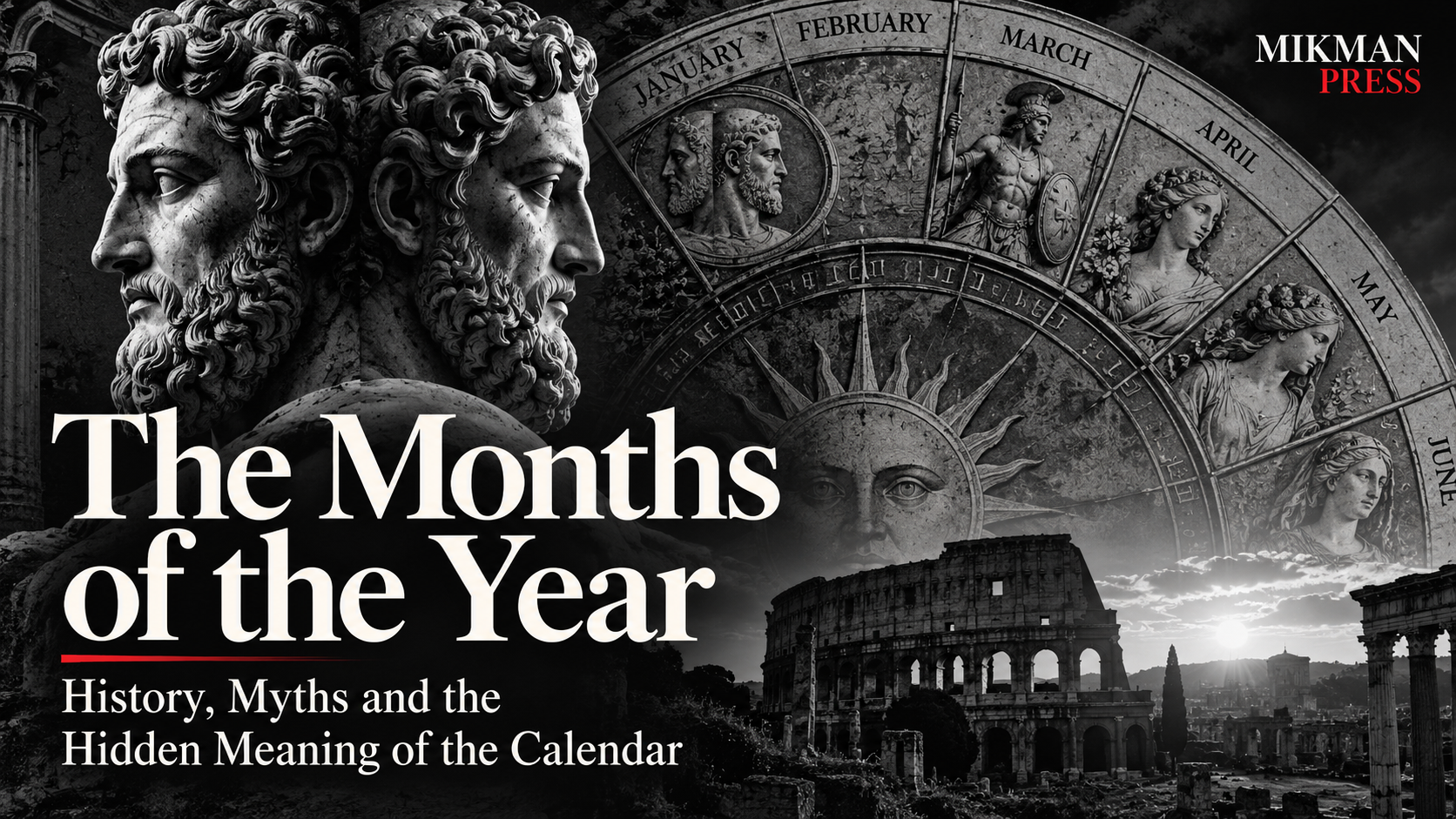
We look at the calendar every day without thinking about it.
January. February. March. April.
Twelve familiar names, twelve boxes on a page, twelve points in the cycle of the year.
But the calendar is not as neutral as it seems.
Behind the names of the months are ancient gods, Roman emperors, forgotten rituals, political decisions, agricultural traditions, ideas about death and fertility — and the human desire to give meaning to the passage of time.
Some of these names have survived for more than two thousand years.
And every one of them has a story.
January — The Two-Faced Guardian
January takes its name from Janus, the ancient Roman god of doors, transitions and beginnings.
Janus was traditionally depicted with two faces: one looking into the past, the other towards the future. It made him a perfect symbol for the first month of the year.
But January was not always the beginning.
In early Rome, the year traditionally began in March. In 153 BC, however, January 1 became the official starting point for the Roman political year, largely because newly elected consuls began their terms on that date.
A political decision eventually became one of the world’s most familiar calendar traditions.
January therefore carries an unusually powerful idea: the moment between what has ended and what has not yet begun.
February — The Month of Purification
February comes from the Latin februare, meaning “to purify.”
For the Romans, February was a month of purification, atonement and rituals intended to prepare the community for a new cycle.
It was also associated with ancient ceremonies such as the Lupercalia, which involved ritual purification and sacrifice.
For a long period, February was the final month of the Roman year.
Perhaps that is why it has always seemed slightly different from the others.
Twenty-eight days. Sometimes twenty-nine.
The shortest and most irregular month still occupies a strange position at the edge of the calendar.
March — War, Spring and Awakening
March was named after Mars, the Roman god of war.
But Mars was more than a god of battle. He was also connected with agriculture and the protection of Roman society.
In the old Roman calendar, March was the first month of the year.
It was the beginning of military campaigns, agricultural activity and the return of life after winter.
March therefore represented both destruction and renewal.
Warriors went to war.
Farmers returned to the fields.
Nature began again.
April — Opening and Renewal
The origin of the name April is less certain.
One traditional explanation connects it with the Latin aperire, meaning “to open” — an appropriate image for the month when flowers and trees begin to open after winter.
Another theory connects April with Venus, the Roman goddess of love.
Whatever its precise origin, April has long been associated with spring, fertility, beauty and renewal.
Later traditions added another curious association: April became the month of practical jokes and deception.
The exact historical connection between springtime traditions and April Fools’ Day remains debated, but the symbolism is strangely appropriate.
A month of opening can also be a month of illusion.
May — Fertility and Fear
May is traditionally connected with Maia, a goddess associated with growth and fertility.
Yet the Romans did not consider May an especially fortunate month for marriage.
An old Roman belief held that weddings celebrated in May could bring misfortune.
At the same time, May was connected with rituals concerning the dead and the spirits of ancestors.
This gives the month an unusual duality.
Growth and death.
Fertility and fear.
Life emerging from the earth while memories of the dead remain close.
June — Marriage and the Household
June takes its name from Juno, the Roman goddess of marriage, women and the household.
Unlike May, June became famous as a favorable month for weddings.
The association has survived remarkably well.
Even today, June remains one of the traditional wedding months in many cultures.
There is something fitting about the connection between Juno and the early summer: the month sits close to the summer solstice, when daylight reaches its annual peak.
June stands at a moment of balance — between the growing light and the inevitable return of darkness.
July — The Month of a Man
July changed the rules.
It was originally called Quintilis, meaning “the fifth month” in the old Roman system.
Then came Julius Caesar.
After his assassination, the month was renamed Julius in his honor. The name eventually became July in English.
This was more than a change of vocabulary.
For thousands of years, months had been associated primarily with gods, seasons and numbers.
Now a calendar month carried the name of a human ruler.
July became a reminder that calendars are not simply measurements of time.
They can also be monuments to power.
August — Empire and Ambition
August followed the same path.
Originally called Sextilis, meaning “the sixth month,” it was renamed Augustus after the Roman emperor Augustus.
According to a long-standing tradition, the month was given an additional day so that Augustus would not have a shorter month than Julius Caesar.
Whether every detail of that popular story is historically accurate is debated, but the symbolism is clear.
The calendar had become political territory.
Names could commemorate rulers.
Numbers could be rearranged.
Time itself could carry the memory of power.
September — The Lost Number
September means “seven.”
Yet September is the ninth month.
Why?
Because the Roman calendar once began in March.
March was month one.
April was two.
May was three.
June was four.
Quintilis was five.
Sextilis was six.
September was seven.
Later, January and February were moved into the beginning of the year, but the old names remained.
The calendar changed.
The language did not.
September is therefore a linguistic fossil — a small surviving piece of an older calendar hidden in everyday speech.
October — The Eighth Month
October comes from the Latin word for eight.
Today it is the tenth month.
Like September, November and December, October preserves the memory of a calendar that no longer exists.
In ancient Rome, October was associated with the closing of the military season and rituals connected with Mars.
The active period of the year was ending.
Winter was approaching.
The rhythm of human life was beginning to slow.
November — The Ninth Month
November means “nine.”
Its place in the modern calendar tells the same story as September and October.
Once ninth.
Now eleventh.
Over time, November became associated in European traditions with the approach of winter, remembrance and the dead.
The landscape changes.
The days become shorter.
The year begins to disappear.
November has therefore acquired a cultural identity far beyond its original numerical meaning.
December — Saturn, Reversal and Celebration
December means “ten.”
It was once the tenth and final month of the Roman year.
Its most famous ancient celebration was Saturnalia, a festival dedicated to Saturn.
During Saturnalia, normal social rules could be temporarily turned upside down. Servants and masters could exchange roles, public celebrations filled the streets, and gifts were exchanged.
The world was briefly allowed to become different.
Centuries later, December became associated with Christmas and other winter celebrations.
The traditions changed.
The religious meaning changed.
But something remained: light in darkness, celebration at the end of the year, gifts, gatherings and the temporary suspension of ordinary life.
The Calendar Is a History Book
The twelve months are not simply a convenient way to divide the year.
They are fragments of a much older world.
January remembers Janus.
March remembers Mars.
June remembers Juno.
July remembers Caesar.
August remembers an emperor.
And September, October, November and December quietly remember a calendar that disappeared more than two thousand years ago.
The names survived because language is often more conservative than civilization.
Empires disappear.
Religions change.
Political systems collapse.
Calendars are redesigned.
But words remain.
We still say September without remembering that it once meant seven.
We still say December without realizing that it once marked the end of the Roman year.
Perhaps that is the most fascinating thing about the calendar.
Every morning, when we check the date, we are not simply looking at numbers.
We are looking at a piece of ancient history that has never completely disappeared.
**Time changes.
The names remember.**
MIKMAN PRESS