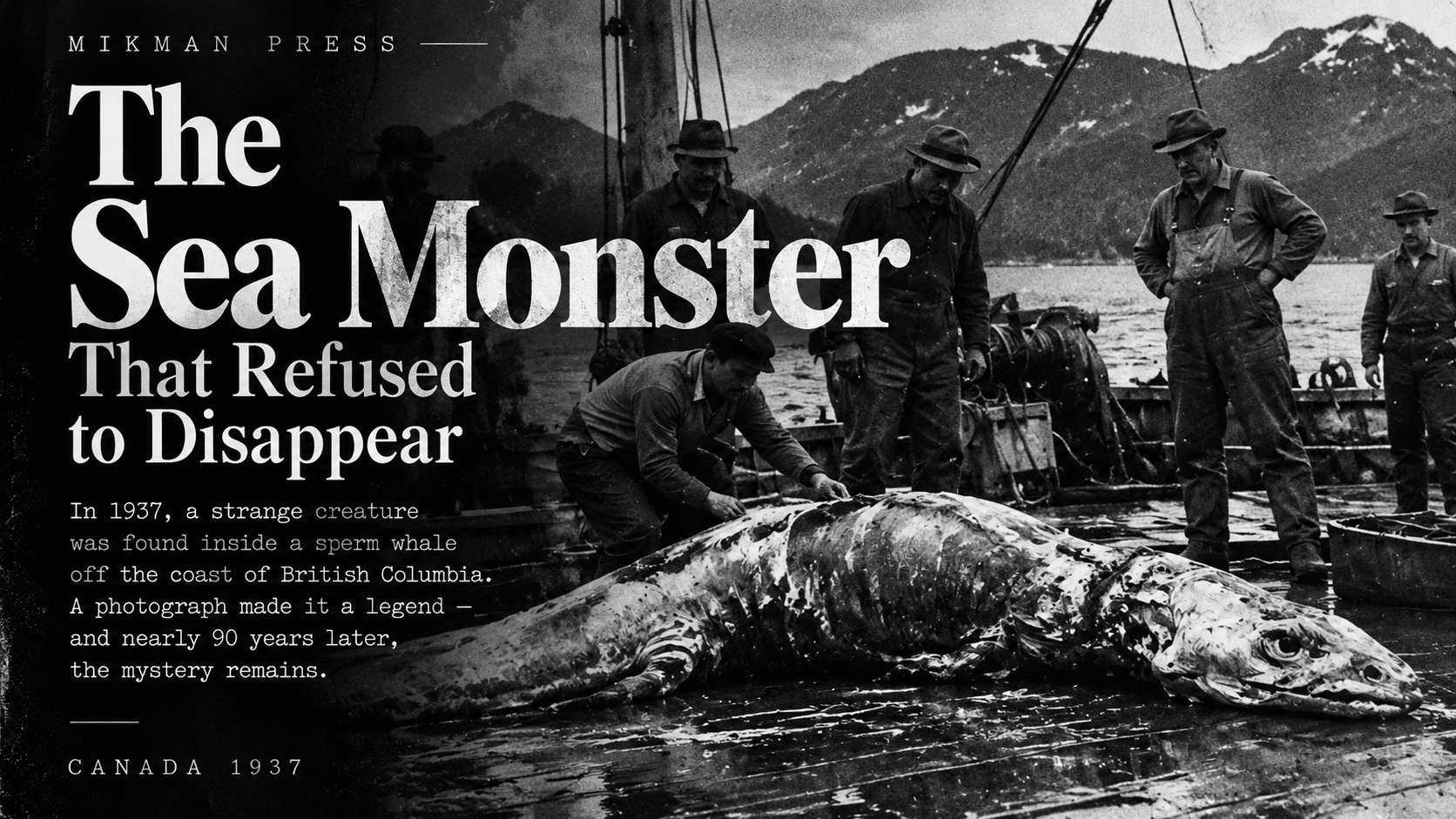
In 1937, a strange creature was pulled from the stomach of a sperm whale off the coast of British Columbia. A photograph made it famous. Nearly nine decades later, the mystery still refuses to disappear.
There are mysteries that survive because nobody ever finds an answer.
And then there are mysteries that survive precisely because the answers never seem quite good enough.
Off the coast of British Columbia, one such mystery acquired a name: Cadborosaurus.
The creature became part of local folklore after a bizarre discovery in 1937. A sperm whale had been caught near the Canadian coast. When its stomach was opened, workers found something that appeared to be unlike anything they recognized.
It was long, strange-looking and difficult to identify.
Then someone took a photograph.
That photograph would help turn an obscure maritime incident into one of Canada’s most enduring sea-monster stories.
A creature inside a whale
The story sounds almost too strange to be true.
A giant whale had swallowed something.
Inside its stomach was what appeared to be the remains of another animal — a creature with an elongated body and an unusual head.
Witnesses described a body several metres long.
At a time when photographs were still powerful evidence in newspapers, the image attracted attention. The story spread, and the creature acquired the name Cadborosaurus, after Cadboro Bay near Victoria, British Columbia.
The name sounded scientific.
The mystery certainly did not.
Was it an unknown species?
A surviving prehistoric animal?
A giant eel?
Or simply the decomposed remains of something much more familiar?
The problem with sea monsters
The oceans are unusually good at creating mysteries.
Much of the deep sea remains difficult for humans to observe directly. Animals can be damaged by predators, altered by decomposition or distorted by the pressure and movement of water.
A carcass that looks unmistakable on the beach can become almost impossible to identify after spending days in the sea.
This has produced a long history of supposed sea monsters.
Some turned out to be sharks.
Others were whales.
Still others were large fish or ordinary marine animals whose bodies had decomposed into strange shapes.
But Cadborosaurus became particularly persistent.
People in British Columbia had already been reporting sightings of unusual creatures in the waters around the region.
The 1937 discovery appeared to give those stories something tangible.
There was now a photograph.
The photograph
And photographs have a peculiar power.
A written description can be dismissed as exaggeration.
A photograph feels different.
It appears to say:
Look. This existed.
But a photograph does not necessarily tell us what we are looking at.
That distinction became central to the Cadborosaurus mystery.
The image was real.
The animal was real.
What remained uncertain was what the animal actually was.
Science enters the story
Over the years, researchers and marine specialists have offered more conventional explanations.
Some have suggested that the creature may have been the remains of a known marine animal whose body had been heavily altered by digestion and decomposition.
Others have pointed toward species that naturally have elongated bodies.
There is no established scientific evidence that a previously unknown giant sea serpent was discovered inside the whale.
And yet the mystery survived.
That may be the most interesting part of the story.
Why do we still want to believe?
The fascination with Cadborosaurus is not really about proving that sea monsters exist.
It is about something more human.
We are uncomfortable with mysteries that remain open.
We like the world to be classified.
A whale should be a whale.
A fish should be a fish.
A carcass should have a name.
But the ocean repeatedly reminds us that nature does not always cooperate with our categories.
The deeper waters remain difficult to explore, and strange animals continue to appear on beaches around the world.
Sometimes the explanation is perfectly ordinary.
Sometimes it takes years to find.
And sometimes the evidence disappears before anyone can examine it properly.
The monster that became a legend
Cadborosaurus has now existed for almost a century as an idea.
It has appeared in books, documentaries, newspaper stories and popular accounts of unexplained creatures.
The original mystery has become larger than the original animal.
That is how legends work.
A photograph becomes a story.
A story becomes a name.
A name becomes a creature.
And eventually the creature becomes part of the identity of a place.
Whether Cadborosaurus was an unknown animal, the remains of a familiar one, or simply a spectacular case of mistaken identification, the legend has achieved something the animal itself may never have done.
It survived.
Perhaps that is the real mystery
There is a temptation to ask whether Cadborosaurus was real.
But perhaps that is the wrong question.
The more interesting question is why, after nearly ninety years, people still care.
The photograph has not changed.
The 1937 incident has not changed.
What has changed is us.
Every generation looks at the same strange image and asks the same question:
What was that?
And as long as nobody can give an answer that completely satisfies our curiosity, the sea monster will remain there — somewhere between science, folklore and the dark waters of the Pacific.
Still waiting to be identified.