The strange figure walking through Nairobi in a Buddha-like mask and enormous metal shoes was not looking for fame. He was looking for work.
By MikMan Press
For several days, people in Nairobi could not quite decide what they were looking at.
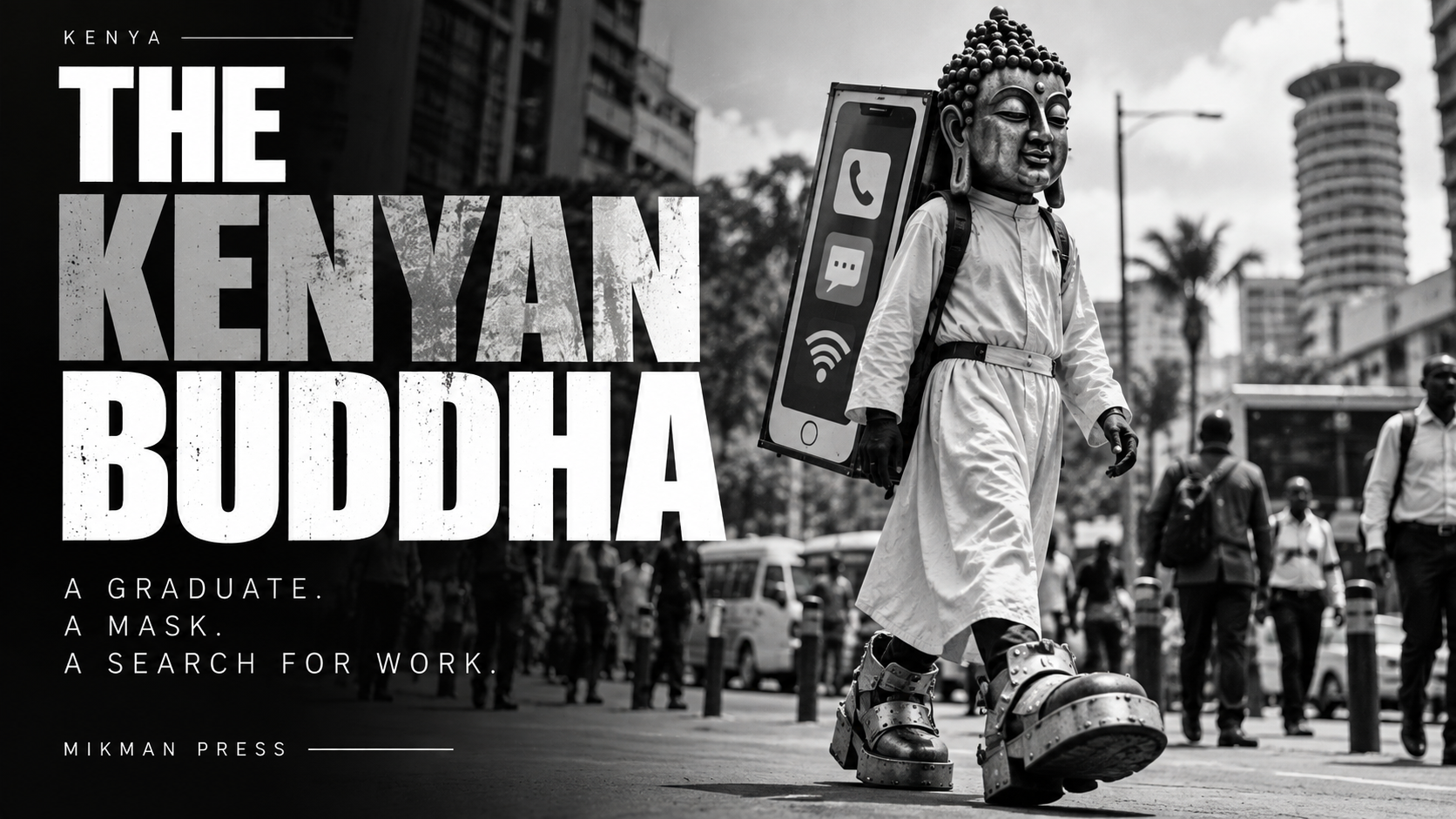
A man was walking through the city’s Central Business District wearing a flowing white kanzu, a heavy mask resembling a Buddha-like face and enormous metallic shoes that announced every step with a loud, unmistakable clank.
On his back was another strange object: a large board shaped like a smartphone.
He looked less like a job seeker than a character who had escaped from a film.
People stared.
Some filmed him.
Others tried to work out what the costume meant.
On social media, the theories multiplied.
Who was he?
Why was he dressed like that?
Was it performance art? Advertising? A joke? A religious statement?
Then the mystery began to unravel.
Behind the mask was a young Kenyan graduate.
He had a diploma in telecommunications engineering.
And he did not have a job.
His name became known online as Kienyeji Smarter, while social media users also gave him another name: the Kenyan Buddha.
The costume was not simply a costume.
It was his attempt to create an opportunity where none had appeared.
The job that did not come
The story is familiar in Nairobi, even if the way this particular young man responded to it is not.
He had studied telecommunications engineering and spent months looking for employment.
Applications went out.
Nothing came back.
The qualification existed on paper. The job did not.
Eventually, he stopped waiting.
Instead, he built something that nobody had advertised.
He created a character.
The mask made him impossible to ignore.
The metallic shoes made sure people heard him before they saw him.
The enormous smartphone-shaped board turned his body into a moving advertisement.
He was no longer simply another unemployed graduate walking through Nairobi.
He had become a walking billboard.
That was the point.
He wanted companies to notice him.
Not necessarily because he expected to be hired as an engineer, but because he hoped a company might see the value in what he had created and employ him to advertise its products or services.
It was an unusual application for a job.
There was no CV in an envelope.
No interview room.
No polished LinkedIn photograph.
Instead, there was a man in giant shoes walking through the middle of Nairobi.
The road from Uthiru
There is another detail that changes the way the spectacle looks.
Sometimes he does not even have enough money for the journey into the city.
On those days, he walks from Uthiru to Nairobi’s city centre.
Then he puts on the costume and begins.
He has said that people sometimes give him as much as KSh 200.
Sometimes they give him nothing.
The costume attracts attention, but attention does not necessarily pay the rent.
“Life as an unemployed youth is not easy,” he said, according to reports from Kenyan media.
That sentence strips away some of the theatre.
The giant shoes are funny from a distance.
The mask is strange.
The smartphone on his back is almost absurd.
But underneath all of it is something much less amusing.
A young man with a technical qualification is walking across Nairobi because he cannot afford the bus fare.
When unemployment becomes performance
There is something particularly modern about his solution.
For generations, looking for work meant sending applications, visiting offices and asking people for opportunities.
Now there is another possibility:
become visible.
The Kenyan Buddha is doing exactly that.
He is turning attention into currency.
Every person who stops to look is potentially a future customer.
Every photograph uploaded to social media is free publicity.
Every video is another chance for someone — perhaps a company, perhaps an employer — to discover him.
It is not a conventional business plan.
But neither is the digital economy particularly conventional.
A young person can have a diploma and no employer.
He can have no capital and still have an audience.
And sometimes the only asset available is the ability to make people look.
Nairobi finally looked
Eventually, Geoffrey Mosiria, a Nairobi City County official, managed to track him down.
Mosiria wanted to understand who the mysterious figure was and what he was trying to achieve.
The answer was considerably less mysterious than the costume.
He was trying to survive.
Mosiria subsequently offered to help him find formal employment and appealed to Kenyans online to assist him with rent.
The story had suddenly changed direction.
What had begun as curiosity became a human-interest story.
The city had first noticed the costume.
Then it noticed the person.
What the mask hides
There is an uncomfortable irony in the story.
The man spent years acquiring a technical qualification.
Yet it was not his diploma that made Nairobi stop and look.
It was a mask.
It was the enormous shoes.
It was the spectacle.
His engineering qualification had not made him visible.
The costume did.
That does not mean the diploma was worthless.
It means that, in a crowded city where thousands of young people are searching for work, qualifications alone may not guarantee that an employer will notice you.
So he found another way to be noticed.
He made himself impossible to overlook.
The city as a stage
Nairobi is a city accustomed to improvisation.
Its streets are filled with people selling, repairing, transporting, performing and inventing ways to make a living.
The Kenyan Buddha belongs to that world, but with one crucial difference.
His product is not food.
It is not a phone.
It is not a service that can be put on a shelf.
His product is attention.
The white clothing.
The enormous shoes.
The mask.
The giant phone.
Together they form a brand.
And the brand is built around one simple message:
Look at me. I am here. I am available.
In another context, this might be called marketing.
On the streets of Nairobi, it is also a form of survival.
The strange logic of visibility
There is no neat ending to the story yet.
The promise of help is not the same thing as a job.
The social-media attention may disappear as quickly as it arrived.
The costume may stop attracting crowds.
And the young graduate still has a telecommunications diploma.
What he has achieved so far is something different.
He has made himself visible.
For a few days in September 2026, thousands of people who would never have known his name were asking the same question:
Who is that man?
Now they know.
He is a young Kenyan graduate looking for work.
He is a street performer.
He is an aspiring advertiser.
He is Kienyeji Smarter.
And, for the moment, he is the man in the giant shoes.
Perhaps the strangest part of the story is not that an unemployed graduate decided to dress like this.
Perhaps it is that he had to become this visible before anyone noticed that he was qualified.
In a city of millions, the first step toward getting a job may sometimes be simply getting people to look.
And so he walks.
Clank.
Clank.
Clank.
Through Nairobi.