Before he became the idol of Naples, the world champion of 1986 and one of the most famous footballers in history, Diego Armando Maradona was simply a boy from Villa Fiorito — a poor neighbourhood on the southern edge of Buenos Aires.
There is a story about Maradona that has circulated for years.
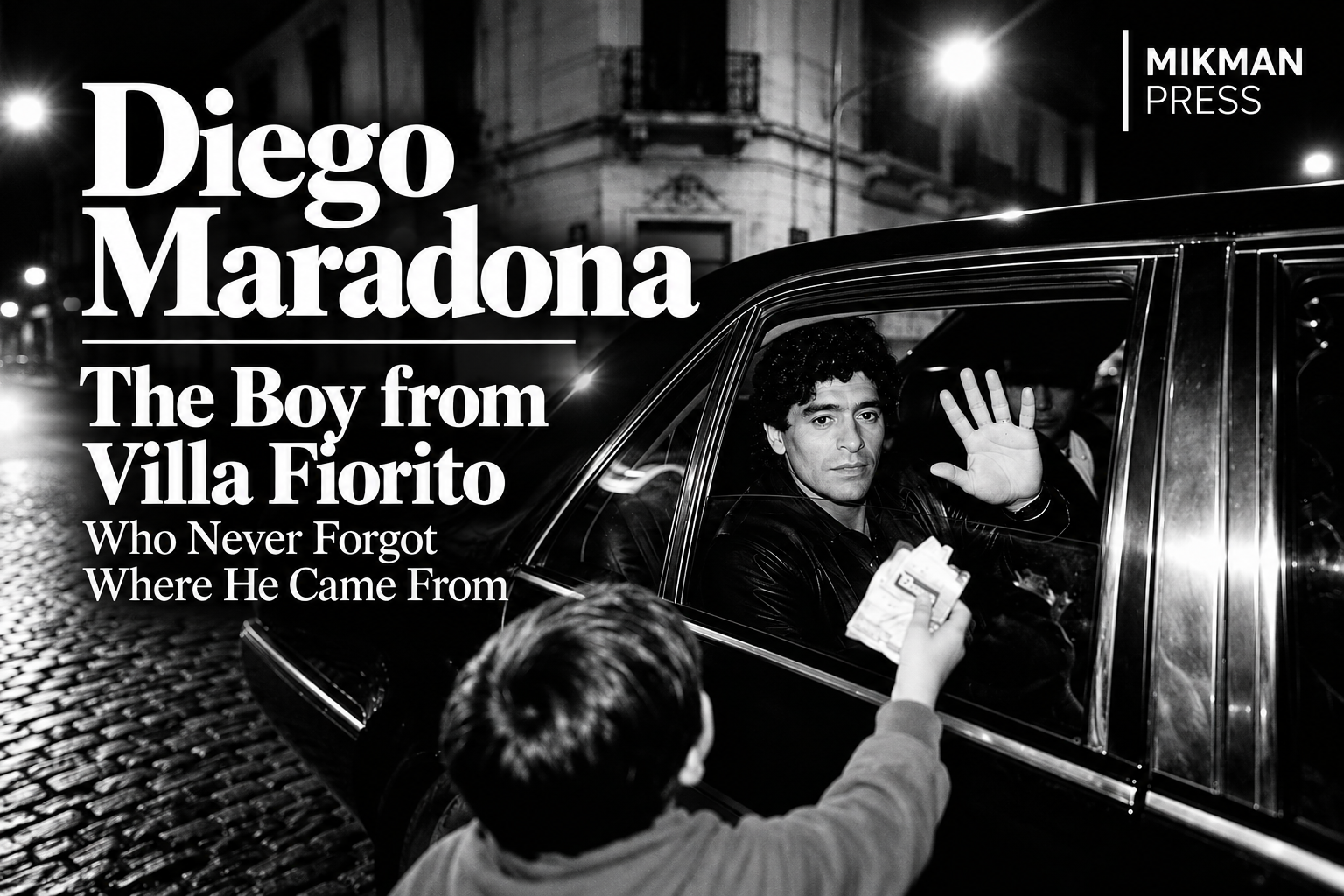
It tells of a cold night in Buenos Aires in 1989. A black car stops at a traffic light. Inside sits Maradona, already a superstar in Napoli. At the window is a poor boy selling tissues. Maradona supposedly invites him into the car, follows him back to his home in the slums and gives his family money and a chance at a different life.
It is a beautiful story.
There is only one problem.
There is no reliable evidence that this particular encounter ever happened.
There is no verifiable record of the boy named Rodrigo, no contemporary report of the traffic-light encounter, and no trustworthy source documenting the supposed visit to the boy’s home.
But that does not mean the story has no connection with reality.
Because the real story of Maradona and Villa Fiorito is, in its own way, even more powerful.
The Place That Made Diego
Diego Armando Maradona was born on October 30, 1960, in Lanús, Buenos Aires Province, but his childhood was shaped by Villa Fiorito.
His family lived at 523 Azamor Street, in a modest house with a dirt yard, a dining room and two bedrooms. There were eight children in the family. The house would later be declared a National Historic Site by the Argentine government because of its connection to Maradona’s life and origins.
Fiorito was poor.
Very poor.
The streets could turn to dust in dry weather and mud after rain. Houses were modest, infrastructure was limited and many families struggled simply to put food on the table.
Maradona never tried to hide that past.
Quite the opposite.
He carried Villa Fiorito with him for the rest of his life.
In his autobiography, he described the neighbourhood with one word:
“Struggle.”
And then he explained what that meant: if there was food, people ate. If there wasn’t, they didn’t.
That sentence tells us more about the future Maradona than any luxury car ever could.
A Mother Who Went Hungry
One of the most painful memories Maradona shared about his childhood concerned his mother, Dalma Salvadora Franco, known as Doña Tota.
There were times when there simply wasn’t enough food for everyone.
Maradona later recalled seeing other children with new shoes, bicycles and toys — things his own family could not afford. His father worked hard, but feeding a large family on one income was difficult.
He also remembered something that he only fully understood when he was older.
At dinner, his mother would sometimes say that she wasn’t hungry.
As a child, Diego believed her.
Later he understood the truth.
She was giving her food to her children.
The story became one of the deepest emotional memories of his childhood. Maradona repeatedly spoke about his mother with extraordinary affection and credited his parents with giving him the foundation that allowed him to escape poverty.
That experience mattered.
Because Maradona never forgot what hunger looked like.
The Ball
There was, however, something in Villa Fiorito that gave Diego another kind of escape.
Football.
The neighbourhood had improvised playing fields — potreros — where children played for hours.
The Argentine government has preserved the story of the seven local pitches near Maradona’s childhood home, including the field where his father, Don Diego, coached a neighbourhood team. That was where the boy began developing the extraordinary footballing instincts that would eventually make him famous.
Football did not simply entertain Diego.
It gave him a language.
A purpose.
And eventually, a way out.
By the time he was eight, his ability had become impossible to ignore.
He joined the youth setup at Argentinos Juniors and became part of the legendary Los Cebollitas.
The boy from Fiorito was beginning to leave the neighbourhood.
But he never really left it behind.
From Fiorito to Naples
The transformation was extraordinary.
The boy from a poor Buenos Aires neighbourhood became a professional footballer.
Then a star.
Then an international icon.
Then, in Naples, something approaching a religious figure.
When Maradona arrived at Napoli in 1984, he entered a city that had long lived in the shadow of the wealthier north of Italy.
Naples recognized something in him.
He was not simply a brilliant footballer.
He was someone who understood what it meant to come from somewhere that others looked down upon.
That connection became one of the defining elements of the Maradona myth.
He played for Napoli as though every match were personal.
When he eventually led the club to its first Serie A title in 1987, and later to another in 1990, the achievement meant much more than football to the people of Naples.
Maradona understood that.
He understood what it meant to become a symbol for people who felt ignored.
The Myth and the Man
This is where the unverified story of the boy at the traffic light becomes interesting.
Perhaps someone created it because it sounds like Maradona.
A superstar sees a poor child.
He remembers his own childhood.
He stops.
He helps.
He refuses to forget where he came from.
It is a perfect Maradona story.
But journalism has to make a distinction between a story that feels true and a story that can be demonstrated to be true.
The Rodrigo story belongs in the first category.
Maradona’s documented connection to poverty and Villa Fiorito belongs in the second.
And the documented story is already extraordinary enough.
He Never Stopped Belonging to Fiorito
People from Villa Fiorito continued to remember Maradona as one of their own.
When he died on November 25, 2020, residents gathered around the house where he had grown up.
Flowers appeared.
Murals appeared.
People came simply to stand outside the place where Diego had once been a child.
Local residents described him not only as a football genius, but as someone whose story represented their own neighbourhood.
That relationship has continued even after his death.
In 2026, Maradona’s childhood home was transformed into a community soup kitchen, where volunteers began preparing meals for residents in need.
The symbolism is difficult to miss.
The house where Maradona experienced poverty as a child became a place where people from the same neighbourhood could receive food.
The people running the project have explicitly connected the initiative with Maradona’s own memories of hunger and his mother’s sacrifices. Al Jazeera
It is perhaps one of the most fitting forms of memorial imaginable.
Not a statue.
Not a luxury museum.
Food.
For people who need it.
The Boy Who Never Disappeared
Maradona’s life was complicated.
There were extraordinary victories and devastating failures.
There was genius.
There was fame.
There were addictions, scandals, conflicts and personal tragedies.
There is no need to turn him into a saint to understand why millions of people loved him.
What makes his story so powerful is precisely the contrast.
The world saw the superstar.
Villa Fiorito remembered the boy.
And Maradona himself never completely separated the two.
He could become the king of Naples, lift the World Cup and stand before millions of people — but somewhere inside him remained the child from the dirt streets of Fiorito.
The child who knew what it meant when there wasn’t enough food.
The child who watched his father work.
The child who understood what his mother sacrificed.
The child who discovered that a football could offer an escape from poverty.
A Different Kind of Legacy
The unverified story about Rodrigo tells us what people want to believe about Maradona.
The documented history tells us something more complicated — and perhaps more meaningful.
Maradona didn’t need a fictional encounter with one particular boy to prove that he understood poverty.
He had lived it.
He knew what Villa Fiorito looked like.
He knew what hunger felt like.
He knew what it meant to dream of something that seemed impossible.
And he knew that football could change a life.
That is why his connection with poor communities was so powerful.
He wasn’t looking at poverty from the outside.
He had come from it.
And perhaps that is the simplest way to understand Diego Maradona.
Before the stadiums.
Before Napoli.
Before Argentina.
Before the World Cup.
Before the millions of people chanting his name —
there was a boy in Villa Fiorito with a football at his feet.
And, despite everything that happened afterward, he never completely stopped being that boy.
Michael Manukian