A coach between Denmark and Armenia on football, character, culture and what it really means to build a team
In football, the result is easy to measure.
Three points. Two goals. A victory. Promotion. A trophy.
What is much harder to measure is everything that happens before the result.
Why do some teams begin to fight for one another while others fall apart under pressure? Why can a group of talented players still lack a real identity? And why can one coach achieve more with limited resources than another with considerably greater possibilities?
The answers are not always found on the tactical board.
Sometimes they are found in the dressing room.
And sometimes they are simply about people.
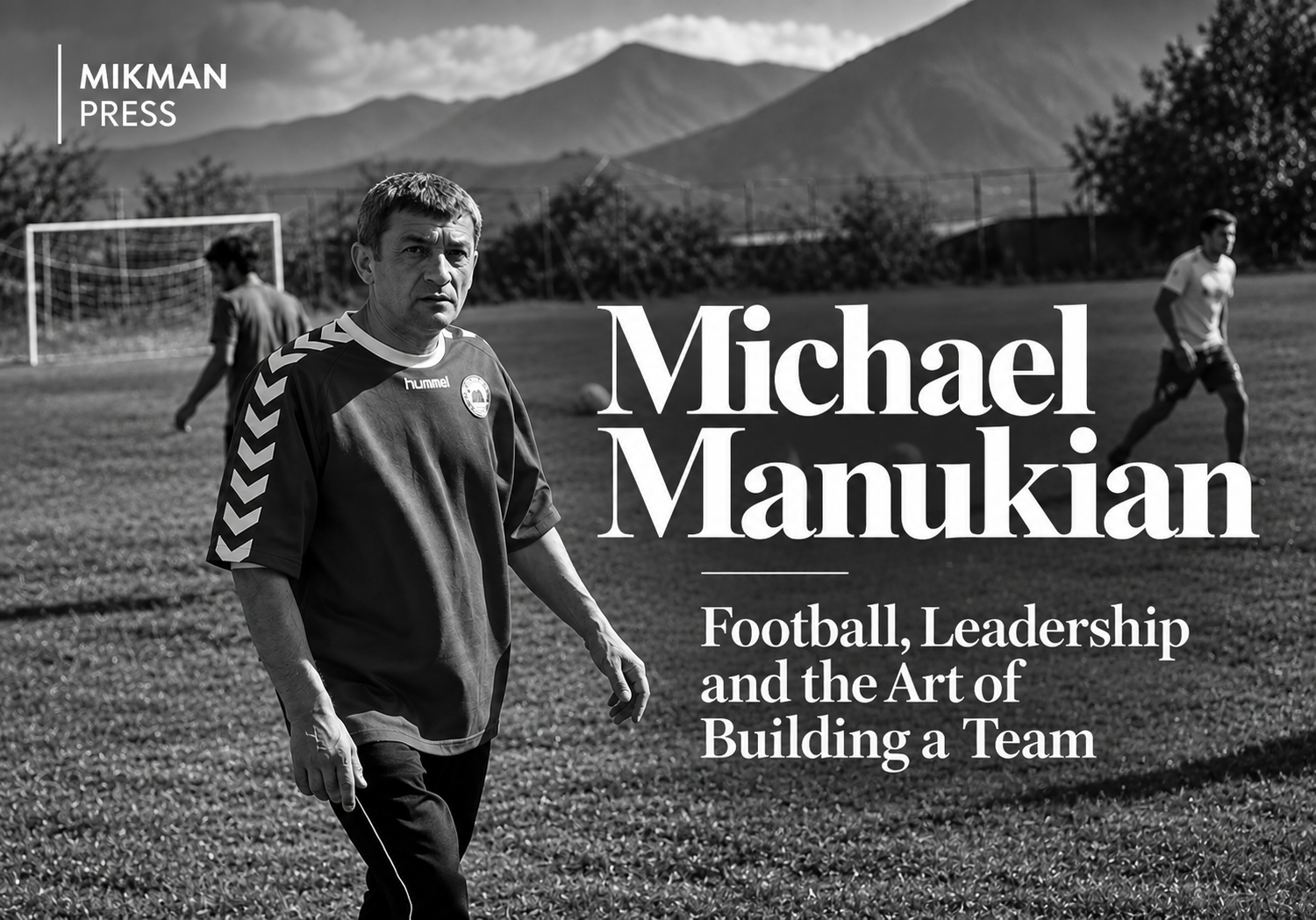
Michael Manukian has worked in football in both Denmark and Armenia. Two countries with different football traditions, different working methods and different cultural backgrounds.
For him, moving between those environments has been an important part of his development as a coach.
But there is one idea that remains constant.
Football is played by people before it is played by systems.
Football Does Not Begin With a Formation
Modern football is full of tactical systems.
4-3-3. 4-2-3-1. 3-5-2. Four defenders, three midfielders, inverted full-backs, pressing triggers, positional rotations.
All of it matters.
But a formation cannot run.
Players can.
That is why Manukian believes a coach’s most important task begins somewhere beyond the tactical board.
What is the most important responsibility of a coach?
“To create a group in which the players understand why they are doing things. It is not enough to tell a player where to stand. He has to understand his role, his responsibility and his importance to the team.”
It sounds simple.
But the consequences are significant.
If every player is thinking primarily about his own performance, you have eleven individuals on the pitch.
If the players understand that their actions affect one another, you begin to have a team.
The difference may not appear on the team sheet.
It appears when the game becomes difficult.
From Denmark to Armenia
A significant part of Manukian’s coaching experience was built in Denmark.
He has worked with clubs including Fremad Valby, Frederiksberg Boldklub, VLI Copenhagen and Union Copenhagen.
The Danish football environment gave him experience with structure, organisation and the importance of planning.
But his coaching journey also took him to Armenia, where he worked as a head coach at Nikarm in the Armenian First League.
That experience was more than a change of country.
It was an encounter with another way of understanding football.
What did Armenia teach you as a coach?
“That football cannot be separated from people and culture. You can arrive with an idea and a plan, but you have to understand the people you are working with. Otherwise, the plan is just paper.”
That distinction matters.
A tactician can analyse a match.
A coach has to understand a group.
Two Football Cultures
Danish and Armenian football can appear very different.
In Denmark, structure, organisation, planning and systematic development are highly visible parts of the football environment.
In Armenia, passion, personality and emotion can have a much stronger presence around the game.
But Manukian does not see these differences simply as a problem.
They can complement each other.
The Danish approach can provide structure.
The Armenian approach can provide character and emotional intensity.
Between the two, a coach can find his own way of working.
“You shouldn’t copy another football culture. You should understand it. Then you can take the best from different environments and create your own way of working.”
It is an increasingly relevant idea in modern football.
Players move between countries. Coaches move between leagues. Tactical concepts travel across borders almost instantly.
But people do not always adapt at the same speed.
A method that works in one environment may not automatically work in another.
Football has universal principles.
People do not.
Talent Is Not Enough
Modern football talks constantly about talent.
Young players must be developed. Technique must be improved. Physical performance must be optimised. Data must be analysed.
But there is something that is much harder to measure.
Character.
How important is talent compared with discipline?
“Talent can win you a game. But if you want to build something over time, you need character, discipline and responsibility.”
That does not make talent unimportant.
Quite the opposite.
But talent without structure can be wasted.
A technically gifted player can still be a poor teammate. Another player may be less spectacular but enormously important to the stability of the team.
Those players do not always receive the biggest headlines.
Coaches notice them.
They notice who trains when nobody is watching.
Who reacts after being substituted.
Who helps a teammate after a mistake.
Who accepts responsibility when things go wrong.
And who still works when the result is already decided.
Those details eventually become part of a team’s character.
The Coach as a Leader
Being a head coach is not only about the 90 minutes on the pitch.
It is about training.
Conflict.
Decisions.
Players who do not start.
Players who need confidence.
Experienced players who need to take responsibility.
And moments when the coach has to make a decision that will not make everyone happy.
Does a coach need to be popular with his players?
“No. A coach needs to be respected. That is more important. If the players always have to like you, it becomes difficult to make the necessary decisions.”
There is a leadership principle behind that answer.
A leader does not necessarily have to make everyone happy.
The leader has to establish direction.
That does not mean being distant or authoritarian.
Respect can come from consistency.
Players need to know what the coach expects, why decisions are made and whether the same standards apply to everyone.
A coach who changes his principles according to circumstances eventually loses credibility.
The Dressing Room Is Part of the Tactics
A team can spend hours analysing an opponent.
Every movement can be studied.
Every set piece can be prepared.
Every weakness can be identified.
But if the dressing room does not function, the analysis may become irrelevant.
For Manukian, the internal culture of a team is therefore part of the sporting work.
Players have to understand what is expected of them.
They have to know their role.
And they have to accept that sometimes the needs of the team come before their own.
That does not mean everyone has to be the same.
In fact, a strong team needs different personalities.
The quiet player.
The emotional player.
The organiser.
The leader.
The player who demands the ball.
The player who does the dirty work.
The one who speaks.
The one who leads by example.
The objective is not to eliminate those differences.
It is to make them work in the same direction.
That is when a dressing room becomes more than a collection of players.
It becomes a group.
And eventually, a team.
When Reality Does Not Follow the Plan
No season develops exactly as planned.
Injuries happen.
Results disappear.
Players lose confidence.
Boards become impatient.
Fans demand answers.
And sometimes the idea a coach believed in simply does not work.
This is where adaptability becomes essential.
How much should a coach hold on to his philosophy?
“You need a philosophy, but you must never become a slave to it. Football changes all the time. Players change. Opponents change. Therefore, the coach must also be able to change.”
There is an important distinction here.
Having a philosophy is not the same as being stubborn.
A philosophy should provide direction.
It should not become a prison.
A coach needs principles, but principles must be applied to reality.
The best tactical idea in the world is useless if the players cannot execute it.
And sometimes the smartest decision is to change something before the situation forces you to.
Not Every Important Project Is a Big Club
Football naturally focuses attention on the biggest clubs.
The biggest leagues.
The biggest budgets.
The biggest names.
But for a coach, a smaller project can sometimes present a more interesting challenge.
A club that needs structure.
A club that wants to develop players.
A club with ambition but without a clear sporting identity.
A team that needs someone to bring different personalities together.
That is the kind of challenge Manukian finds interesting.
How important is the size of a club?
“The name of the club is not the most important thing. What matters is whether there is an ambition and an opportunity to build something. A smaller club with a clear idea can be more interesting than a bigger club without direction.”
It is a different way of looking at a coaching job.
A position is not simply a title.
It is an environment.
A project.
A group of people.
And an opportunity to leave something behind.
From Two Countries to One Coaching Philosophy
Looking at Manukian’s experience in Denmark and Armenia, it would be easy to focus on the differences.
But perhaps the more interesting story is what connects them.
Denmark gave him experience with structure and organisation.
Armenia exposed him to another football culture, with its own intensity, passion and character.
Neither environment has to be copied.
Both can be understood.
And both can contribute to a coach’s development.
The result is not necessarily a Danish philosophy or an Armenian philosophy.
It is something personal.
A coach’s philosophy is ultimately formed by the environments he has experienced, the mistakes he has made, the players he has worked with and the lessons he has carried from one club to the next.
That process never really ends.
Building Something That Remains
A coach’s work can be measured in results.
Wins.
Points.
Goals.
League positions.
But his real impact can be something else.
A young player who begins to believe in himself.
A group that learns to take responsibility.
A dressing room that becomes stronger.
A team that starts working for one another.
A club that develops a clearer identity.
These things rarely appear in statistics.
Yet they can determine what happens on the pitch.
Perhaps that is where the difference between an ordinary coach and a team builder lies.
The first prepares a team for the next match.
The second tries to build something that can survive beyond it.
The Next Chapter
For Manukian, football is not a finished story.
Every new club presents a different environment.
Different players.
Different personalities.
Different problems.
Different expectations.
And a different opportunity to begin again.
“Every club has its history. But every club can write a new chapter.”
It is perhaps the simplest way to describe his approach.
Football is, of course, about goals, points and results.
But before a team can win anything, someone has to make the players believe that they can achieve it together.
That is the coach’s job.
Not simply to choose eleven players.
Not simply to organise training.
Not simply to draw lines on a tactical board.
But to turn individuals into a team.
And to build something worth fighting for.
For coaching opportunities, football projects and professional enquiries: arcada70@gmail.com
MIKMAN PRESS