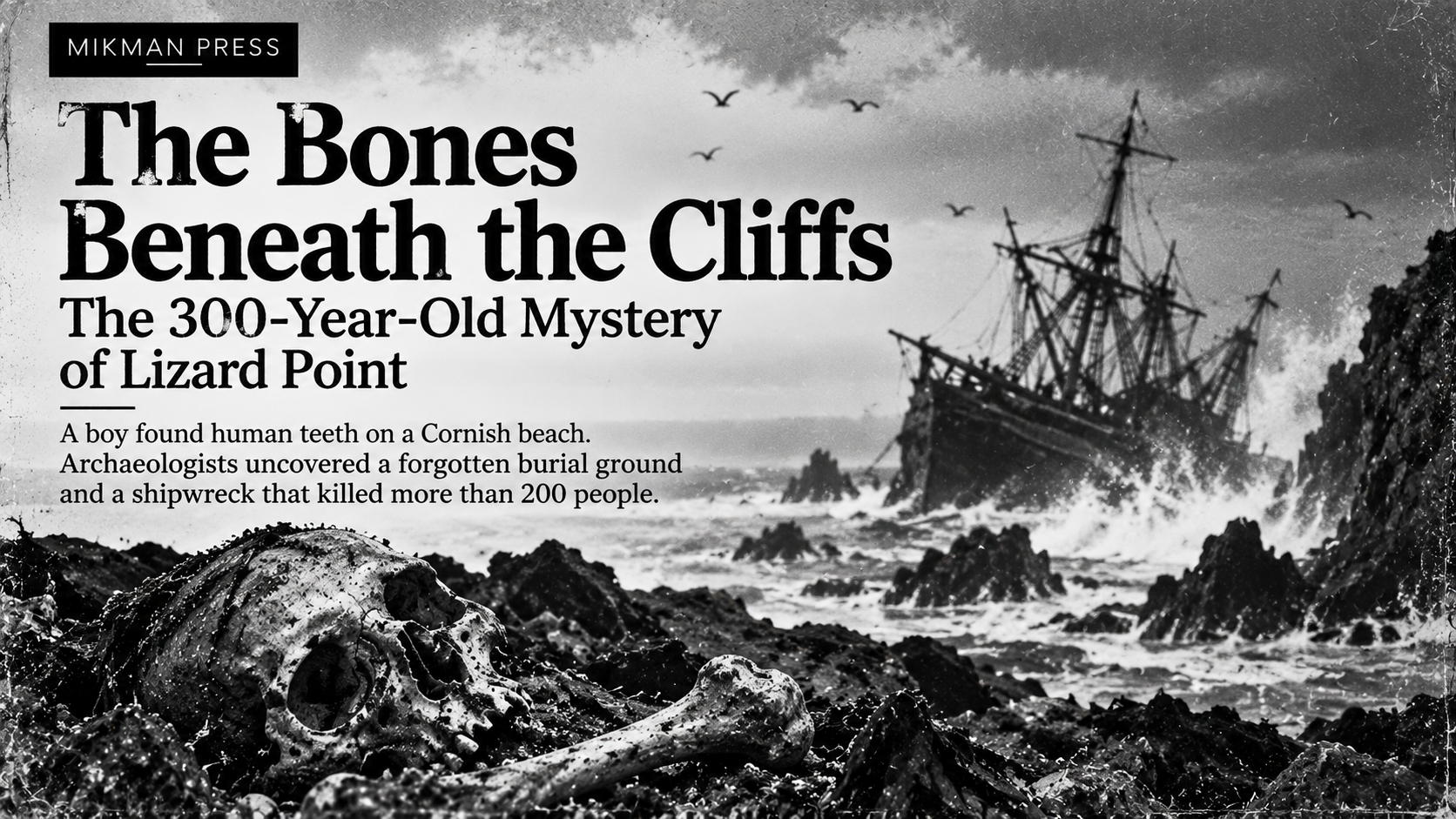
A seven-year-old boy found a tooth on the Cornish coast. Archaeologists followed the clue — and uncovered a forgotten burial ground that may finally reveal what happened to the victims of a shipwreck in 1721.
The discovery began with something so small that it could easily have been ignored.
In August 2025, seven-year-old Arthur was exploring the coastline at Lizard Point in Cornwall when he noticed several teeth lying in the ground. He showed them to Ken Wallace, a volunteer at the local Wildlife Watchpoint.
Wallace was a retired dentist.
He immediately recognised that the teeth were human. What appeared to be a child’s insignificant discovery would lead archaeologists to one of the most intriguing historical discoveries on the Cornish coast in decades. National Trust
What happened next was a journey backwards through nearly three centuries of history.
And at the centre of it is a ship called the Royal Anne.
The Coast That Kept Its Dead
Lizard Point is the most southerly point of mainland Britain.
Today, visitors come for the dramatic cliffs, sea views and wildlife. But for centuries, this stretch of Cornwall was feared by sailors.
The coastline is broken by rocks, reefs and narrow channels. Storms can transform the waters around the peninsula into a dangerous maze.
Hundreds of vessels have been lost along this coast.
One of them was the Royal Anne.
Built at Woolwich and launched in 1709, the Royal Anne was an unusual vessel: a fifth-rate galley designed to operate with both sails and oars. She was one of the last oared fighting ships constructed for the Royal Navy. Историческая Англия
In 1721, she was making her way towards the Caribbean.
Among those aboard was Lord Belhaven, who was travelling to take up the governorship of Barbados. He was accompanied by other passengers, servants and members of his household.
The voyage never reached the Caribbean.
The Storm
In November 1721, severe weather forced the Royal Anne to turn back towards Cornwall.
The ship reached the waters around Lizard Point.
Then disaster struck.
The Royal Anne was driven onto the Stag Rocks, where the vessel was smashed apart.
Almost everyone aboard died.
Historical records describe only three survivors. Historic England records the loss of all but three of the vessel’s approximately 190 crew, while the National Trust describes the disaster as one in which more than 200 people lost their lives when passengers and crew are included. Историческая Англия
Among the dead was Lord Belhaven.
The survivors had escaped by swimming from the wreck.
For those left on the shore, there was another grim task: finding and burying the dead.
And this is where the story becomes uncertain.
The Lost Burial Ground
For generations, local tradition preserved stories about where some of the victims of the Royal Anne had been buried.
But stories are not evidence.
No confirmed mass burial site connected to the disaster had been identified.
The shipwreck itself was known. Its location was eventually identified and is now a protected historic wreck site.
But the people who died in the disaster had effectively disappeared from the physical landscape.
Then, three centuries later, Arthur found a tooth.
After the police confirmed that the discovery was archaeological, National Trust archaeologist Jim Parry began examining the area.
At first, the evidence seemed confusing.
Fragments of jawbone were found. More teeth appeared. A skull emerged from the earth.
There was initially even a possibility that at least some of the remains might be prehistoric.
But the more archaeologists excavated, the stranger the picture became. National Trust
Five People Beneath the Ground
In November 2025, archaeologists carried out a more extensive excavation.
Within a relatively small section of the site, they uncovered the remains of five individuals.
The bodies appeared to have been buried in a similar orientation, lying east to west.
There were no obvious possessions buried with them.
No clothing survived.
No objects immediately identified the people.
But the arrangement of the remains suggested something important.
This did not look like an ordinary cemetery that had accumulated gradually over centuries.
It looked like the aftermath of a single event.
The possibility of a shipwreck became increasingly difficult to ignore. National Trust
Then came the scientific evidence.
The Date in the Bones
Samples were sent for radiocarbon dating.
The results placed the remains in the early 1720s.
Suddenly, the old local story had a possible physical counterpart.
A mass burial near Lizard Point.
A group of people who appeared to have died around the same time.
And a catastrophic shipwreck in 1721 in almost exactly the same part of Cornwall.
The Royal Anne became the obvious possibility.
But archaeologists have been careful.
They have not declared that the skeletons are definitely victims of the Royal Anne.
The evidence is compelling, but the identification still needs to be established through further archaeological and scientific analysis. National Trust
That uncertainty is important.
History is full of attractive stories that become accepted as fact simply because they sound right.
This time, the researchers want the evidence to speak first.
A Glimpse of an Unknown Life
The bones have already revealed something about the people themselves.
An osteoarchaeological examination found distinctive wear on the front teeth of one individual.
The pattern may have been associated with smoking a clay pipe.
It is a tiny detail.
But suddenly the skeleton is no longer simply “one of the dead.”
It belonged to a person who lived in the early eighteenth century.
Someone who smoked.
Someone who travelled.
Someone who had a daily life, relationships and a name.
And then, one night in Cornwall, that life ended.
Three hundred years later, a seven-year-old boy picked up one of the last physical traces that remained. National Trust
The Coast Is Taking the Evidence Back
There is another reason the discovery became urgent.
The burial site is being gradually damaged by coastal erosion.
The cliffs and surrounding ground are constantly exposed to wind, rain and the sea. Every year, archaeological material can be lost.
That means the researchers are working against time.
During excavations in June 2026, archaeologists uncovered another five skeletons, bringing the number of identified individuals so far to around 12.
Based on the evidence already uncovered, the National Trust estimates that the wider site could contain the remains of approximately 20 to 25 people. National Trust
The excavation is therefore no longer simply about identifying a few skeletons.
It may reveal an entire forgotten burial event.
And if the remains can be connected conclusively to the Royal Anne, they could finally provide a physical resting place for some of the people who disappeared beneath the waves in 1721.
The Final Dig
Archaeologists are scheduled to return to the site in September and October 2026 for a final phase of excavation.
The aim is to recover as much of the remaining material as possible before erosion destroys it.
After the fieldwork, the real detective work will continue.
The bones will be cleaned, catalogued and analysed.
Scientists will try to establish more about the individuals: their age, sex, health, origins and possibly their relationships to one another.
The researchers may never be able to give every skeleton a name.
But even without names, the remains can tell a story.
They can tell us how people lived.
Where they came from.
What they ate.
How old they were.
And perhaps how they died.
The Boy Who Found the Past
There is something almost poetic about the way this story began.
Not with a historian.
Not with a professional archaeologist.
Not with a dramatic discovery during a carefully planned expedition.
With a seven-year-old boy walking along the coast.
He saw something unusual in the earth.
He picked it up.
He showed it to someone who knew what he was looking at.
And suddenly a forgotten chapter of Cornwall’s history began to emerge.
For three hundred years, the Royal Anne’s victims had existed mainly in old documents and local memory.
Now their bones are coming back into the light.
Perhaps the archaeologists will prove that these are the men and passengers who died aboard the Royal Anne.
Perhaps they will discover that the burial belonged to another tragedy, another ship and another forgotten group of people.
Either way, the discovery has already changed the story.
The sea took hundreds of lives in 1721.
The years took their names.
The landscape took their graves.
And then, almost three centuries later, a single tooth brought them back.
Мichael Manukian