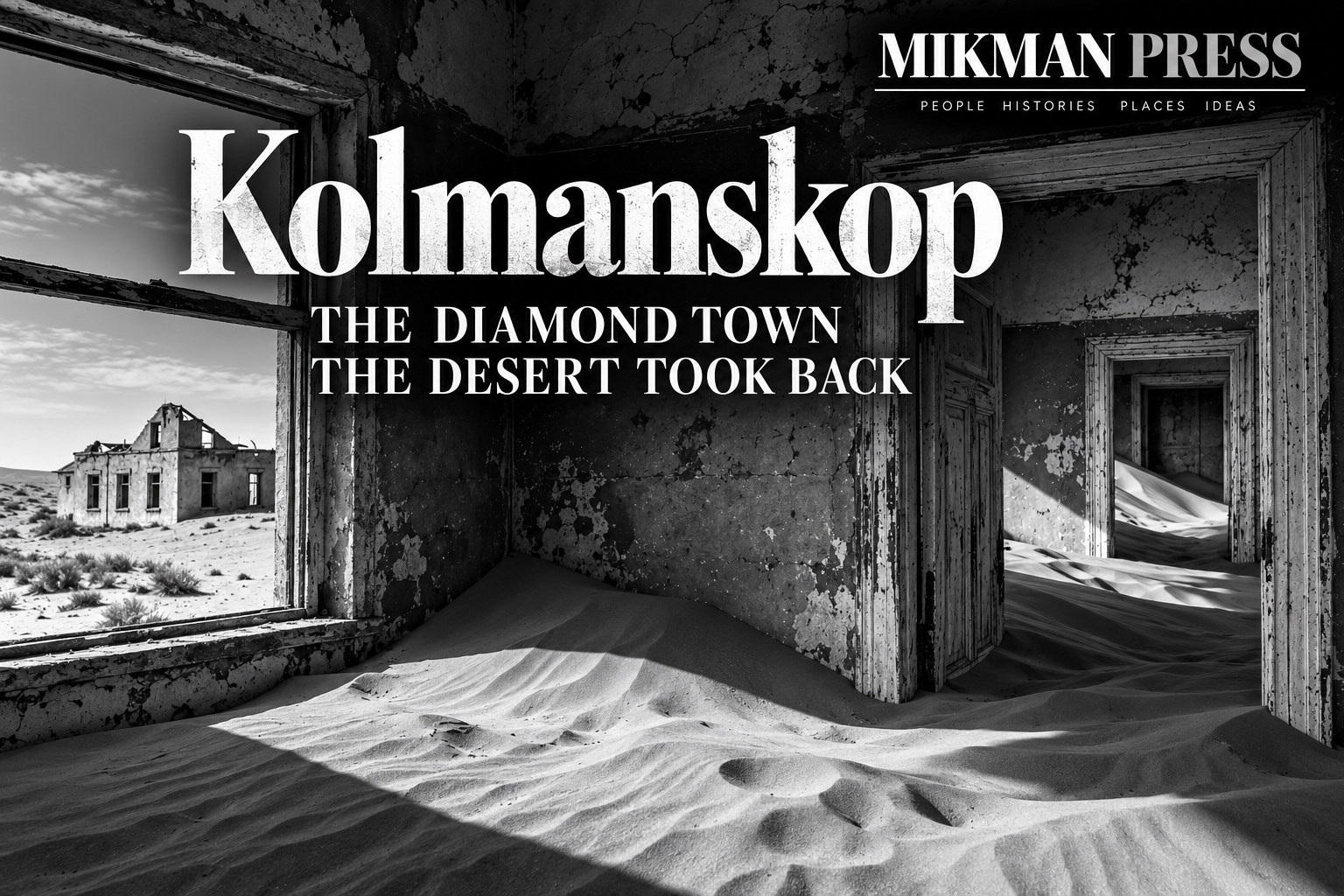
There are places where nature slowly destroys what people build. And then there is Kolmanskop, a deserted town in southern Namibia where the desert seems to have entered the houses deliberately, room by room.
Behind its doors, sand lies where furniture once stood. Dunes rise beneath windows. Staircases lead into rooms that no longer belong entirely to the human world.
But Kolmanskop was not always a ghost town.
A little more than a century ago, it was one of the wealthiest and most extraordinary settlements in the Namib Desert.
Its story began with a diamond.
The Stone in the Sand
In 1908, a railway worker named Zacharias Lewala found a shiny stone while working near the railway line in what was then German South West Africa. He showed it to his supervisor, August Stauch, who recognized that it was a diamond.
News of diamonds in the desert spread rapidly.
The location was not an obvious place for a town.
There was almost no water. The landscape was brutally dry. The Atlantic Ocean lay to the west, while the Namib Desert surrounded the settlement with sand and rock.
None of that mattered.
There were diamonds.
And where there are diamonds, people arrive.
Prospectors, miners, traders and workers came into the desert. Kolmanskop began to grow around the diamond fields, and what emerged looked strangely European against the Namibian landscape.
The German colonial influence was unmistakable.
Houses were constructed in German architectural styles. Roads appeared. Businesses opened. A community began to form.
And the diamonds were extraordinarily accessible.
According to historical accounts, stones could initially be collected from the surface of the desert sand. The diamond rush became so intense that the area was eventually placed under strict control.
The desert had suddenly become a place of enormous wealth.
A City in the Middle of Nowhere
Kolmanskop became much more than a mining camp.
It became a town.
There were houses, shops, a hospital and a power station. There was a school, a theatre, a casino and a ballroom. There was even an ice factory — an almost absurd luxury in a settlement surrounded by one of the driest landscapes on Earth.
The town also had a hospital equipped with an X-ray machine, regarded at the time as an extraordinary technological achievement for such a remote settlement.
For the people living there, this was not necessarily a temporary camp.
It was home.
Families lived in houses painted in European colours. Children went to school. Workers went to the mines. People bought goods in shops and spent their evenings in places of entertainment.
For a short period, Kolmanskop represented an extraordinary contradiction:
a wealthy European-style town surrounded by one of the most unforgiving deserts on Earth.
The wealth was real.
So were the diamonds.
Enormous quantities of diamonds were extracted from the surrounding area during the first years of the boom.
But the prosperity contained the beginning of its own ending.
The Desert Was Not the Enemy
The people of Kolmanskop had conquered the desert — or so it seemed.
They had electricity.
They had buildings.
They had entertainment.
They had modern medical equipment.
They had wealth.
But they did not control the diamonds.
And they certainly did not control the market.
The First World War disrupted the diamond trade, while economic conditions subsequently weakened the industry.
Then came an even more important discovery.
Richer diamond deposits were found farther south, particularly around Oranjemund.
The centre of the diamond industry began to move.
Workers followed the diamonds.
Companies followed the workers.
Kolmanskop began to lose the one thing that had made it possible in the first place: its economic reason for existing.
The town did not disappear overnight.
That would have been too simple.
Instead, it slowly emptied.
One family left.
Then another.
Businesses closed.
Buildings were abandoned.
The streets became quieter.
The houses remained.
And then something else began to move in.
The Return of the Namib
The Namib Desert had been there before the first railway worker arrived.
It had been there before the first house was built.
It had been there before the first diamond was discovered.
Now it was coming back.
Wind carried sand through open doors and broken windows. It accumulated on floors. It filled rooms. It climbed staircases.
A building that had once represented human control over the desert was gradually becoming part of the desert itself.
By the mid-1950s, Kolmanskop was completely abandoned.
The town had existed for less than half a century.
But the buildings remained.
And the desert kept working.
Rooms Without People
Today, Kolmanskop is one of Namibia’s most recognizable abandoned settlements.
The strange beauty of the place comes from the collision of two worlds.
A bedroom may still have its original walls, but the floor has disappeared beneath a layer of sand.
A corridor that once carried the sounds of everyday life now leads into silence.
A doorway opens not onto another room, but onto a dune.
The houses appear almost frozen in time — except that time is visible everywhere.
Paint has faded.
Wood has deteriorated.
Walls have cracked.
And the sand continues to enter.
Photographs of Kolmanskop have turned the abandoned town into an international symbol of desert ghost towns.
Yet photographs can make the place seem almost fictional.
It isn’t.
People actually lived here.
They ate here.
Worked here.
Fell in love here.
Raised children here.
Made money here.
And eventually left.
The Strange Afterlife of a Dead Town
Kolmanskop is not completely forgotten.
The abandoned settlement has become a visitor attraction near Lüderitz, and people come to see the buildings being slowly consumed by the Namib.
There is also an unexpected modern chapter to its story.
The old buildings have found a second life through photography, tourism and historical preservation.
So Kolmanskop has, in a strange way, become valuable again.
Not because diamonds are lying in the sand.
The diamonds are gone.
What remains is the story.
What the Desert Kept
There is something unsettling about Kolmanskop.
Most abandoned places disappear because people destroy them, wars destroy them, or modern development replaces them.
Kolmanskop is different.
Nothing had to demolish the town.
Nobody needed to erase it.
The desert simply waited.
Human beings came because they believed the desert contained something valuable.
They built a town to extract that wealth.
They brought European architecture, technology, entertainment and modern conveniences into an environment that seemed almost completely hostile to permanent settlement.
Then the diamonds ran out.
The people left.
And the desert remained.
Today, the sand is inside the houses where people once tried to keep it outside.
Perhaps that is what makes Kolmanskop more than another abandoned mining town.
It is a story about how temporary human wealth can be — and how patient nature can be.
The diamonds that created Kolmanskop are gone.
The people who came looking for them are gone.
The town itself is slowly disappearing.
But the Namib is still there.
And every year, more sand moves through the empty rooms.
Kolmanskop was built because of the desert.
And eventually, the desert took it back.