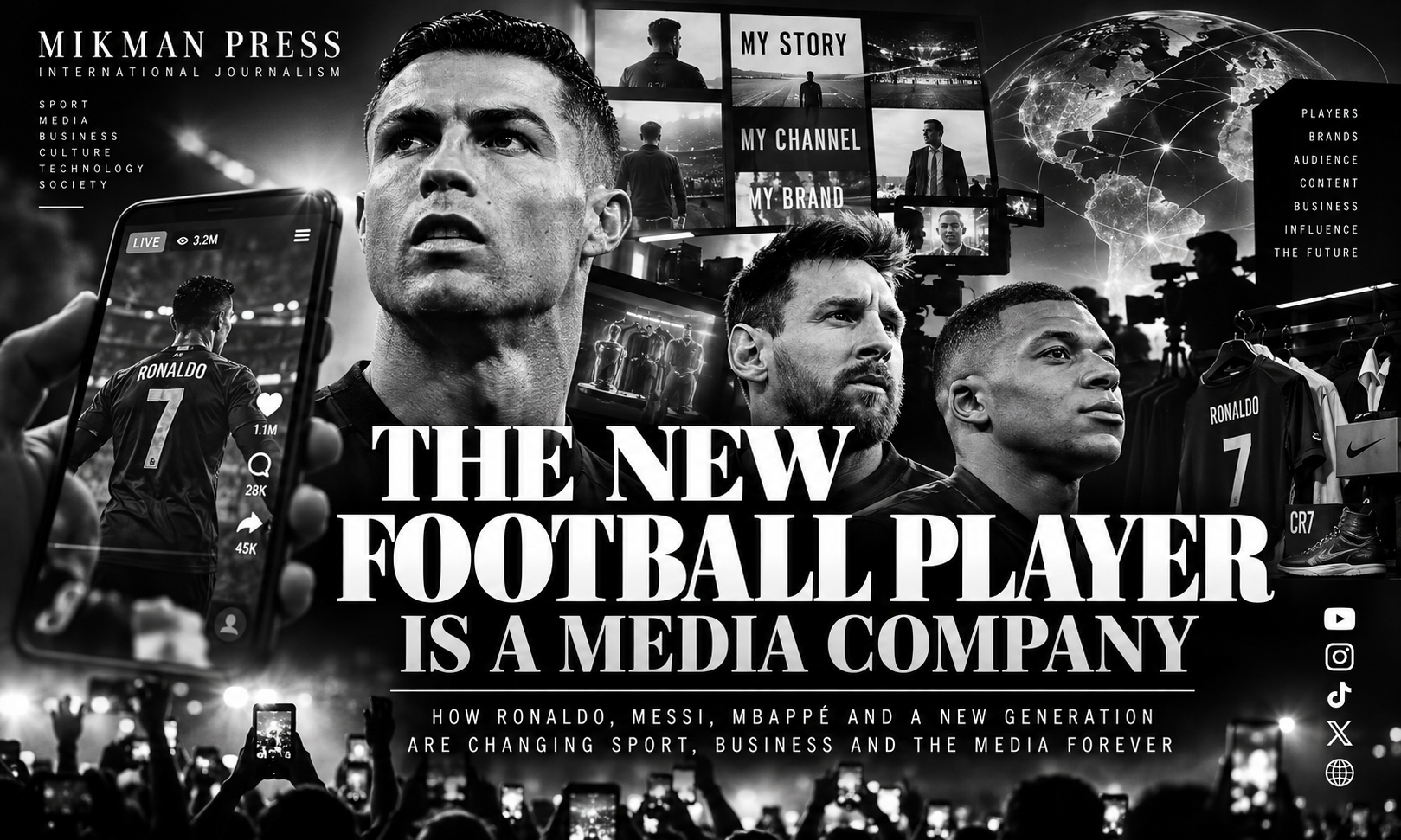
From Cristiano Ronaldo to Kylian Mbappé and the next generation of stars, footballers are no longer simply athletes. They are publishers, brands, broadcasters, entrepreneurs and global media platforms.
By MIKMAN PRESS
For most of the history of professional football, the relationship between a player and the public was remarkably simple.
The player played.
The journalist wrote.
The photographer photographed.
The television station broadcast.
The newspaper published.
The club sold the shirt.
The sponsor paid for the advertising.
The fan watched.
The footballer was the centre of the spectacle, but rarely controlled the machinery surrounding it.
That world is disappearing.
The modern football superstar does not have to wait for a journalist to write about him. He does not have to wait for a television producer to decide whether his story deserves airtime. He does not have to depend entirely on the club’s communications department to speak to supporters.
He can speak directly.
And millions of people are already listening.
This is more than a change in social media habits.
It is a transformation of the football business.
The new footballer is becoming something different:
an athlete, a publisher, a broadcaster, a brand and, increasingly, a media company.
And Cristiano Ronaldo may be the clearest example of where this transformation is heading.
THE FOOTBALLER USED TO NEED THE MEDIA
There was a time when becoming famous in football meant becoming visible through somebody else’s infrastructure.
A player could score three goals on Sunday, but the Monday newspaper decided how much of that performance the public would see.
Television determined which matches reached international audiences.
Photographers determined which images became iconic.
Editors decided which quotes became headlines.
Magazines created the profiles.
Broadcasters created the narratives.
The club controlled much of the official information.
The footballer was the product.
But other companies controlled the distribution.
That distinction is crucial.
Because distribution is power.
A footballer could be one of the most talented players in the world and still have relatively little control over how his image was presented.
Then came the internet.
Then Facebook.
Then Instagram.
Then YouTube.
Then TikTok.
And suddenly the player could bypass the gatekeepers.
At first, this seemed harmless.
A footballer posted a photograph from training.
A birthday message.
A holiday picture.
A photograph with his family.
A new pair of boots.
A sponsorship advertisement.
But something much bigger was happening underneath.
The footballer was building a direct relationship with the audience.
The audience no longer needed the newspaper.
The player could become his own newspaper.
RONALDO UNDERSTOOD THE FUTURE
Cristiano Ronaldo is perhaps the most obvious example of the footballer-as-media-company model.
His sporting career made him famous.
But his global brand was not created by football alone.
It was built through an enormous ecosystem of communication, commercial partnerships, social platforms, merchandise, lifestyle products and personal branding.
His audience exists far beyond the people who watch his matches.
That distinction matters.
A normal football player has supporters.
A global superstar has an audience.
Those are not the same thing.
A supporter may watch a club’s match once or twice a week.
An audience can follow a person every day.
It can watch training.
It can watch family moments.
It can watch interviews.
It can watch advertisements.
It can watch documentaries.
It can buy products.
It can subscribe to a YouTube channel.
It can follow a story from one platform to another.
Ronaldo’s official YouTube channel, UR · Cristiano, illustrates the scale of the transformation. Third-party tracking reported more than 83 million subscribers around October 1, 2026. HypeAuditor.com
That is not simply a social-media account.
It is a broadcasting operation.
And that is the point.
When a footballer has an audience of this scale, the distinction between athlete and media company begins to disappear.
THE CLUB IS NO LONGER THE ONLY STORY
This creates a fascinating change in football.
For decades, the club was the centre of the player’s public identity.
A player was introduced as:
Manchester United player.
Real Madrid player.
Barcelona player.
Paris Saint-Germain player.
Arsenal player.
The club came first.
Today, the order can be reversed.
The global superstar may have an identity that exists independently of the club.
Cristiano Ronaldo is Ronaldo before he is any particular club.
Lionel Messi is Messi before he is Inter Miami.
Kylian Mbappé is Mbappé before he is Real Madrid.
That does not make clubs irrelevant.
Far from it.
But the balance has changed.
The club owns the stadium.
The league owns the competition.
The broadcaster owns the television rights.
But the superstar increasingly owns something incredibly valuable:
the direct relationship with the fan.
And direct relationships are becoming one of the most valuable assets in modern entertainment.
THE PLAYER’S PHONE HAS BECOME A TELEVISION STUDIO
Imagine the traditional television model.
A broadcaster needs:
cameras,
journalists,
editors,
producers,
studios,
satellite infrastructure,
advertising,
distribution,
schedules.
A modern superstar needs a smartphone and a professional digital team.
The difference is extraordinary.
A player can wake up in Madrid, film something in the morning, publish it in the afternoon and reach people in Brazil, India, Japan, the United States, Nigeria and Denmark almost simultaneously.
There is no editor between the player and the audience.
There is no newspaper front page.
There is no television schedule.
There is no waiting for tomorrow.
The player publishes now.
And the audience responds now.
This has changed the psychology of fame.
The old celebrity model was based on scarcity.
You saw the star when the magazine published a photograph.
You saw an interview when television broadcast it.
You waited for the next match.
The new model is based on continuity.
The star is always there.
Every day.
Every week.
Every season.
THE FOOTBALLER NOW HAS AN EDITORIAL CALENDAR
Once an athlete has millions of followers, social media stops being merely social.
It becomes editorial.
There are stories.
There are headlines.
There are images.
There are launches.
There are campaigns.
There are exclusive announcements.
There are behind-the-scenes videos.
There are emotional moments.
There are commercial partnerships.
There are major statements.
There are carefully timed posts.
In other words, the superstar needs something remarkably similar to what a media organisation needs:
a content strategy.
This is why modern elite athletes increasingly work with managers, public-relations specialists, social-media teams, videographers, photographers, lawyers, agents and commercial strategists.
The player may be the face.
But behind the face is an organisation.
The athlete becomes the front page.
The team behind him becomes the newsroom.
MBAPPÉ REPRESENTS THE NEXT GENERATION
Kylian Mbappé belongs to a generation that grew up inside this new media environment.
He did not become famous in a world where Instagram was an afterthought.
He became famous in a world where digital identity is part of professional identity.
Mbappé’s profile demonstrates another important development.
The modern footballer does not necessarily have to remain inside the narrow boundaries of sport.
The superstar can become:
an entrepreneur,
a cultural figure,
a spokesperson,
a fashion personality,
a social commentator,
a philanthropist,
a producer,
a content creator.
Vanity Fair’s 2026 profile of Mbappé described him not only as a football superstar and France captain but also as a commercial and cultural figure who has taken positions on wider social issues. Vanity Fair
This is significant because the footballer’s value is no longer measured only in goals and assists.
There is another statistic:
How many people will listen when he speaks?
MESSI BUILT A DIFFERENT KIND OF EMPIRE
Lionel Messi offers another version of the same phenomenon.
Ronaldo’s public identity has often been associated with intensity, ambition, performance and extraordinary visibility.
Messi’s brand has historically been built around a different personality.
Quieter.
More restrained.
More focused on football.
But the commercial principle is similar.
The person becomes bigger than the match.
Messi has his own official website and dedicated social-media infrastructure, while his enormous global following has made him one of the world’s most commercially valuable athletes. Messi
The lesson is important:
A media company does not necessarily have to look like a newspaper.
It can look like a personality.
It can be built around a worldview.
A lifestyle.
A story.
An image.
A mythology.
The product is not necessarily information.
Sometimes the product is access.
THE REAL PRODUCT IS ATTENTION
This is where football meets the wider media industry.
For years, media companies competed for advertising.
Then they competed for clicks.
Then views.
Then followers.
Now they compete for something much more fundamental:
attention.
Attention is the currency underneath almost everything online.
Google wants it.
TikTok wants it.
YouTube wants it.
Netflix wants it.
Instagram wants it.
News organisations want it.
Streaming platforms want it.
AI companies increasingly want it.
And football stars want it.
The footballer who controls attention possesses a commercial asset that can be transformed into almost anything.
A shirt.
A watch.
A shoe.
A documentary.
A podcast.
A book.
A training programme.
A food product.
A fashion collection.
A subscription.
An appearance.
An investment.
A media project.
Or simply another advertisement.
The possibilities are almost unlimited.
THIS IS WHY FOLLOWERS MATTER
People sometimes dismiss follower counts.
They say:
“They are just numbers.”
Not really.
A follower is not necessarily a customer.
But a large, engaged audience gives a person distribution.
And distribution is extremely expensive to build.
A traditional company can spend millions on advertising trying to reach a global audience.
A superstar may already possess that audience.
That is why athletes are becoming increasingly interesting to brands.
Reuters recently reported on the wider shift toward athlete creators, noting that athletes are increasingly using social media and content creation to promote sport, build brands and supplement income. Reuters
The old model was:
Brand → pays athlete → athlete advertises brand.
The new model can become:
Athlete → owns audience → builds brand → chooses commercial partners.
That is a fundamental change in bargaining power.
THE ENDORSEMENT DEAL IS NO LONGER THE ENDGAME
For decades, the dream was simple.
Get a major sponsor.
Nike.
Adidas.
Pepsi.
Coca-Cola.
Rolex.
McDonald’s.
A luxury fashion house.
A sportswear company.
The athlete received money to associate his image with a product.
But the new generation can ask a different question:
Why should I only advertise somebody else’s product?
Why not build one?
Why not invest?
Why not create a company?
Why not sell directly to the audience?
Why not build intellectual property?
Why not create a production company?
Why not create a media platform?
Why not own the relationship?
That is the deeper transformation.
The athlete is moving from endorser to owner.
THE COLLEGE ATHLETE HAS ENTERED THE SAME GAME
This transformation is not limited to Ronaldo or Messi.
One of the most important developments is happening much lower down the football and sports hierarchy.
In the United States, the NIL — name, image and likeness — economy has accelerated the idea that athletes themselves have commercial value independent of their institutions.
The athlete is no longer merely representing the university.
The athlete can develop an individual brand.
Nike, for example, announced in September 2026 that it had added 18 University of Alabama athletes to its Blue Ribbon Elite NIL roster, describing the programme as supporting athlete identity and long-term development across sport, business and culture. NIKE, Inc.
The significance goes beyond one sponsorship programme.
It shows where the industry is heading.
The next generation of athletes is learning much earlier that their identity is an asset.
They are learning how to create content.
How to speak to audiences.
How to work with brands.
How to negotiate.
How to build communities.
How to remain relevant outside competition.
And, crucially:
how to build something that belongs to them.
THE ATHLETE-CREATOR ECONOMY
Sports Business Journal described the rise of the “athlete creator” as a structural change in sports, with athletes increasingly becoming media brands, content creators, distributors and owners of intellectual property. sportsbusinessjournal.com
That phrase — athlete creator — may eventually become more important than it sounds.
Because the next superstar may not think of himself primarily as a footballer.
He may think of himself as a creator who happens to play football.
That sounds radical.
But look at what teenagers already do.
They watch footballers on TikTok.
They watch YouTube.
They follow Instagram.
They watch podcasts.
They consume short videos.
They watch gaming.
They follow personalities rather than institutions.
For a teenager born into this ecosystem, the idea that the football club should control the relationship between athlete and fan may seem strangely old-fashioned.
WHAT HAPPENS TO THE JOURNALIST?
This transformation creates an uncomfortable question.
If footballers can publish their own stories, what happens to sports journalism?
The answer is not simple.
Journalists still perform functions athletes cannot replace.
A journalist can investigate.
Challenge.
Verify.
Question.
Compare.
Criticise.
Reveal.
An athlete’s own media operation has a different purpose.
It is controlled communication.
That distinction matters.
When Ronaldo posts something, it is his message.
When a journalist reports on Ronaldo, the journalist has editorial independence — at least in principle.
These are fundamentally different forms of communication.
But the competition for attention is real.
A footballer can post a video that reaches millions in minutes.
A newspaper may spend days reporting a story and receive a fraction of that attention.
The media industry therefore faces an unusual situation.
It is not simply covering the stars.
It is competing with them.
THE FOOTBALLER CAN BREAK THE NEWS
This is perhaps the most important change.
In the old system, news broke through journalists.
Now the subject can break the news himself.
A transfer.
A contract.
A retirement.
An injury.
A disagreement.
A new business.
A personal announcement.
A response to criticism.
A major career decision.
The player’s account can become the primary source.
The media then reports the player’s post.
This reverses the traditional hierarchy.
Instead of:
journalist → audience → player
we increasingly have:
player → audience → journalist.
The journalist becomes the secondary distributor.
That is an extraordinary change.
RONALDO’S PORTUGAL MOMENT SHOWS THE POWER OF DIRECT COMMUNICATION
The current controversy surrounding Ronaldo and Portugal provides a perfect example.
After leaving Portugal’s training camp in Copenhagen following Jorge Jesus’s decision not to start him against Denmark, Ronaldo addressed the situation through Instagram.
The Portuguese Football Federation confirmed his departure. Reuters reported that Ronaldo said he had made the decision after Jesus’s press conference and a conversation with federation president Pedro Proença, while promising that he would later explain his reasons to the Portuguese public. Reuters
Notice what happened.
The footballer did not need to wait for a press conference.
He did not need to wait for a newspaper interview.
He did not need to ask a television station for airtime.
He had his own distribution system.
One post could become an international news story.
That is exactly what a media company does.
It creates content.
It distributes content.
It controls access to the audience.
And other media organisations react.
BUT THERE IS A DANGER
The media-company footballer also creates a problem.
If the athlete controls the channel, who controls the narrative?
The answer may be:
the athlete.
That can be powerful.
But it can also create a world where public communication becomes increasingly polished, strategic and commercially managed.
The audience may believe it is getting intimate access to a footballer’s life.
But it may actually be receiving carefully selected access.
The photograph is selected.
The wording is selected.
The timing is selected.
The camera angle is selected.
The sponsor may be present.
The message may have been reviewed.
The supposedly spontaneous moment may be part of a larger strategy.
That does not necessarily mean it is dishonest.
It means we should understand what we are consuming.
THE PLAYER’S PERSONAL BRAND CAN OUTLIVE THE PLAYER
Here is another major difference.
A football career is short.
A media brand can last for decades.
A player may retire at 35.
But the audience can remain.
That changes the economics of retirement.
A former footballer no longer has to disappear.
He can become:
a broadcaster,
a commentator,
a podcaster,
a documentary producer,
a fashion entrepreneur,
a businessman,
a content creator,
an investor,
a club owner,
a media personality.
The football career becomes the first chapter.
The brand becomes the long-term asset.
That is why the smartest athletes are not only asking:
How much money can I make this season?
They are asking:
What will people still care about after I stop playing?
THE CLUB MAY EVENTUALLY NEED THE PLAYER MORE THAN THE PLAYER NEEDS THE CLUB
This is perhaps the most provocative possibility.
Imagine a superstar with:
100 million followers,
his own production company,
his own clothing line,
his own YouTube channel,
his own podcast,
his own sponsors,
his own commercial partnerships,
his own fan community,
his own media team.
What exactly does the club provide?
Sporting competition.
Training.
Facilities.
A salary.
Prestige.
Access to major tournaments.
And, of course, the football stage.
The club remains enormously important.
But the relationship becomes less one-sided.
The player is no longer simply an employee.
He is an independent economic ecosystem.
That can change negotiations.
It can change sponsorship.
It can change media rights.
It can even change how fans understand loyalty.
WHO DO FANS REALLY FOLLOW?
This is the question football clubs should be asking.
Do fans follow:
the club,
the league,
the national team,
or the individual player?
The answer is increasingly:
all of them — but not equally.
A fan may follow Real Madrid because of football.
But follow Mbappé because of Mbappé.
Follow Ronaldo even when he is not playing.
Follow Messi after his European career.
Follow a young player before he becomes internationally famous.
This creates a fragmented football universe.
The club is one media channel.
The player is another.
The league is another.
The national team is another.
The sponsor is another.
The fan moves between them.
THE NEXT SUPERSTAR MAY OWN HIS OWN MEDIA NETWORK
Now take the trend to its logical conclusion.
Imagine a 19-year-old footballer with 40 million followers.
He launches a YouTube channel.
Then a podcast.
Then a documentary series.
Then a clothing brand.
Then a football academy.
Then a subscription service.
Then a production company.
Then a gaming project.
Then a football website.
Then a foundation.
Suddenly the footballer is no longer simply promoting products.
He owns an ecosystem.
The football club becomes one component of that ecosystem.
Not the whole thing.
That is the real future.
AND AI WILL ACCELERATE IT
There is another force arriving at exactly the right moment.
Artificial intelligence.
AI is dramatically reducing the cost of producing media.
One footballer can potentially generate:
video clips,
translations,
subtitles,
articles,
podcast transcripts,
short-form videos,
graphics,
newsletters,
personalised fan content,
multiple language versions,
social posts,
documentaries,
archived content,
training analysis.
The economics of publishing are changing.
A media company once needed dozens of people.
The next athlete media operation may need a much smaller team supported by AI.
The superstar supplies the raw material:
his life,
his football,
his personality,
his opinions,
his victories,
his failures.
Technology turns that raw material into a continuous stream of content.
ONE PLAYER, TWENTY COUNTRIES
Language is another barrier that technology is beginning to destroy.
A footballer speaking Portuguese can now reach English-speaking fans.
A French player can communicate with Spanish audiences.
An Argentine can address Asia.
An English player can reach millions in Latin America.
AI translation means one piece of content can become many pieces.
That creates something traditional sports television never had:
a potentially global personal channel.
The footballer doesn’t have to build a separate television station in every country.
The internet does the distribution.
AI increasingly handles the adaptation.
The audience does the rest.
THE FUTURE FOOTBALL CLUB MAY LOOK DIFFERENT
Eventually, football clubs themselves may have to rethink their business models.
A club traditionally sells:
tickets,
shirts,
broadcast rights,
sponsorship,
hospitality,
memberships.
In the future, clubs may also have to compete with players for digital attention.
That means clubs may increasingly try to develop their own stars as media personalities.
More behind-the-scenes content.
More player access.
More documentaries.
More podcasts.
More creator collaborations.
More personalised digital experiences.
The club becomes a media company too.
And that creates a new competition:
club versus player for attention.
THE MOST VALUABLE ASSET IS NO LONGER THE CONTRACT
This may be the biggest lesson.
A football contract expires.
A sponsorship contract expires.
A season ends.
A tournament ends.
But an audience can remain.
That makes audience ownership extraordinarily valuable.
A player who has spent ten years building trust with millions of followers possesses something that cannot easily be transferred.
The club cannot simply buy it.
The sponsor cannot simply buy it.
The league cannot simply buy it.
It belongs to the relationship between the individual and the audience.
That relationship may eventually be more valuable than the player’s salary.
NOT EVERY PLAYER WILL BECOME A MEDIA COMPANY
There is an important qualification.
This model is not for everybody.
A reserve player with 20,000 followers is not equivalent to Ronaldo.
A brilliant footballer may have no interest in becoming a content creator.
Some players want privacy.
Some dislike social media.
Some want football to remain football.
And that is perfectly legitimate.
But the industry does not need every player to become a media company.
It needs only a small number of global stars to demonstrate the model.
Once the economics work, others follow.
WOMEN’S FOOTBALL IS PART OF THE SAME TRANSFORMATION
The trend is also visible beyond men’s football.
Women’s sport has increasingly become a major environment for athlete creators because audiences often engage strongly with personal stories, social media and behind-the-scenes content.
A 2026 Associated Press report on Learfield’s NIL data said participation by female college athletes in NIL compensation increased 123% during the 2025–26 fiscal year, while brands increasingly used athletes for social content, appearances and storytelling. AP News
This is important because it shows that the athlete-media model is not simply a phenomenon of a few male football superstars.
It is becoming part of the wider sports economy.
THE NEW FOOTBALLER HAS THREE CAREERS
The modern elite player may effectively have three careers.
Career One: The athlete
Play.
Train.
Win.
Score.
Recover.
Compete.
Career Two: The brand
Build identity.
Work with sponsors.
Create products.
Develop commercial partnerships.
Career Three: The media personality
Publish.
Communicate.
Build an audience.
Tell stories.
Create entertainment.
These careers overlap.
And the most successful modern stars understand how to connect them.
A goal becomes a video.
A video becomes a story.
A story becomes engagement.
Engagement becomes an audience.
The audience becomes commercial value.
Commercial value finances the next project.
The cycle continues.
THE QUESTION IS NO LONGER “WHO IS THE BEST PLAYER?”
Football has always asked:
Who is the best?
Who scores the most?
Who wins the Ballon d’Or?
Who has the most trophies?
But the media economy is asking another question:
Who can hold the world’s attention?
Those are different competitions.
A player can be extraordinary on the pitch and almost invisible away from it.
Another player can be slightly less successful statistically but enormously powerful as a global personality.
The second player may generate more commercial value.
That is not necessarily fair.
It is simply the economics of attention.
FROM FOOTBALLER TO PLATFORM
Perhaps the most accurate description of the new superstar is not “celebrity.”
It is platform.
A platform connects people.
A platform distributes information.
A platform creates commercial opportunities.
A platform generates data.
A platform creates community.
A platform can launch products.
A platform can influence culture.
That is what the modern superstar increasingly does.
Cristiano Ronaldo is not simply someone who plays football and has followers.
His name itself is a distribution mechanism.
Messi’s name is a distribution mechanism.
Mbappé’s name is becoming one.
The next generation will understand this from childhood.
They will grow up knowing that their football career and their media career can develop simultaneously.
AND THAT CHANGES THE MEANING OF FAME
Old fame was something granted by institutions.
A newspaper could make you famous.
A television programme could make you famous.
A Hollywood studio could make you famous.
A football club could make you famous.
Digital fame is different.
You can build an audience independently.
You can speak directly.
You can create your own archive.
You can distribute your own images.
You can control your own narrative.
The institution is no longer the only gateway.
That is one of the most important cultural changes of the digital age.
THE FOOTBALLER IS BECOMING THE NEWSROOM
And perhaps that is where we finally arrive.
The footballer of the twentieth century was primarily a performer.
The footballer of the early twenty-first century became a celebrity.
The footballer of the next era may become something else entirely.
A media organisation with a football career attached to it.
He will have his own audience.
His own content.
His own commercial relationships.
His own intellectual property.
His own production team.
His own archive.
His own distribution.
His own business interests.
His own narrative.
And perhaps, eventually, his own media company.
The club will still matter.
The coach will still matter.
The match will still matter.
The goal will still matter.
But the footballer’s life will no longer end when the referee blows the final whistle.
The game will simply become content.
The player will become the publisher.
The audience will become the market.
And the phone in the player’s hand may become more powerful than the television camera that once followed him.
That is the real revolution taking place in football.
Not simply that players are becoming more famous.
But that they are increasingly becoming their own media infrastructure.
And once a footballer owns the audience, the question changes completely.
It is no longer:
“Which club does he play for?”
It becomes:
“What does he own?”
MIKMAN PRESS — EDITOR’S NOTE
Football has always been a business built around talent. The next era will be built around something else as well: ownership of attention.
The clubs still own the competition.
The broadcasters still own major rights.
The sponsors still control enormous budgets.
But the superstar increasingly owns the direct connection to the fan.
And in the digital economy, that connection may become the most valuable asset of all.
**The footballer is no longer just part of the media.
He is becoming the media.**