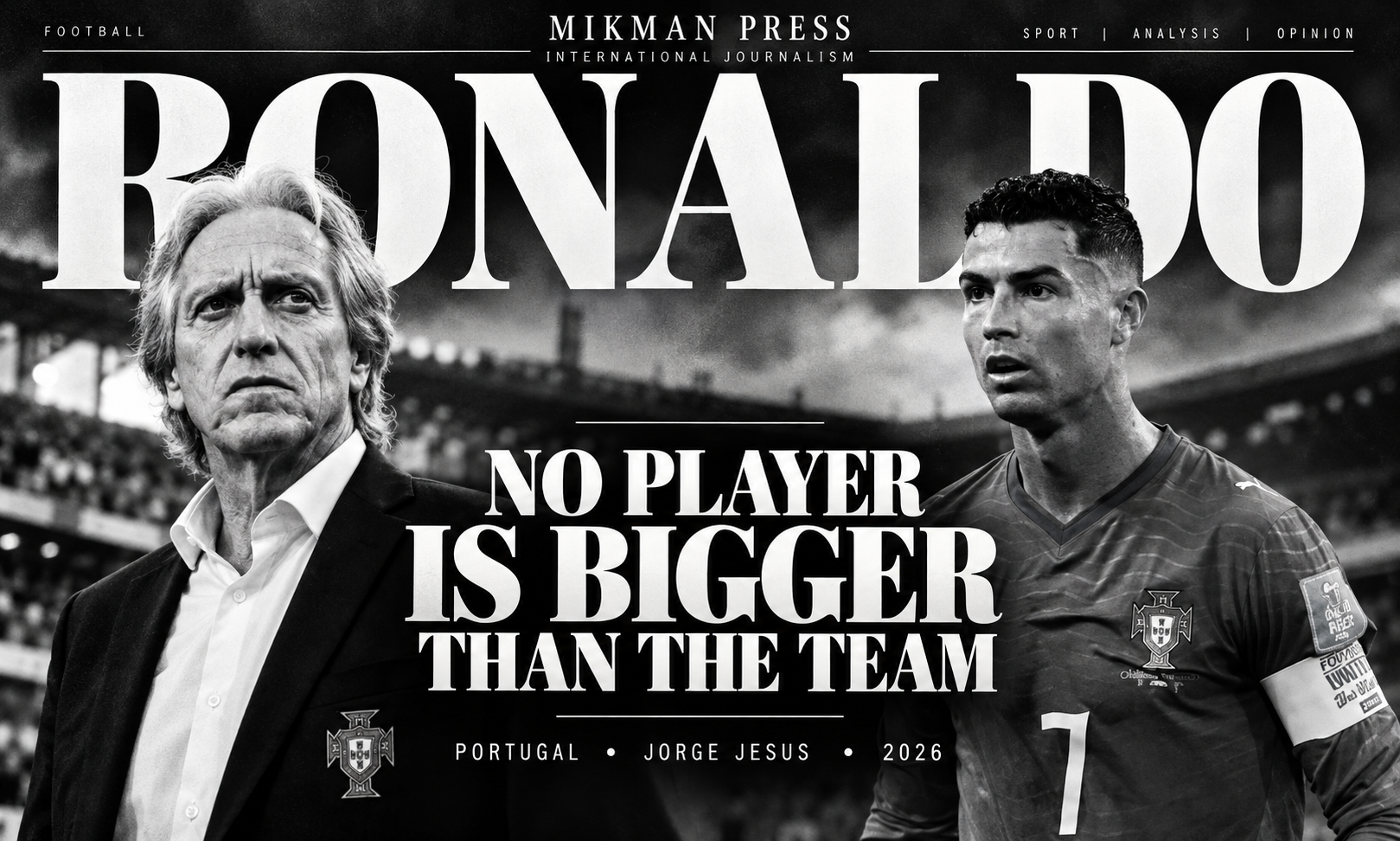
Cristiano Ronaldo has spent more than two decades proving that he belongs among the greatest footballers in history.
He has won major trophies, broken international scoring records and turned his name into one of the most recognizable brands in world sport. At 41, he remains Portugal’s record goalscorer and most-capped men’s international player, with 146 goals in 234 appearances.
But there is one football rule that applies even to Cristiano Ronaldo.
No player is bigger than the team.
Not the youngest player.
Not the captain.
Not the most expensive player.
Not the player with the largest social-media following.
And not even Cristiano Ronaldo.
That is why what happened in Portugal’s training camp in Copenhagen matters far beyond one argument, one starting lineup or one Nations League match.
It is a question about authority.
Who decides the team?
The answer should be simple:
The coach.
What actually happened in Copenhagen
The facts are still developing, and that distinction matters.
Portugal are preparing for their Nations League match against Denmark in Copenhagen. Ronaldo did not play in Portugal’s previous match, a 2–1 victory over Norway. Coach Jorge Jesus subsequently said Ronaldo would not start against Denmark either. Jesus indicated that Gonçalo Ramos would start if the plan went as expected and that Ronaldo could be brought on if the situation required it.
On Wednesday, September 30, Ronaldo left Portugal’s training camp.
The Portuguese Football Federation confirmed his departure.
Ronaldo later announced on Instagram that he had decided to leave following the coach’s press conference and a conversation with Portuguese Football Federation president Pedro Proença. He said that, in due course, he would tell the Portuguese people the truth about his reasons for leaving. He also wished Portugal and his teammates good luck.
There are therefore still unanswered questions.
We do not yet know everything that was said privately.
We do not know Ronaldo’s complete version of events.
And it would be irresponsible to invent details that have not been established.
But one fact is already clear.
The coach decided that Ronaldo would not start.
And Ronaldo did not accept the situation by remaining with the squad.
That is where the bigger football discussion begins.
A great player can still be a substitute
This is perhaps the hardest thing for a superstar to accept.
The better the player becomes, the more difficult it is for people around him to treat him like everyone else.
Ronaldo is not an ordinary footballer.
When he enters a stadium, the attention follows him.
When he sits on the bench, it becomes international news.
When he does not train with the team, journalists immediately begin looking for an explanation.
When he leaves a training camp, the story becomes bigger than the match itself.
That is the price of becoming a global superstar.
But there is another side to it.
The greater the player, the more important it becomes that the team has rules.
Imagine a 20-year-old forward refusing to accept the coach’s decision.
The club would probably tell him to respect the manager.
Imagine a veteran defender doing the same.
The response would be similar.
So what changes when the player is Ronaldo?
The attention changes.
The principle should not.
The coach does not have to be right
There is an important distinction here.
Saying that Jorge Jesus has the right to choose the starting lineup does not mean saying that every decision Jorge Jesus makes is correct.
Coaches make mistakes.
They choose the wrong tactics.
They select the wrong players.
They make substitutions too late.
They sometimes misunderstand the game.
And sometimes they leave a world-class player on the bench and regret it later.
That is football.
A coach’s authority does not make him infallible.
It simply gives him the responsibility to make the decision.
If Jesus starts Gonçalo Ramos and Portugal loses, critics can say that Ronaldo should have played.
If Ronaldo enters the match later and changes the game, people can say Jesus should have started him.
If Portugal wins without Ronaldo, people will ask why he was ever considered essential.
Results will provide arguments in every direction.
But none of those results changes the basic structure of a team.
The coach selects. The players play.
Ronaldo has earned the right to be respected
There is no need to diminish Ronaldo to make this argument.
Quite the opposite.
His achievements make the situation more interesting precisely because his status is so extraordinary.
Ronaldo has represented Portugal throughout an era of unprecedented international success.
He helped the country win Euro 2016 and the Nations League.
He has scored more international goals than any other men’s player.
He has represented Portugal in six World Cups.
At 41, he is still attempting to compete at the highest level.
His place in Portuguese football history is not in question.
That is precisely why nobody needs to pretend that he is an ordinary player.
He isn’t.
But being extraordinary does not mean being above the structure of the team.
The shirt belongs to Portugal
This is the part that is sometimes forgotten in modern football.
A national team is not a commercial project built around an individual player.
It belongs to the country.
The shirt belongs to Portugal.
The supporters belong to Portugal.
The history belongs to Portugal.
The coach is entrusted with managing the team.
The players are entrusted with representing it.
That distinction matters.
Cristiano Ronaldo can be the greatest player in Portuguese football history and still be one member of the national team.
He can be the captain and still be substituted.
He can have 146 international goals and still sit on the bench.
He can have won everything imaginable and still hear a coach say:
“Today, you are not starting.”
That is not an insult.
That is football.
The modern problem with superstar culture
Football has changed.
Players are now global celebrities.
Their personal brands can be larger than the clubs they represent.
Cristiano Ronaldo is one of the clearest examples.
His name reaches audiences that may never watch an entire football match.
His social-media presence is enormous.
His commercial value is enormous.
His individual statistics are followed around the world.
This creates a strange situation.
The individual can become almost as important as the institution.
And that can be dangerous.
Because football is still a team game.
The goalkeeper needs defenders.
The defenders need midfielders.
The midfielders need forwards.
The forwards need service.
The captain needs teammates.
The coach needs players who accept their roles.
No matter how famous one player becomes, he cannot play eleven positions.
That is why the team must remain bigger than the individual.
What should a great player do when he disagrees?
There is nothing wrong with disagreement.
A professional footballer does not have to agree with every decision made by his coach.
Ronaldo can believe he should start.
He can tell the coach that.
He can train.
He can fight for his position.
He can score.
He can demonstrate on the pitch that the manager made a mistake.
That is the most powerful answer a footballer can give.
Play so well that the coach has no choice.
That is how competition is supposed to work.
A player does not win an argument with the coach by becoming more powerful than the coach.
He wins it by performing.
The difference between frustration and authority
It is perfectly normal for Ronaldo to be frustrated.
Jorge Jesus himself acknowledged that Ronaldo had been angry after being left out against Norway, while saying that, from his perspective, the issue was over.
A great player wants to play.
A striker wants goals.
A captain wants to lead.
There is nothing strange about that.
The important question is what happens next.
A player can be disappointed without becoming bigger than the institution.
He can be angry without destroying the team’s hierarchy.
He can disagree without making the coach’s authority meaningless.
That is the line every professional team eventually has to defend.
Why the coach’s authority matters
Imagine a national team in which the biggest player can effectively decide whether the coach’s decision is acceptable.
What happens next?
Another player wants special treatment.
Then another.
The captain receives one rule.
The younger players receive another.
The substitutes begin to question why they have to accept decisions that the biggest star can reject.
Soon there is no team.
There are factions.
Football teams cannot function that way.
The coach may be unpopular.
He may make mistakes.
He may eventually be fired.
But while he is in charge, he has to be able to make football decisions.
Otherwise, his position becomes meaningless.
Ronaldo’s departure makes the question even sharper
The most striking part of the current story is not simply that Ronaldo was told he would not start.
It is that he subsequently left the training camp.
The Portuguese federation confirmed that the rest of the squad would continue preparations for the upcoming fixtures.
That sentence tells us something fundamental about football.
The team continues.
The match continues.
Training continues.
Another player takes the position.
Another player has to assume responsibility.
Portugal does not stop being Portugal because Cristiano Ronaldo is not there.
That may sound obvious.
But it is exactly the principle that must be remembered whenever the relationship between a superstar and a coach becomes complicated.
The danger of confusing respect with submission
A coach should respect his players.
A player should respect his coach.
But respect does not mean that the coach has to submit to the player’s wishes.
And it does not mean that the player has to pretend he agrees with every decision.
There is room for disagreement inside a professional team.
There is even room for heated disagreement.
What cannot exist is the idea that one player has the final authority.
Because if the player has the final authority, then he is effectively the coach.
And there cannot be two coaches.
The legacy argument
There is also something slightly ironic about the entire situation.
Ronaldo does not need to protect his legacy.
His legacy is already enormous.
Nobody will look at his career and say it was unsuccessful because Jorge Jesus left him on the bench against Denmark in October 2026.
Nobody will erase Euro 2016.
Nobody will erase his records.
Nobody will erase the goals.
Nobody will erase his years of service to Portugal.
One starting lineup cannot change any of that.
And perhaps this is why the most dignified response for a player of Ronaldo’s stature is actually the simplest one:
Accept the decision.
Stay with the team.
Work.
Wait for the opportunity.
Then show the coach what he is capable of.
But there is still another side to the story
It would be wrong to declare that everything is understood.
It isn’t.
Ronaldo has said he will eventually explain his reasons for leaving.
And there may be information that is currently unavailable to the public.
Reuters reported on October 1 that Portuguese reports said Jesus and federation president Pedro Proença went to Copenhagen airport in an unsuccessful attempt to persuade Ronaldo to remain with the squad. Reuters also reported that the federation’s disciplinary rules may allow sanctions for a player who leaves a national-team camp without permission, although the federation had not immediately commented on that report.
Those details could become important.
They could change how the episode is understood.
But they do not change the principle that a national team needs a clear sporting hierarchy.
The real test is not whether Ronaldo is a great player
He is.
There is nothing left to prove on that question.
The real test is whether greatness can coexist with discipline.
That is a much harder question.
Every generation produces players who become bigger than ordinary footballers.
Some become legends.
Some become symbols.
Some become institutions.
But the greatest teams have always understood something simple:
The institution has to survive the individual.
Players come and go.
Coaches come and go.
Presidents come and go.
Generations change.
The shirt remains.
That is why the coach must be allowed to coach.
And that is why the player, no matter how famous, must accept that his place in the team is not permanent.
Ronaldo should be judged by what happens next
The story is not finished.
Ronaldo may explain his decision.
He may return.
He may not return.
The relationship with Jorge Jesus may be repaired.
It may become impossible.
Portugal may win without him.
Portugal may miss him badly.
All of those possibilities remain open.
But the most important question is not whether Ronaldo is bigger than Jorge Jesus.
He isn’t supposed to be.
The question is whether Portugal can remain bigger than both of them.
That is what a national team is supposed to be.
And that is the standard that should apply to every player.
No player is bigger than the team.
Not because the player is unimportant.
Quite the opposite.
The team is bigger precisely because every great player eventually leaves it.
Cristiano Ronaldo will one day play his final match for Portugal.
Jorge Jesus will one day leave his position.
Another generation will take their places.
But Portugal will remain.
The shirt will remain.
The supporters will remain.
And the game will continue.
That is why, whatever happens next between Ronaldo and Jesus, one principle should not be negotiable:
The coach decides the team. The player earns his place in it. And the team comes first.