She never made it to church. Sixty-five years later, her communion purse named the killer.
Some things are made for a single day. A white communion purse is one of them: small, with a thin strap, holding nothing but a prayer book. You carry it for a few hours, then it goes into a drawer, and someone looks at it fondly now and then.
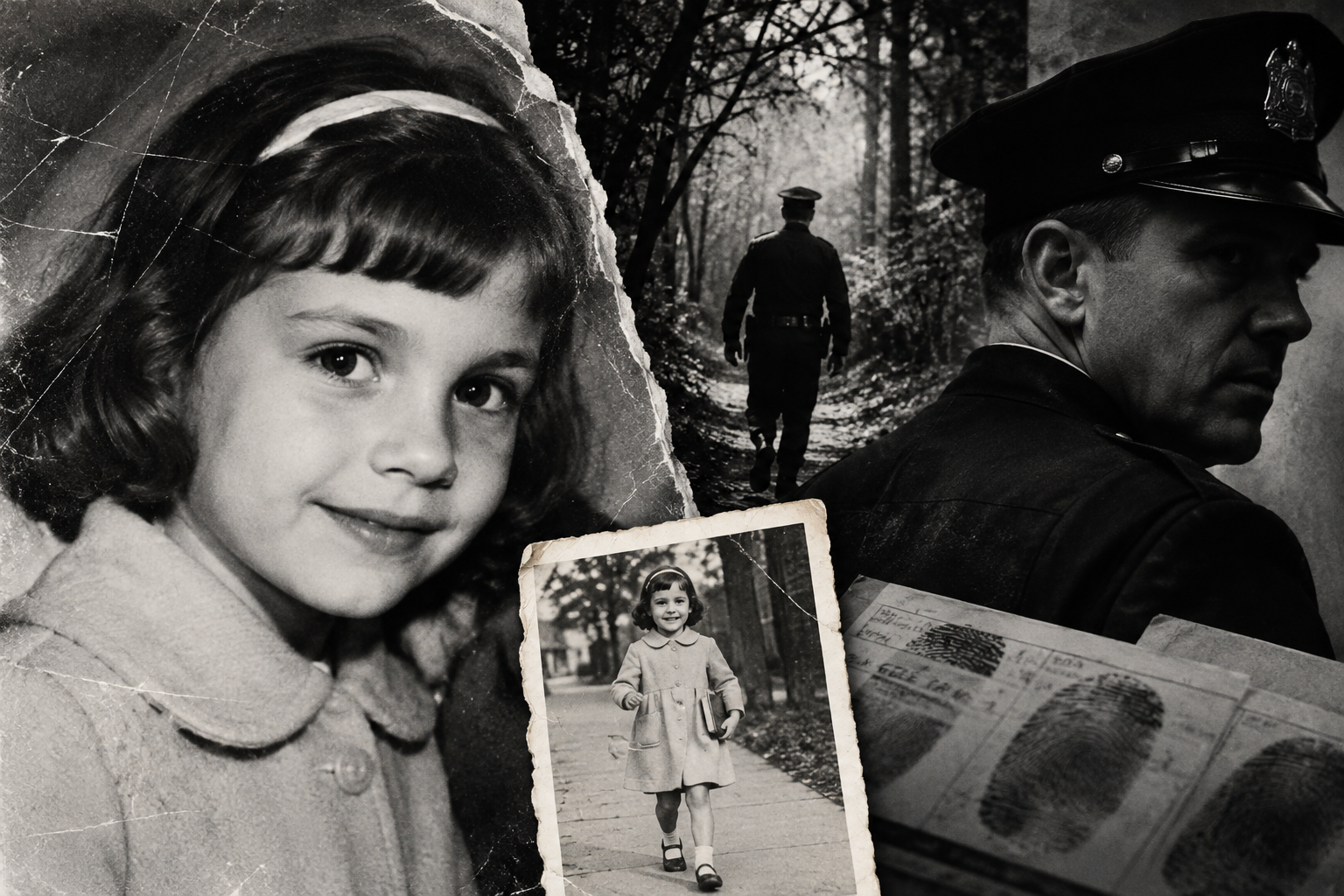
In 1960, eight-year-old Gloria Kowalewicz left her home in Chicago with a purse like that. She was walking to church. She never got there. Four hours later she was found in a forest preserve on the city’s southwest side. She had been shot.
Then everything was done by the book. Police interviewed more than 1,300 people and knocked on hundreds of doors. The bullet, the coat, the shoes and the purse with the prayer book went into storage. Back then those objects couldn’t speak. Forensics could do very little, and a fingerprint with no database and nothing to compare it to meant no more than a smudge. The case couldn’t be closed, so it stayed on the shelf with the evidence.
Now, a different man. A year earlier, in 1959, Thomas F. McInerney Jr. joined the same police department. He worked his way up to detective, took violent crimes, wore the badge and built a career. He retired in 1987 and moved to Nevada, where he spent another seventeen years as an investigator for the Federal Public Defender’s Office, in Reno and Las Vegas. In 2003 he was honored as an outstanding investigator. In 2006 he died. His obituary listed the awards and commendations. No one ever charged him with anything.
I don’t know what he felt during those forty-six years, and nobody does. He left no confession, no letters, and he didn’t drink himself half to death like the heroes of bad movies. On paper it’s an ordinary life, even an exemplary one. That is exactly what makes it frightening: a perfectly normal biography sitting next to a murder.
And the purse lay in a box.
The conclusion is obvious, and I won’t soften it. For sixty-five years the police were looking for a man who was inside the police. He didn’t hide, didn’t change his name, didn’t flee the country. He just worked, and walked the same corridors where the girl’s file was kept. There is no evidence that he influenced the investigation, and I won’t invent any. But the arrangement is an indictment in itself: the badge turned out to be the perfect mask, because it never occurs to anyone to check the person who does the checking.
Then technology caught up with an old object. A fingerprint and DNA were recovered from the strap of the purse. Analysts compared them with McInerney, and they matched. The department stated publicly that he should never have worn the badge, and that it is devastating he was never identified and held accountable while he was alive. Notice what that is: not an apology, but a statement of fact. You apologize to people. You state facts.
There is no one left to put on trial. No indictment, no verdict, no last word. The Cook County State’s Attorney’s Office is now reviewing cases McInerney may have touched. The FBI says it is pursuing every lead on other unsolved crimes from that era in the area. That is the heaviest part of the story: nobody knows how many more boxes need opening, or what is in them.
Gloria’s brother, Adam, lived to see this day. When a newspaper photographed him, he was holding a picture of his sister. They gave him a name, but he will never see the man. Not in a courtroom, not in a defendant’s chair. The knowledge arrived. Justice didn’t.
I keep thinking about that purse. It was made for a happy day, then it became evidence, then for sixty-five years it was just an object in a bag. Nobody threw it away, not after ten years, not after thirty, not after the case had long stopped being opened. And one small act of diligence, simply putting something in storage and not discarding it, ended up mattering more than all the interviews and door-knocking combined.
Sometimes justice comes down to something that small: not throwing it away.
Sources: AP, Chicago Tribune, Fox News, The National Desk. Police name McInerney as the killer; there was no court ruling.