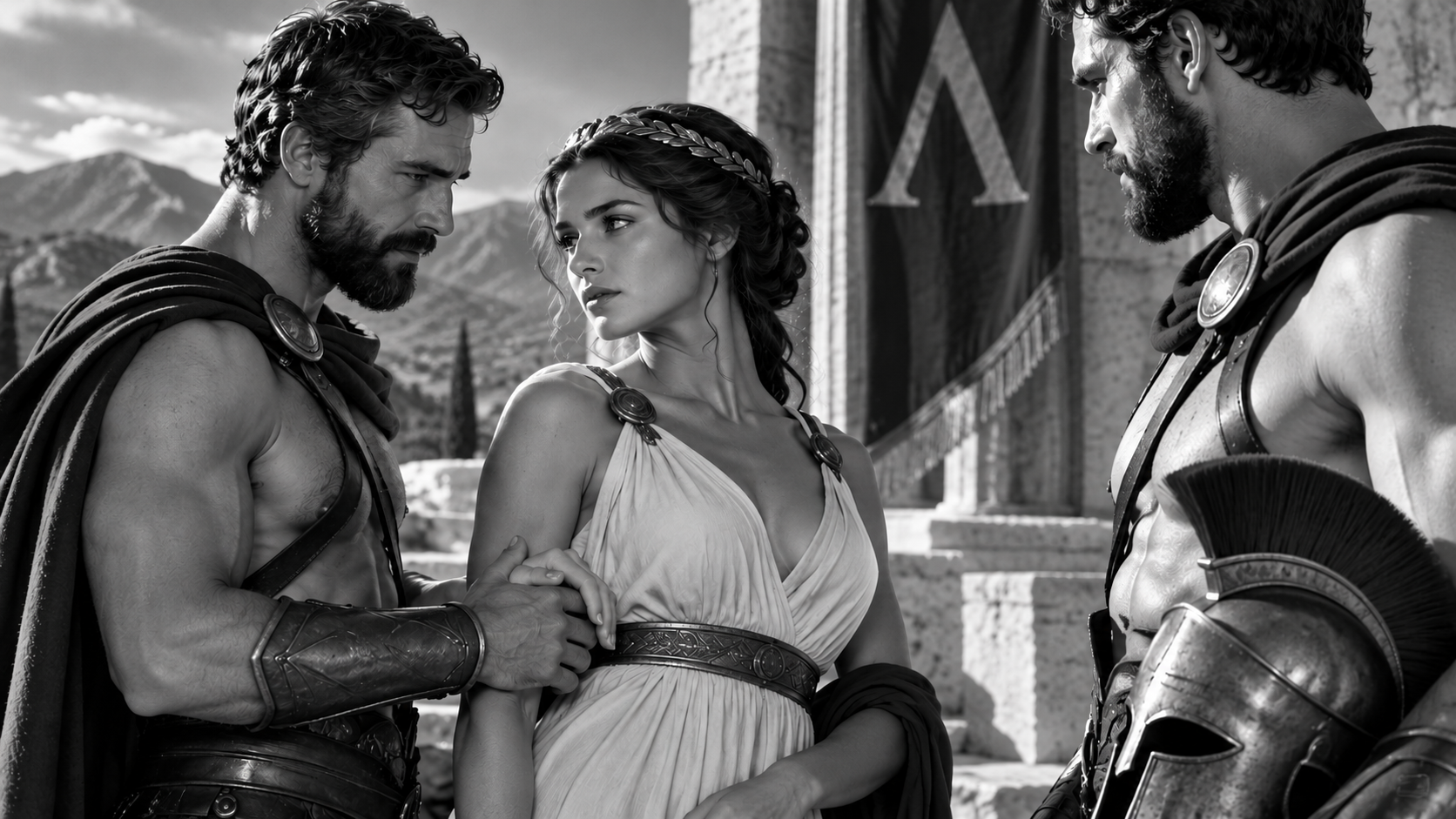
Spartan Marriage: Children Belong to the City
Plutarch, in his Life of Lycurgus, gives two examples. An old man with a young wife could invite a younger man he respected to father her child, and then raise it as his own. And a man who admired someone else’s wife, and the children she’d already borne, could simply ask the husband for permission. Jealousy over this was considered petty.
The logic is blunt. Children are future soldiers, so the state has a stake in who their father is.
Xenophon says much the same in his Constitution of the Lacedaemonians. A husband could bring a man he admired into the household to give his wife children. A man who wanted kids but didn’t care to keep a wife full-time could arrange to father them with another man’s wife.
Notice who negotiates in every one of these scenarios. The men do. Nobody asks the woman.
Spartan Women
Spartan women had it better than most Greek women, Athenians especially. They owned and inherited property, trained athletically, and showed up in public. This wasn’t feminism. Xenophon says Lycurgus wanted strong mothers because strong mothers produce strong soldiers.
Don’t read modern equality into it. Whether a Spartan wife could refuse a husband’s arrangement is something we just don’t know.
Breeding Citizens
Plutarch goes all in on the idea. People are careful about breeding horses and dogs, he says, so why would anyone be careless about breeding humans? That’s not science, it’s ancient common sense: strong father, strong son.
It’s tempting to explain the whole thing as a fix for Sparta’s shrinking citizen body, or as a safety net for war widows. Neither explanation appears in the texts. They’re modern guesses.
Did Husbands Live in Barracks?
Spartan men went through the agoge, a harsh state upbringing, and later ate in common messes called syssitia. Both Xenophon and Plutarch describe young husbands sneaking off to see their wives. Xenophon even argues this was deliberate: keep the spouses hungry for each other and the children come out stronger.
From this we got the popular picture of every Spartan man under thirty locked in a barracks with no family life. That’s an exaggeration. The texts describe a disciplined ideal, and it would be a stretch to apply it to every household.
Who to Trust
Plutarch wrote around 100 AD, centuries after Lycurgus, who may be half legend anyway. His biography mixes tradition, moral lessons and custom he credits to the lawgiver.
Xenophon wrote in the 4th century BC and knew Sparta firsthand. He also loved the place, and it shows.
I’d treat Xenophon as the stronger witness and Plutarch as a collector of stories. Neither proves these customs were law or ran through all of Spartan history. They prove people were telling these stories in antiquity.
How Sparta Ended
It was Thebes that broke Sparta, at Leuctra in 371 BC. The Theban invasion of 370–369 BC then stripped away Messenia, the land and labor that had fed the Spartan system.
Sparta wasn’t wiped out in 146 BC when Rome crushed the Achaean League, and it certainly wasn’t destroyed at the start of the Common Era, as you sometimes read. It lived on as a city under Roman rule, kept some of its old customs and, at times, a measure of autonomy. The fall took centuries.