From horses to airplanes. From letters to smartphones. From drawing on paper to Photoshop. Every great technological leap in human history has done the same thing: it has made the human being capable of more. Artificial intelligence is simply the newest — and perhaps the most remarkable — step in that journey.
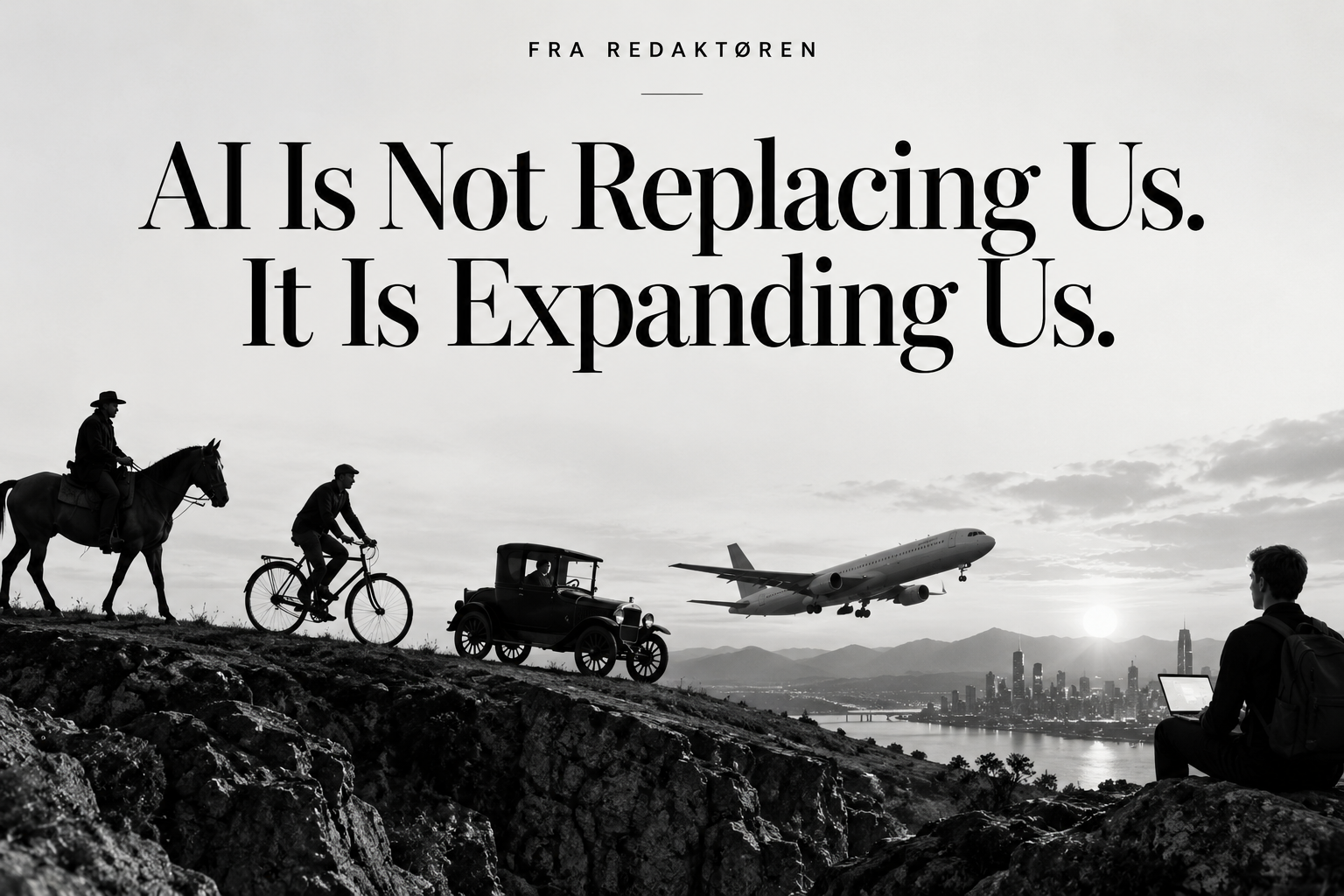
There was a time when going somewhere meant walking.
Then humanity discovered that a horse could take us farther and faster than our own legs.
The bicycle came later.
Then the train.
Then the automobile.
Then the airplane.
Nobody looked at an airplane and said: This is terrible. Humans are no longer capable of travelling by themselves.
We understood what had happened.
We had invented a better way to travel.
The airplane did not make the human being less capable.
It made the human being capable of crossing an ocean in hours.
That is the story of technology.
And it is worth remembering this story now, because artificial intelligence is often discussed as if humanity has suddenly encountered something completely unnatural.
We haven’t.
We are doing what we have always done.
We are building another tool.
We have always wanted to do more
Human history is full of limitations.
We could not see very far.
So we invented telescopes.
We could not remember everything.
So we invented writing.
We could not reproduce books quickly.
So we invented the printing press.
We could not communicate across great distances.
So we invented the telegraph.
Then the telephone.
Then radio.
Then television.
Then the internet.
Each invention removed another limitation.
And each time, the world became larger.
A person in a small town could suddenly hear a voice from another continent.
A photograph could travel thousands of kilometres without the physical photograph travelling anywhere.
A student could access information that once required a university library.
A small company could reach customers on the other side of the planet.
Technology did not reduce human possibility.
It multiplied it.
From paper to Photoshop
Consider something as ordinary as drawing.
For generations, architects, engineers and designers worked with paper, pencils, rulers and physical models.
The computer changed that.
A line could be moved.
A mistake could be corrected.
A design could be copied.
A project could be changed without starting again from the beginning.
Then came digital photography.
Then Photoshop.
Suddenly an image could be transformed in ways that would have required hours of laboratory work only a generation earlier.
Did Photoshop destroy photography?
No.
It gave photographers another language.
The camera still needed a person behind it.
The software still needed a person with an idea.
The tool simply expanded what was possible.
That is an important distinction.
A powerful tool does not eliminate creativity. It gives creativity somewhere new to go.
And now comes AI
Artificial intelligence feels different because it interacts with us.
A computer used to wait for instructions in a very literal way.
AI can understand a question.
It can discuss an idea.
It can analyse information.
It can help write.
It can translate.
It can create images.
It can help with programming.
It can organise information.
It can take something that exists only as an idea in someone’s head and help turn it into something visible.
That is a remarkable change.
But it is not necessarily a frightening one.
It is the next stage of a very old human habit:
finding a way to do more with what we already have.
The greatest change may be accessibility
Perhaps the most important thing about AI is not that it makes experts faster.
It is that it can make sophisticated capabilities accessible to people who previously could not afford them, learn them or spend years mastering them.
A person with an idea for a website can begin building it.
A person who cannot draw can explore a visual concept.
A person who speaks one language can communicate with someone who speaks another.
A small business owner can prepare material that previously required a designer, writer or consultant.
A researcher can work through enormous amounts of information more quickly.
A teacher can create different explanations for different students.
A journalist can organise research.
A filmmaker can test ideas before investing in production.
A person with no programming background can experiment with software.
The distance between “I have an idea” and “I have something I can show you” is becoming shorter.
That is not a small change.
It is a change in who gets to create.
Technology has always done this
Think about the personal computer.
Before it, many tasks required specialised equipment, specialised knowledge and specialised people.
The computer brought enormous capabilities onto the desk.
Then the internet connected those computers.
Then the smartphone put much of that power into a pocket.
A teenager today carries in a small device more access to information, communication, photography, navigation, music and computing power than an entire office could have imagined decades ago.
And we barely notice it.
That is perhaps what happens with technology.
At first, it looks extraordinary.
Then it becomes normal.
The things that once seemed impossible become the things we expect.
AI will probably follow the same path.
Today we are fascinated by what it can do.
Tomorrow we may wonder how we ever worked without it.
The human being remains the interesting part
There is one thing technology cannot automatically provide:
a reason.
A machine can help produce an image.
But why should the image exist?
It can help write a text.
But what should the text say?
It can analyse thousands of pieces of information.
But which question is worth asking?
It can generate possibilities.
But which possibility matters?
These are human questions.
And perhaps as machines become better at execution, human judgement becomes more valuable, not less.
The future may not belong to people who refuse technology.
Nor will it necessarily belong to people who blindly accept everything a machine produces.
It may belong to people who know how to use powerful tools while still knowing what they want to build.
We did not stop being human when we learned to fly
There is a strange tendency to believe that every new technology takes something away from us.
But look at history.
The horse did not take away our legs.
The bicycle did not make walking meaningless.
The car did not make people incapable of travelling.
The airplane did not make the journey less human.
The camera did not kill painting.
The computer did not kill writing.
Photoshop did not kill photography.
The internet did not kill communication.
Every one of these technologies changed the rules.
And every one of them expanded the space in which human beings could act.
Perhaps AI should be understood in exactly the same way.
Not as the machine that finally replaces the human.
But as another instrument that allows the human to reach further.
The most exciting part has not happened yet
There is another reason to be optimistic about AI.
We are still at the beginning.
The most important uses of a new technology are often impossible to predict when the technology first appears.
When the internet emerged, nobody could fully describe the world of social networks, streaming, online banking, remote work, digital journalism, online education and global commerce that would follow.
When smartphones appeared, nobody knew exactly what millions of people would eventually build around them.
The same uncertainty surrounds AI.
We can see what it does today.
We cannot yet see everything people will do with it tomorrow.
That is where the real excitement lies.
The future will not be created by AI alone.
It will be created by people who discover what becomes possible when human imagination meets a tool that can finally keep up with it.
The next step
Human civilisation has always moved forward by extending itself.
We extended our reach with tools.
Our memory with writing.
Our voices with communication technology.
Our eyes with cameras and telescopes.
Our strength with machines.
Our speed with engines.
Our ability to calculate with computers.
And now we are extending another part of ourselves: our ability to work with information and ideas.
That is what makes artificial intelligence such a remarkable technological breakthrough.
Not because it makes humans unnecessary.
But because it may make more things possible for more people.
We did not stop being human when we learned to fly.
We simply stopped accepting the limits of walking.
We did not stop thinking when we invented the computer.
We simply stopped accepting the limits of manual calculation.
And perhaps AI is the same kind of moment.
Not the end of human ability.
The expansion of it.