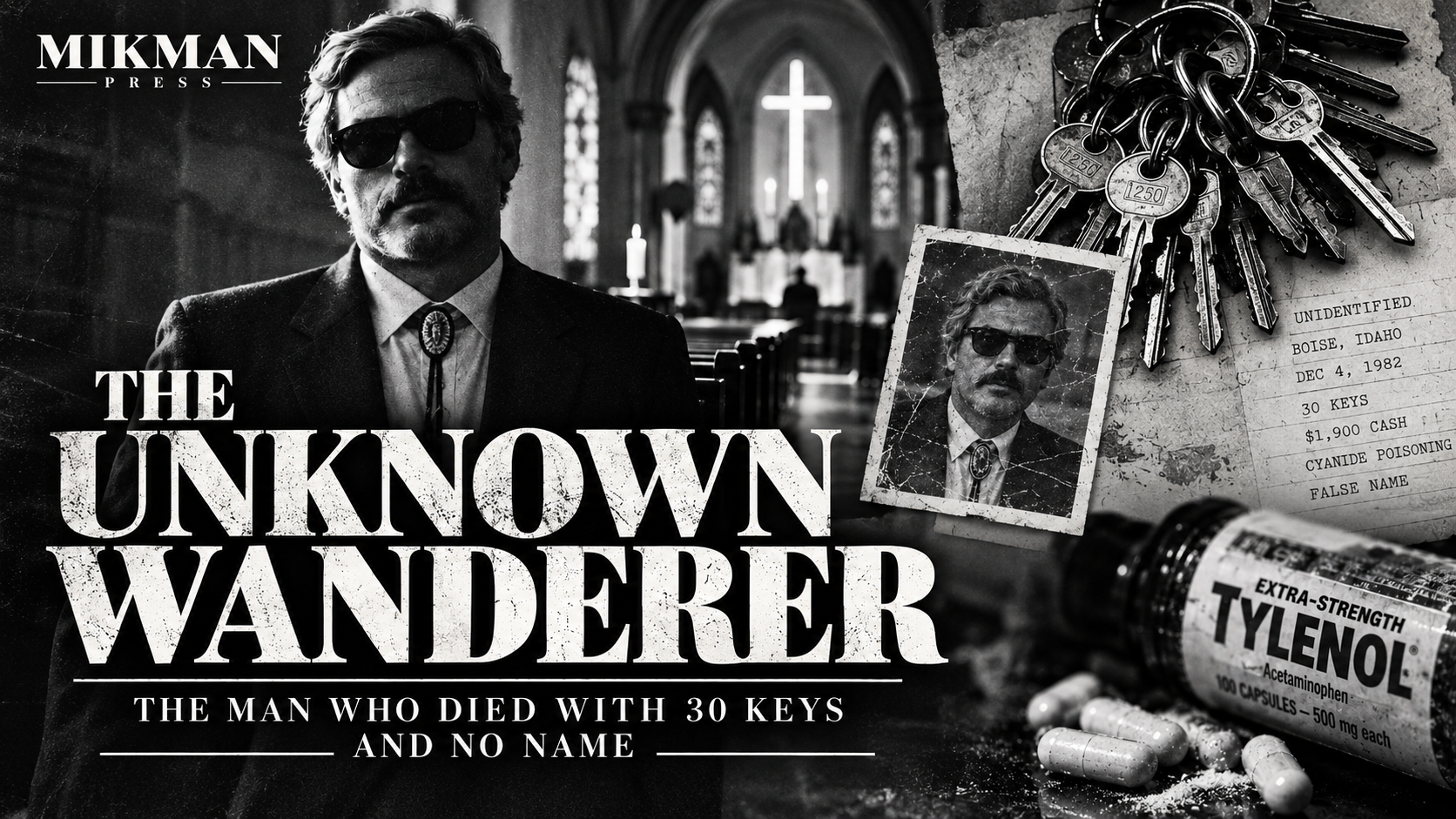
For 44 years, nobody knew who he was. Then one forgotten key opened a door to his identity — and possibly to one of America’s most notorious unsolved crimes.
On December 4, 1982, a stranger walked into Sacred Heart Catholic Church in Boise, Idaho.
He was well dressed. His clothes were clean and carefully pressed. His hair appeared to have been dyed and styled. He carried cash, wore a distinctive turquoise-and-silver bolo tie and had a Seiko watch on his wrist.
There was nothing about him that immediately suggested a man living on the streets.
But there was one extraordinary problem.
Nobody knew his name.
And when police eventually found him dead inside the church, he seemed to have made sure they would have difficulty discovering it.
For more than four decades, he remained one of America’s unidentified dead — remembered simply as the Unknown Wanderer.
Now, 44 years later, investigators say they finally know who he was.
His name was Dr. Mathew Francis Betkouski.
And the investigation that finally revealed his identity has opened another, far more disturbing question:
Could the Unknown Wanderer have had a connection to the unsolved 1982 Tylenol murders?
Authorities have not established that connection. Betkouski has not been officially named as the killer.
But investigators have uncovered enough unusual evidence to send their findings to authorities in Chicago. boisestatepublicradio.org
A man with no name
When the stranger was found in Sacred Heart Catholic Church in December 1982, investigators had very little to work with.
There was no identification in his wallet.
There were no obvious clues to his family.
There was no missing-person report that immediately matched him.
Yet he was carrying an unusual collection of possessions.
Among them were 19 $100 bills — $1,900 in total — and nearly 30 keys on two key rings.
There was also a typed note signed with the name William L. Toomey.
Investigators eventually determined that William L. Toomey was not his real name.
The man’s fingerprints were checked against available records but produced no identification.
The case became a mystery.
Who was this man?
Where had he come from?
Why had he come to Boise?
And why had he entered a church shortly before his death?
The autopsy provided one answer.
He had died from cyanide poisoning. East Idaho News
But almost everything else remained unknown.
The mystery that survived for decades
The unidentified man eventually became known as the Unknown Wanderer.
His case was eventually featured on Unsolved Mysteries in 1990.
Thousands of people saw the story.
Thousands of tips followed.
None solved the mystery.
For years, investigators tried to follow whatever clues they could find.
The man’s unusual bolo tie was traced to a silversmith in the American Southwest.
His possessions were examined.
His fingerprints were checked.
Nothing produced a name.
The case eventually became one of those strange American mysteries that seemed destined to remain unsolved.
Then, decades later, Detective Tim Cooper reopened it.
In 2019, Cooper began taking another look at the evidence.
And eventually, he concentrated on something that had been sitting in the evidence room for years.
The keys.
The key that changed everything
There were almost 30 keys.
Most appeared meaningless.
But one of them contained a marking that indicated it had come from a hardware store in Jacksonville, Florida.
Cooper also noticed an engraving on the key that investigators believed had previously been overlooked or misinterpreted.
That tiny detail gave investigators somewhere to go.
They began examining property records in Jacksonville.
Eventually, they focused on a street called Mills Court.
The investigation revealed a property connected to a man who had been declared dead in 1989.
But something was strange.
The man’s brother said he had actually disappeared in 1982.
Now investigators had a possible identity.
They obtained DNA from the brother and compared it with DNA recovered from the Unknown Wanderer’s wallet.
The result established that the two men shared a father.
The Unknown Wanderer finally had a name.
Mathew Francis Betkouski. BoiseDev
A mystery that had survived for 44 years had finally been solved.
But solving one mystery created another.
Who was Mathew Betkouski?
Betkouski was not simply a man who had disappeared from nowhere.
Investigators reconstructed a complicated life.
He had a Ph.D. in organic chemistry and had lived in several American states, including California, Texas, New Mexico, Ohio and Florida.
He had worked in drugstores and later in scientific environments.
According to investigators, his history also contained references to cyanide, poisons and experiments involving medication capsules.
In New Mexico, he worked at a Lockheed facility at White Sands.
Investigators said former colleagues recalled conversations in which Betkouski discussed the possibility of introducing poison into capsules of over-the-counter medication.
He was fired from Lockheed in 1982 following an incident involving a pharmacy, according to investigators. East Idaho News
And then there was something else.
After examining his belongings and records, investigators discovered evidence that brought them back to Chicago.
The seven deaths that changed America
In September 1982, seven people in the Chicago area died after taking Extra-Strength Tylenol capsules contaminated with cyanide.
The victims had not been targeted in the traditional sense.
The killer had apparently placed poisoned capsules into ordinary consumer packaging.
The result was panic.
Tylenol was recalled.
Consumers became suspicious of products that had previously seemed completely safe.
The killings ultimately transformed the way medicines and other consumer products were packaged in the United States, helping establish the tamper-resistant and tamper-evident packaging that consumers now take for granted. ABC News
But the killer was never conclusively identified.
The case remains one of America’s most notorious unsolved crimes.
For decades, investigators pursued leads.
One man, James Lewis, became a central figure in the investigation, but he was never charged with the killings and always denied being responsible. He died in 2023. ABC News
And now, more than 40 years later, the name of another man has suddenly entered the story.
Mathew Betkouski.
The Chicago connection
The similarities immediately attracted investigators’ attention.
Betkouski was a chemist.
He had knowledge of pharmacy operations.
Investigators found evidence that he had discussed poisoning medication capsules.
And among the material associated with him was a map of Chicago.
There was also cyanide.
But this is where the story needs an important qualification.
The cyanide investigators found was not the same chemical form as the cyanide used in the Tylenol killings, according to officials. East Idaho News
And perhaps more importantly, investigators have not established that Betkouski was in the Chicago area when the seven deaths occurred.
Photographs place him in the Chicago area a year before the killings, but authorities have not been able to establish that he was there during the crucial period in September 1982. CBS News
That distinction matters.
There is a difference between a person of interest whose history raises questions and a person proven to have committed a crime.
At the moment, the evidence establishes the first — not the second.
The detective who wouldn’t let the case die
For Detective Tim Cooper, the investigation began with an unidentified body and a box of old evidence.
The keys had survived.
So had the wallet.
So had the records.
The case had not disappeared completely. It had simply been waiting for someone to look at it differently.
Cooper eventually traced the key to Jacksonville.
The Jacksonville records led to a missing man.
The missing man’s family led to DNA.
The DNA led to Betkouski.
And Betkouski’s history led investigators toward Chicago.
It is an extraordinary chain of events — one tiny piece of metal connecting a church in Idaho to a missing man in Florida and, potentially, to one of America’s most famous unsolved murder cases.
But was he the Tylenol killer?
That is the question everyone now wants answered.
The honest answer is:
Nobody knows yet.
The Ada County Sheriff’s Office has sent its information to investigators in the Chicago area.
Chicago authorities have acknowledged contact with Idaho investigators.
But officials have not announced that Betkouski was the murderer.
NBC Chicago reported that despite expectations surrounding the Idaho press conference, investigators did not produce evidence establishing a direct connection between Betkouski and the Tylenol killings. NBC Chicago
The FBI has also continued to treat the Tylenol investigation as an open case.
So the mystery has not been solved.
It has simply acquired a new name.
The man who disappeared
There is perhaps an even stranger element to the story.
Betkouski disappeared in 1982.
Nobody reported him missing in a way that immediately connected him to the unidentified man in Boise.
He travelled across several states.
He left behind traces of his life but apparently succeeded in becoming invisible.
Then, in December, he appeared in Idaho.
He entered a church.
He died from cyanide poisoning.
And for 44 years, the world did not know who he was.
His body was eventually buried under an unknown identity.
The church remembered him.
The investigators remembered him.
The case file remained.
But his real name disappeared.
Until one key came along.
One key. Two mysteries.
There is something almost literary about the way this case unfolded.
The Unknown Wanderer arrived with nearly 30 keys.
For decades, they seemed like useless pieces of metal.
Then one of them became the first step toward his identity.
That identity led investigators into the man’s past.
And his past led them toward a crime that has haunted the United States since 1982.
The key opened the first door.
Nobody yet knows whether it will open the second.
For now, Mathew Francis Betkouski is no longer an unknown man.
But the biggest question surrounding him remains unanswered:
Did the man who died alone in an Idaho church know something about the seven people who died after taking poisoned Tylenol in Chicago?
The answer, if it exists, may have been buried with him for 44 years.
And investigators are now trying to find it.
Why this story matters now
The case has returned to public attention at a particularly significant moment. A new documentary, ** Unsolved Mysteries: Unmasking the Tylenol Killer **, is scheduled to begin streaming on Roku on October 9, 2026. The renewed investigation and the documentary are bringing the 1982 mystery back into the American public conversation. East Idaho News
For four decades, the Unknown Wanderer was a man without a name.
Now he has one.
What remains to be discovered is what else that name might unlock.
Michael Manukian