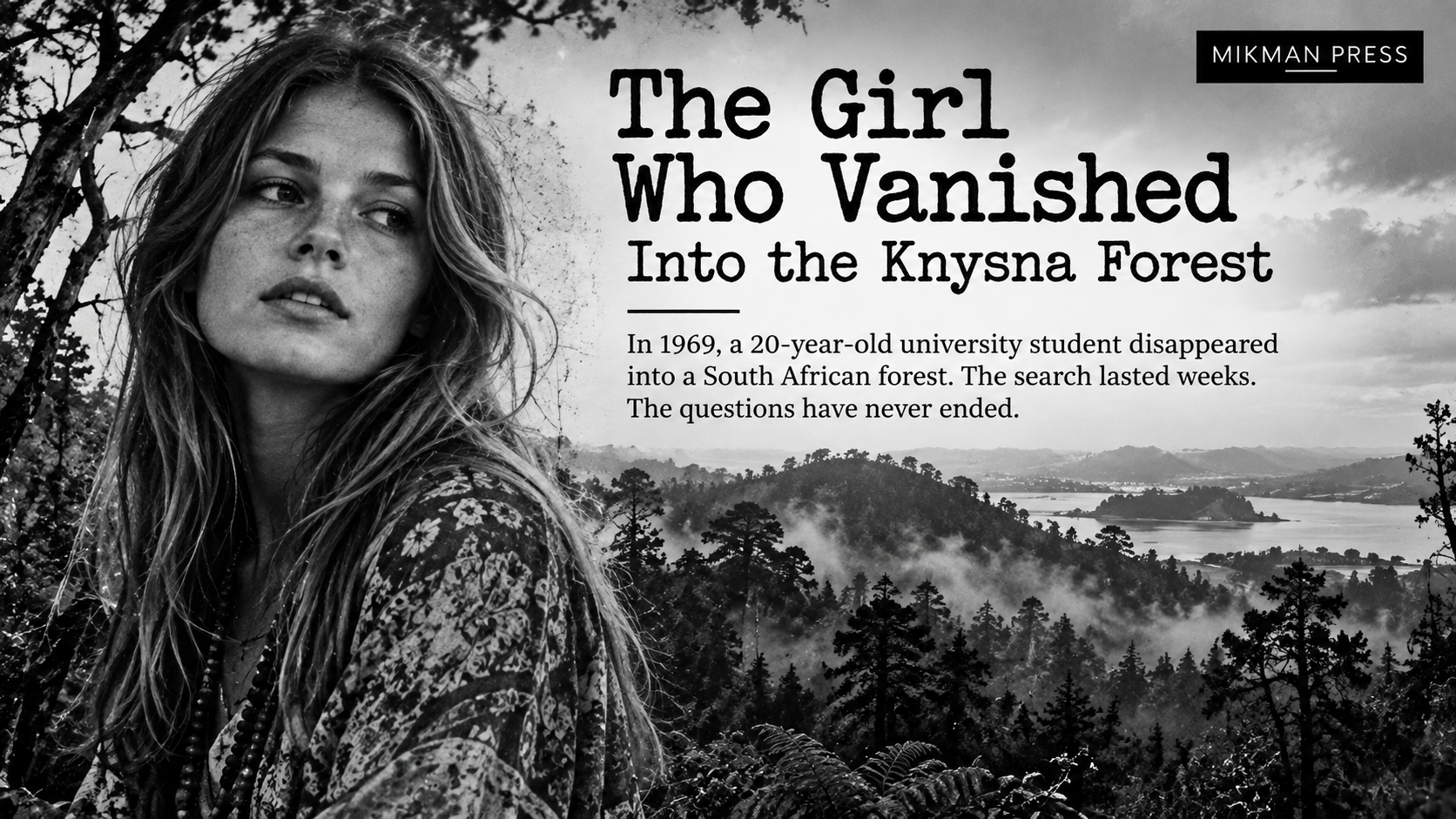
In 1969, a 20-year-old university student disappeared into one of South Africa’s most mysterious forests. The search lasted weeks. The questions lasted decades.
There are places where a person can disappear.
And then there are places where the landscape itself seems capable of swallowing a story.
The Knysna Forest, on South Africa’s southern coast, is one of them.
In August 1969, a 20-year-old University of Cape Town student named Rosalind Ballingall walked into that forest.
She was never seen again.
More than half a century later, nobody knows exactly what happened to her. No body was found. No definitive witness account explained her disappearance. No theory has ever been proved.
What remains is a strange mixture of fact, memory, rumour and unanswered questions — a story that has become inseparable from the unusual world Rosalind inhabited in the final months of her life.
Cape Town, 1969
Rosalind Ballingall was born in 1948 in Northern Rhodesia to British parents. By the late 1960s, she was studying Speech and Drama at the University of Cape Town.
Cape Town was changing.
South Africa was living under apartheid, but among some young white students and artists, another kind of rebellion was emerging. A small counterculture was beginning to develop around alternative lifestyles, art, meditation, Eastern religions and experimentation with drugs.
It was a very different world from the conservative society surrounding it.
Rosalind became part of that world.
She lived in De Waterkant, an area of Cape Town associated with people living outside conventional social structures. She became connected with a group known as Cosmic Butterfly, which some people described as a cult and others as part of the city’s emerging hippie scene.
Later accounts would portray Rosalind as one of the group’s central figures — even a kind of spiritual leader.
But historians have warned against turning her into a mythical character after the fact.
That distinction matters.
The real Rosalind was a young woman living in a turbulent and unconventional time. The legend came later.
And then came August.
The Journey to the Forest
On 11 August 1969, Rosalind left Cape Town.
She travelled to the Knysna area with acquaintances Sasja Sergiev and Tanya Geffin, intending to spend time at a cottage in the forest near a place called Fisantehoek.
The trip was not particularly unusual for people involved in the counterculture of the period.
Getting away from the city and retreating into nature was part of the attraction.
But something happened during that stay.
The precise sequence of events is still unclear.
Rosalind was reportedly at a gathering associated with the alternative community near the forest. Drugs were involved, according to contemporary accounts and later research.
At some point, Rosalind entered the forest.
And then she disappeared.
She was twenty years old.
Into the Green
The Knysna Forest is not an ordinary woodland.
It is enormous, dense and difficult terrain. Paths can disappear. Vegetation can become almost impenetrable. Visibility is limited, and even someone familiar with the area can quickly lose a sense of direction.
Police began searching.
Local people joined them.
The operation continued for days.
Then for weeks.
Searchers examined the forest looking for any sign of the missing student.
But there was nothing.
No body.
No clear trail.
No piece of clothing that could definitively explain where she had gone.
No final message.
Nothing that could establish whether Rosalind had become lost, suffered an accident, deliberately disappeared, or encountered another person.
On 26 August, the official search was called off.
The mystery remained.
One police officer, Major F. J. du Toit, had publicly expressed confidence that Rosalind might still be alive.
It was an extraordinary statement after such an extensive search.
But it also reveals the central problem of the case.
Nobody actually knew where she was.
The Forest Was Only the Beginning
If Rosalind had simply disappeared in a remote forest, the case might have remained a tragic but relatively straightforward missing-person mystery.
Instead, the circumstances surrounding her disappearance created something much larger.
New stories began circulating.
People claimed to have seen her.
Others offered explanations for what might have happened.
Her connection to Cosmic Butterfly became a major part of the public fascination.
The press had found a story that seemed to contain everything contemporary South Africa found unsettling about the emerging counterculture: young people rejecting conventional society, drugs, alternative spirituality, mysticism and a mysterious disappearance in the wilderness.
Rosalind became more than a missing student.
She became a symbol.
And that may have made the truth harder to see.
Historian Albert Grundlingh, whose research examined the case and the counterculture surrounding it, argues that Rosalind’s disappearance became deeply entangled with the public imagination about hippies in late-1960s Cape Town.
In other words, people were no longer simply asking:
Where is Rosalind Ballingall?
They were asking what her disappearance supposedly said about an entire generation.
Theories Without an Answer
Over the decades, several possibilities emerged.
Perhaps Rosalind became lost in the forest.
Perhaps she suffered an accident and died somewhere beyond the areas searched by police.
Perhaps she deliberately left the area.
Perhaps she was murdered.
Suicide was also considered.
But none of these explanations has ever been established as fact.
And because there was no body, almost every possibility remained open.
The forest itself became part of the mythology.
It offered no easy answers.
A person could disappear there without leaving an obvious trace — and that made the landscape an almost perfect setting for rumours.
There were also questions about the people who had been with Rosalind.
What exactly happened before she entered the forest?
What did they know?
What did they tell investigators?
And what information might have been lost over time?
Those questions helped keep the mystery alive.
A Woman Who Became a Legend
In the decades that followed, Rosalind Ballingall slowly became part of South Africa’s cultural memory.
Her disappearance inspired artistic and documentary work.
A 2006 University of Cape Town master’s thesis examined The Ballad of Rosalind Ballingall, a documentary that followed her path from the bohemian streets of 1960s Cape Town into the Knysna Forest. The work explored not only the disappearance but also the collective memory surrounding it. Open UCT
That may be the most fascinating aspect of the story.
Rosalind has never been found.
Yet she has never entirely disappeared.
Her name survived in newspaper archives, academic research, documentaries, recollections and stories passed from one generation to another.
In the mid-1980s, she was legally declared dead.
But legally declaring someone dead is not the same as discovering what happened to them.
The Question That Remains
More than fifty years later, the basic question is brutally simple:
What happened to Rosalind Ballingall?
Did she walk deeper into the forest and become trapped by the terrain?
Did she find a way out and begin another life somewhere else?
Was she the victim of a crime?
Or did the truth disappear with the evidence?
We don’t know.
And perhaps that is why the story continues to fascinate.
It is not simply a mystery about a missing woman.
It is a story about a particular moment in history — a young generation searching for freedom in a society defined by restrictions, a counterculture trying to create its own world, and a vast forest standing at the edge of it all.
Rosalind walked into that world in August 1969.
The forest gave nothing back.
And somewhere between the last confirmed sighting and the stories that followed, the real Rosalind Ballingall disappeared — leaving behind one of South Africa’s most enduring unsolved mysteries.
Michael Manukian