August 11, 1979, was supposed to be another football day.
The players of Tashkent’s Pakhtakor were travelling to Minsk for a Soviet Top League match against Dinamo Minsk.
They never arrived.
High above the Ukrainian city then known as Dniprodzerzhynsk, two passenger aircraft crossed paths.
Within seconds, 178 people were dead.
Seventeen of them belonged to one football club.
It became one of the darkest days in the history of Soviet football.
Two Aircraft in the Same Sky
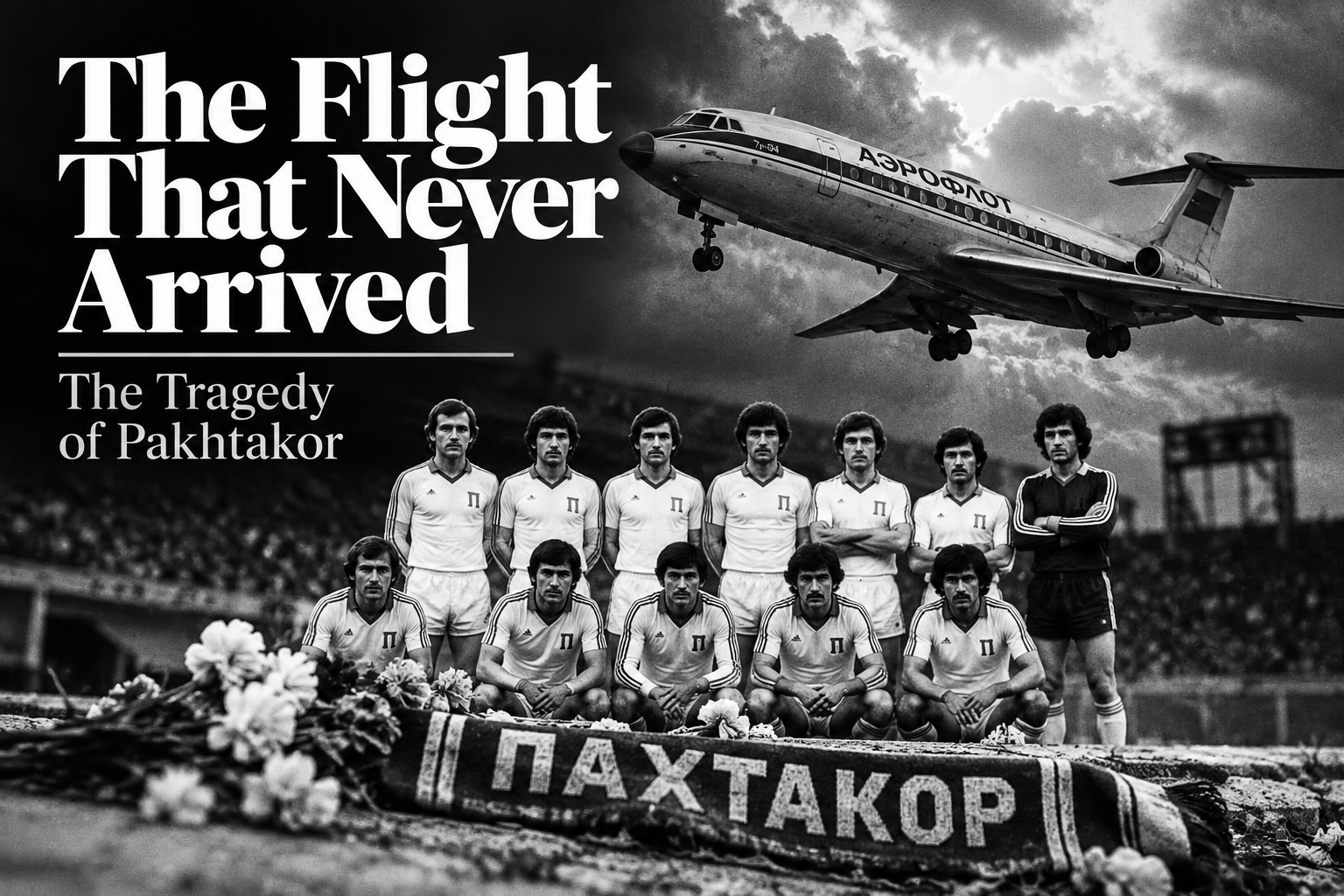
The tragedy involved two Aeroflot Tupolev Tu-134 aircraft.
One was flying from Voronezh toward Chişinău. It carried 94 people.
The other was flying from Donetsk to Minsk. There were 84 people aboard, including 77 passengers and seven crew members.
Among those passengers were 17 members of Pakhtakor, the leading football club of Soviet Uzbekistan. The group included 14 players, a coach, the team doctor and an administrator.
At approximately 8,400 metres above the ground, the two aircraft were on intersecting flight paths.
The danger was not visible to the passengers.
There was no time for them to understand what was happening.
The aircraft collided in mid-air.
Neither survived.
All 178 people aboard the two planes were killed.
A Football Team Disappeared in Seconds
Pakhtakor was not an obscure provincial club.
It was the pride of Tashkent and one of the most important football teams in Soviet Central Asia.
The club had returned to the Soviet Top League and was competing against some of the strongest teams in the country.
The players travelling to Minsk included some of the most recognisable footballers of their generation.
Among those killed were Mikhail An, Vladimir Fedorov, Alim Ashirov, Ravil Agishev, Konstantin Bakanov, Yuri Zagumennykh and others.
They were not simply names on a team sheet.
They were sons, husbands, fathers, friends and footballers whose careers were still unfolding.
Then, in the space of a few seconds, an entire generation of the club was gone.
The Man Who Did Not Board the Plane
There was one extraordinary exception.
Forward Tulyagan Isakov was part of that Pakhtakor generation.
But he was not on the aircraft.
Several months earlier, he had suffered a serious leg injury during a match against Dynamo Moscow. Because of that injury, he was unable to travel with the team to Minsk.
The injury that threatened his football career ultimately saved his life.
For the rest of his life, Isakov carried the memory of the teammates who had died.
He later spoke publicly about the tragedy and became one of the people who kept the memory of Pakhtakor-79 alive.
His story gives the disaster another dimension.
Sometimes survival can become its own burden.
What Caused the Crash?
For years, the disaster generated rumours and speculation.
There were stories about military activity, special flights and other possible explanations.
But the official investigation reached a much less mysterious conclusion.
The collision was attributed to mistakes and violations by air-traffic controllers.
The two aircraft were being handled in a heavily used section of Soviet airspace. A controller issued instructions that ultimately failed to keep the aircraft safely separated. The investigation concluded that the responsibility lay with the air-traffic control system rather than with a mechanical failure of either aircraft.
The two controllers involved were later sentenced to 15 years in prison.
The official explanation was devastating precisely because it was so ordinary.
There was no dramatic mechanical failure.
No spectacular act of sabotage.
A sequence of human errors was enough.
A Tragedy That Was Difficult to Talk About
The Soviet Union had its own way of dealing with disasters.
Information was tightly controlled, particularly when a catastrophe could damage the image of the state or expose failures in its institutions.
The crash received limited coverage in the Soviet press. There was no immediate detailed public account explaining the full circumstances of the disaster.
That silence created a space for rumours.
When people do not receive an explanation, they create one themselves.
And in the Soviet Union of 1979, the truth about an aviation disaster involving a popular football team was not simply a matter of public curiosity. It touched questions of responsibility, state competence and the reliability of the country’s institutions.
The result was a tragedy remembered by many people through fragments: a cancelled football match, a short newspaper notice, whispered conversations and the sudden disappearance of familiar names.
The Team Had to Continue
Football, however, was not allowed to stop.
Pakhtakor had to continue.
Players from other clubs were sent to Tashkent. The devastated squad was rebuilt almost from scratch, and the club was guaranteed a place in the top division for three seasons regardless of its results.
The new team finished ninth in the 1979 Soviet championship.
But statistics could not measure what had been lost.
A football club had survived.
The team itself had not.
The Memory of Pakhtakor-79
The tragedy did not disappear with the end of the 1979 season.
It became part of the identity of Uzbek football.
A memorial was later erected near the crash site in what is now Kamianske, Ukraine, commemorating the victims of the accident and the members of Pakhtakor.
The memorial does not belong only to football.
The 178 people who died were passengers and crew members of two ordinary domestic flights. They came from different places and were travelling for different reasons.
Some were going home.
Some were travelling for work.
Some were travelling to a football match.
All of them expected to land.
None did.
The Last Journey
The story of Pakhtakor-79 is often told as the story of a football team that died in an air crash.
But that description is too small.
It was the story of 178 individual lives interrupted at 8,400 metres above the ground.
The footballers simply made the tragedy especially visible.
They were young men known to thousands of people. Their photographs had appeared in newspapers. Their names were announced over stadium loudspeakers. Supporters knew their faces.
Then suddenly there was no next match.
No next season.
No next goal.
Only photographs.
Only memories.
And an empty place where an entire generation of Pakhtakor should have been.
On August 11, 1979, two aircraft disappeared from the sky over Dniprodzerzhynsk.
One was carrying a football team on its way to Minsk.
The match was never played.
And the names of those who were supposed to play it became part of the history of Soviet football forever.