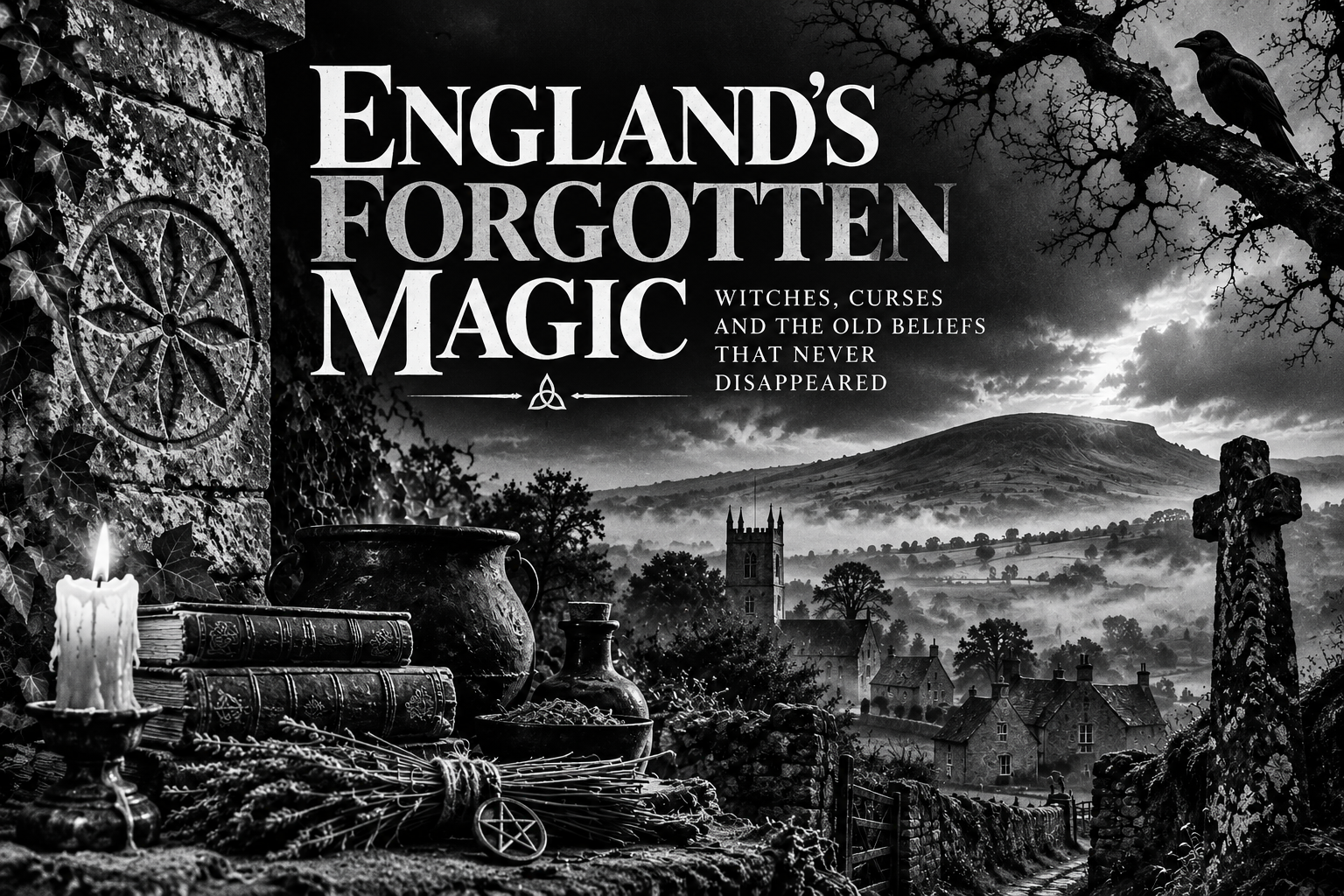
England has always presented itself as a rational country. But beneath its churches, villages, old houses and quiet country lanes lies another England — an England of witches, curses, protective symbols, healing charms and stories that refused to die.
Walk through an old English village today and there may be very little to suggest that its inhabitants once lived in a world where a sick cow, a failed harvest, a sudden death or a series of family misfortunes could be blamed on an invisible enemy.
Yet for centuries, supernatural explanations were not the stuff of fantasy.
They were part of ordinary life.
A neighbour could be suspected of possessing magical powers. A strange mark carved beside a doorway might have been intended to keep evil away. A woman known for her knowledge of herbs might be regarded as both healer and witch. A curse could become a serious explanation for events that medicine, religion and everyday experience could not explain.
And perhaps the most fascinating thing about English witchcraft is that it did not simply disappear.
It changed.
The England of witches
The modern image of the English witch is familiar: an old woman, a black cat, a pointed hat, a broomstick and a cauldron.
Much of this image belongs to later popular culture.
The historical witch was considerably more complicated.
In early modern England, accusations of witchcraft often emerged from ordinary conflicts. A neighbour refused food. A servant was dismissed. A cow became ill. Someone suffered a mysterious illness. A family experienced a sequence of unfortunate events.
Then somebody remembered a quarrel.
The person involved could suddenly become a suspect.
By the late sixteenth century, the English image of the witch had become increasingly associated with poor and socially vulnerable women. The stereotype was often that of an elderly woman who lived on the margins of village society and who was believed capable of causing harm through curses, words or supernatural powers.
The law made matters considerably more dangerous.
England passed its first witchcraft statute in 1542. Witchcraft was later made a felony again under Elizabeth I in 1562.
The result was not simply a collection of strange stories.
People were prosecuted.
People were imprisoned.
People were executed.
The famous Pendle witch trials of 1612 remain one of the most notorious examples. Twelve people from the Pendle area were accused of witchcraft; ten were eventually convicted and hanged.
But the story of English magic is not simply a story about persecution.
It is also a story about survival.
The witch was not always the enemy
Long before the word “witch” became associated with evil, English communities depended upon people who possessed practical knowledge that was difficult to obtain elsewhere.
They knew plants.
They knew animals.
They knew childbirth.
They knew traditional remedies.
They knew how to treat wounds, fevers and minor illnesses.
Some of these people became known as wise women, cunning folk, healers or practitioners of folk magic.
The boundary between medicine and magic was often extremely thin.
A person might pray over an illness, use herbs, recite a charm and perform a ritual without seeing any contradiction between these actions.
To modern eyes, this seems strange.
To people living hundreds of years ago, it could be perfectly logical.
Medicine had enormous limitations. Infection could kill. Childbirth could be dangerous. Animals were essential to survival. Crops could fail. Weather could destroy a year’s work.
When there was no scientific explanation available, people searched for another one.
Sometimes that explanation was God.
Sometimes it was fate.
Sometimes it was witchcraft.
The curse
Few ideas are more powerful in folklore than the curse.
A curse does not require a physical weapon.
It requires belief.
A person can speak words, make a gesture, leave an object somewhere or perform a ritual — and the victim becomes convinced that something terrible has been set in motion.
The psychological power of such beliefs could be enormous.
A farmer whose animals began dying might remember an argument with a neighbour.
A family experiencing repeated illness might suspect that somebody had wished them harm.
A person who entered an old house and immediately felt uncomfortable might interpret the feeling as evidence that the place was haunted.
Once the explanation had been accepted, every new misfortune could become additional evidence.
The curse therefore created a strange circle:
misfortune created suspicion, suspicion created fear, and fear created more evidence for the curse.
And this was not restricted to poor or uneducated people.
One of the most remarkable examples comes from the early nineteenth century.
William Ettrick was a wealthy and educated English clergyman. Yet during a disastrous period of his life, when animals became ill and his family suffered serious problems, he began to believe that witchcraft might be responsible.
His diary records his changing attitude towards supernatural explanations.
Eventually, he blamed women working in his household for the misfortunes.
He had once been sceptical.
He was no longer so sure.
His story demonstrates something important about magic.
Belief in witchcraft was not necessarily a sign of ignorance.
Sometimes it was a response to uncertainty.
When everything else failed to explain the world, magic remained available.
The marks hidden inside old houses
There is another mystery scattered across England.
Look closely at old buildings and you may find strange symbols carved into stone or wood.
Some resemble flowers.
Others look like circles, stars or geometric patterns.
For decades, some of these marks have been interpreted as protective symbols — signs intended to keep evil spirits, witches or other supernatural forces away.
One of the best-known forms is the hexafoil, sometimes called a “daisy wheel”.
These six-petalled patterns can be found in historic English buildings, including churches, houses and other structures.
The traditional interpretation is fascinating.
The entrance to a house was a vulnerable place.
So was the fireplace.
So were windows.
These were places where danger — physical or supernatural — might enter.
A protective mark placed beside an entrance could therefore act as a symbolic barrier.
But here the story becomes even more interesting.
In 2026, historians renewed a debate about these symbols.
Some researchers argue that at least many of the supposed “witches’ marks” may not have been magical at all. Instead, they could have been geometric exercises made by stonemasons and apprentices.
The same symbol can therefore tell two completely different stories.
To one historian, it may represent ritual protection.
To another, it may simply show a craftsman practising with a compass.
The mystery survives precisely because the evidence is incomplete.
And perhaps that is better than having a final answer.
England’s secret language of protection
The idea of protecting a house from supernatural forces was not unique to England.
But English buildings contain a remarkable collection of objects and marks associated with traditional protective practices.
Some were hidden.
That is perhaps the most intriguing part.
A magical object did not necessarily need to be displayed.
It could be concealed inside a wall, beneath a floor or near a doorway.
The purpose was not decoration.
The purpose was protection.
The people who placed such objects were not necessarily trying to create a magical spectacle.
They were trying to make their homes safe.
This tells us something profound about historical England.
Magic was not necessarily separate from everyday life.
It could be integrated into architecture.
It could exist alongside Christianity.
It could exist alongside practical knowledge.
It could exist in the same house as a Bible, a fireplace, a cooking pot and a collection of agricultural tools.
The supernatural was not necessarily considered an alternative world.
It was part of the same world.
The strange world of English folklore
Witchcraft was only one part of the traditional English imagination.
There were ghosts.
Fairies.
Black dogs.
Giants.
Prophetic dreams.
Sacred wells.
Haunted roads.
Mysterious caves.
Spirits associated with particular places.
And stories attached to almost every landscape.
A hill was rarely just a hill.
A forest could have a personality.
A river could possess a memory.
A cave could become the home of an oracle.
A particular tree might be avoided after sunset.
Folklore gave places identities.
It transformed geography into storytelling.
This is one reason English folklore has survived so effectively.
It is attached to physical places.
A story about a witch who supposedly lived three hundred years ago is abstract.
A story about the witch who lived in that house, beside that road, near that church is much harder to forget.
The landscape becomes the archive.
Pendle: where history and legend meet
Few places illustrate this better than Pendle Hill in Lancashire.
The landscape is dramatic enough to encourage legends by itself.
But Pendle also carries the memory of the 1612 witch trials.
The accused were not mythical creatures.
They were human beings living in communities.
They had families.
They had neighbours.
They had disputes.
They had fears.
And eventually their names became part of English history.
Today, the word “witch” can sound theatrical.
At Pendle, however, it represents something much darker.
It represents what can happen when fear, accusation and supernatural belief become connected to legal power.
The landscape therefore carries two histories simultaneously.
There is the folklore.
And there is the human tragedy behind it.
Mother Shipton and the English prophetess
Another famous figure is Mother Shipton of Yorkshire.
According to tradition, she was a witch and prophetess associated with Knaresborough.
Her reputation grew around stories of extraordinary predictions.
Some later accounts attributed astonishing prophecies to her, including predictions concerning technological developments and the future of London.
Whether the predictions were genuinely made centuries ago is another question.
Folklore has a tendency to rewrite itself.
A prediction becomes famous because it appears to have come true.
New details are added.
Old details disappear.
Eventually the legend becomes larger than the historical person.
Mother Shipton therefore occupies a fascinating space between history, folklore and mythology.
She is not simply a historical figure.
She is a character created partly by centuries of storytelling.
The English countryside never completely abandoned magic
Modern England is filled with technology.
Smartphones have replaced many old forms of communication.
Medicine has replaced traditional remedies in most circumstances.
Weather forecasts have replaced many old forms of prediction.
Science explains phenomena that earlier generations interpreted through religion and folklore.
And yet the old stories remain.
They survive in village festivals.
They survive in local legends.
They survive in museums.
They survive in books.
They survive in place names.
They survive in the names of pubs.
They survive in children’s stories.
They survive in Halloween.
And sometimes they survive in the most unexpected places.
England still has traditions involving seasonal celebrations, dancing, ritual, folklore and old customs whose roots reach back through centuries of cultural change. Recent folklore projects and surveys have shown that interest in these traditions remains active rather than merely historical.
The old world has not completely disappeared.
It has simply changed its clothes.
Why do we still believe?
This may be the most interesting question of all.
Why does a rational society continue to tell stories about witches?
Why are haunted houses so popular?
Why do people still visit caves associated with prophetic figures?
Why do ancient symbols fascinate us?
Why does a curse remain such a powerful idea?
Perhaps because rationality does not eliminate the human need for mystery.
We want explanations.
But we also want stories.
We want to know why something happened.
And when there is no satisfying answer, imagination fills the empty space.
A death becomes a ghost.
A coincidence becomes a prophecy.
A series of accidents becomes a curse.
An old carving becomes a magical symbol.
A strange woman becomes a witch.
The human mind has always searched for patterns.
England’s folklore is partly a record of that search.
The magic beneath modern England
There is another reason these stories matter.
They tell us how ordinary people experienced the past.
Official history often concentrates on kings, queens, wars, governments and famous men.
Folklore takes us somewhere else.
Into kitchens.
Barns.
Fields.
Village streets.
Bedrooms.
Churchyards.
Markets.
Into the private fears of people who left few written records.
The history of magic is therefore not simply the history of supernatural beliefs.
It is the history of uncertainty.
It is the history of illness before modern medicine.
It is the history of childbirth before modern obstetrics.
It is the history of agricultural communities dependent upon weather.
It is the history of people who could lose everything because one animal became sick or one harvest failed.
Magic offered explanations.
Sometimes it offered hope.
Sometimes it offered protection.
And sometimes it provided a convenient person to blame.
That final point is perhaps the darkest.
A belief in magic could comfort people.
But it could also destroy lives.
The mystery remains
Walk through England today and most of the old world is invisible.
The witch trials are over.
The village healer has largely been replaced by the doctor.
The fortune teller has become entertainment.
The protective charm has become an antique.
The old curse has become a story.
But the landscape remembers.
An old stone wall may carry a mark whose meaning is uncertain.
A hill may preserve the memory of an execution.
A cave may still be associated with a prophetess.
A village may continue an ancient ceremony without remembering exactly why it began.
A family may repeat a superstition that originated hundreds of years ago.
This is the strange continuity of England.
The country changed.
The beliefs changed.
The language changed.
The science changed.
But the stories survived.
Perhaps that is what folklore really is.
Not proof that magic exists.
Not proof that witches once possessed supernatural powers.
But evidence that human beings have always tried to make sense of the unknown.
And somewhere beneath the modern roads, supermarkets, railway stations and quiet English villages, that older England is still there.
Not necessarily waiting to return.
Just waiting to be remembered.