Once upon a time, if you wanted to lie about your life, you at least had to talk to someone.
Then Instagram arrived.
And everything changed.
Not because Instagram invented the human desire to appear more successful, more attractive, or happier than we really are. That desire had always existed.
But Instagram turned it into a mass visual system.
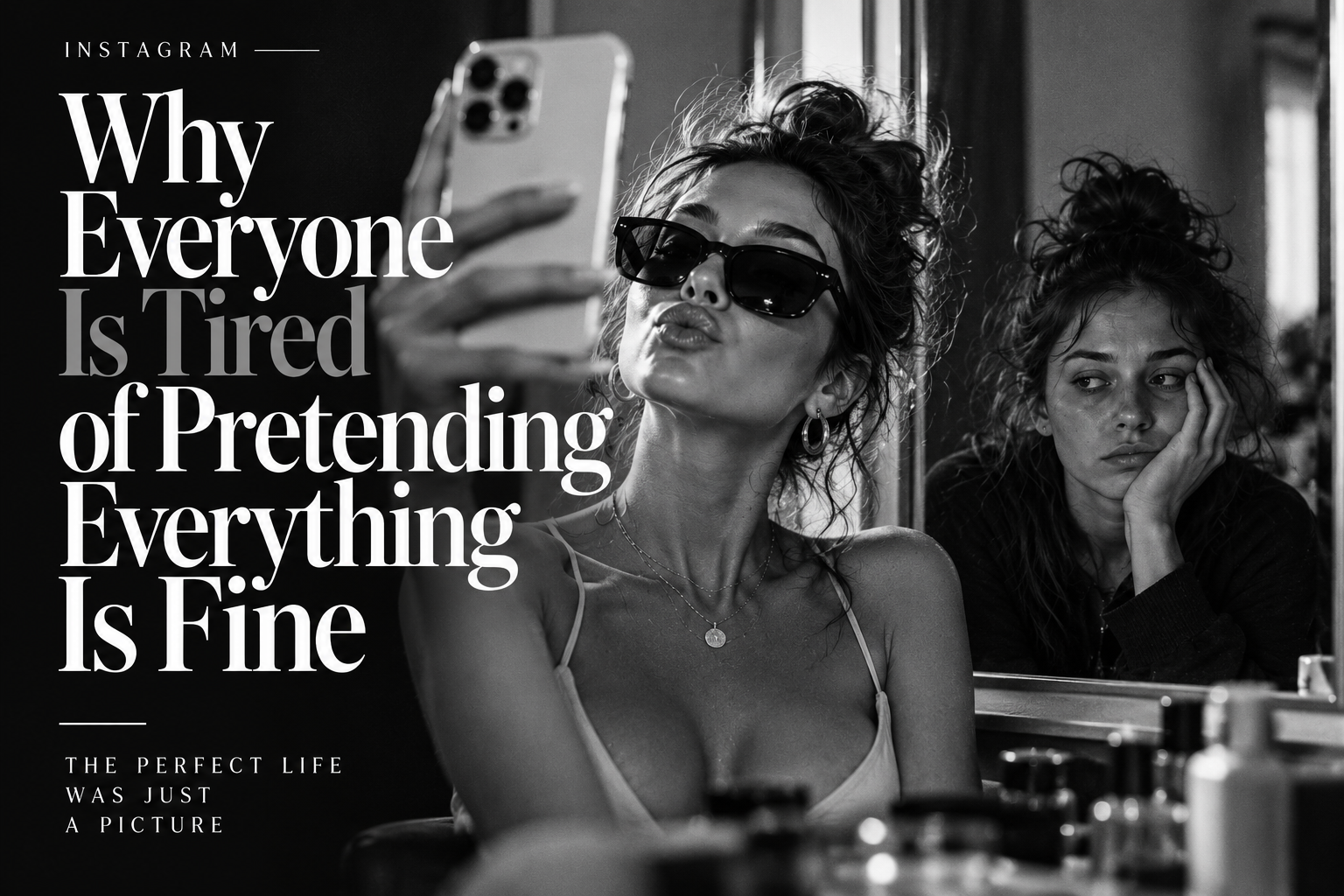
Suddenly, all you needed to show the world that your life was wonderful was a photograph.
A beautiful breakfast.
A beautiful holiday.
A beautiful body.
A beautiful partner.
A beautiful apartment.
A beautiful glass of wine against a sunset.
And, of course, the right filter.
Slowly, a culture emerged in which life became not only something you lived, but something you had to make look good.
Instagram Taught Us to Edit Our Lives
The biggest problem was never really the photographs.
The problem was that photographs gradually became a kind of evidence.
If someone was constantly smiling in pictures, they must be happy.
If they were always traveling, their life must be exciting.
If they were working out, they must be disciplined.
If they had a beautiful home, everything in their life must be under control.
We all understand that this is an illusion.
But our brains still respond to images.
And slowly, a new definition of a normal life emerged:
It had to look good.
You didn’t necessarily have to be happy.
But you should look happy.
You didn’t necessarily have to be successful.
But you should look successful.
You didn’t necessarily have to have a perfect relationship.
But your relationship should look perfect in photographs.
Instagram didn’t invent human vanity.
It simply made it incredibly convenient.
Then Came the Industry of the Perfect Life
An enormous economy grew around this culture.
Influencers.
Fitness.
Beauty.
Fashion.
Travel.
Restaurants.
Real estate.
Self-help.
Wellness.
Products designed to help you become the “best version of yourself.”
People were no longer being sold just products.
They were being sold lifestyles.
You could become like them.
You could look like them.
You could live like them.
All you had to do was buy the right products, eat the right food, exercise correctly, work correctly, rest correctly — and, of course, photograph all of it correctly.
Something strange happened.
Even relaxation became work.
You were no longer simply taking a vacation.
You were producing content about taking a vacation.
You were no longer simply exercising.
You were producing evidence that you exercised.
You were no longer simply eating.
You were photographing the food.
Life slowly became raw material for publication.
But There Was One Problem: Real Life Looks Completely Different
Real life rarely looks like Instagram.
It contains Mondays.
Bad moods.
Boring conversations.
Mistakes.
Debt.
Loneliness.
Failure.
Doubt.
Jobs you sometimes hate.
Relationships that sometimes annoy you.
Bodies that change with age.
Days when you simply don’t feel like doing anything.
Almost none of this makes it into the window display.
So people began comparing their real lives with other people’s edited versions.
And losing.
Before the comparison had even begun.
Then TikTok Arrived
TikTok didn’t destroy this system.
It changed it.
Instead of carefully prepared photographs, there was video.
Instead of the perfect shot, there was the bare face.
Instead of the luxury apartment, there was the small messy room.
Instead of:
“Look how wonderful my life is.”
there was increasingly:
“Look at the mess I’m living in.”
Irony.
Self-irony.
Absurdity.
Exhaustion.
Everyday life.
Failure.
Strange habits.
Awkward situations.
People no longer had to present themselves as perfect products.
Sometimes they could sell their imperfections instead.
But there is a paradox here.
Even imperfection became content.
Even “being real” could become a carefully constructed image.
Maybe We Are Not Tired of Social Media
This is where things become interesting.
Perhaps people are not tired of Instagram.
And perhaps they are not even tired of social media.
Maybe they are tired of the constant need to construct an image of themselves.
Constantly thinking about how they look.
What other people think.
How their apartment looks.
How their job looks.
How their family looks.
How their body looks.
How their vacation looks.
How their life looks.
Human beings have never had so many tools for creating a public version of themselves.
And perhaps we have never been under so much pressure to decide which version of ourselves to show.
The Perfect Life Is Starting to Become Annoying
At some point, something interesting happens.
The things that once created envy begin to create irritation.
Another perfect breakfast.
Another “morning routine of a successful person.”
Another airport photograph.
Another millionaire in a sports car.
Another story about someone who built a $10 million business at the age of 24.
Another person with perfect skin, a perfect body and a perfect kitchen.
And the viewer starts thinking:
“Maybe enough is enough.”
Not because they hate successful people.
But because they understand something:
They are not being shown a life.
They are being shown the packaging of a life.
Normality Is Becoming Valuable Again
Against this background, ordinary life suddenly becomes attractive.
A person who isn’t trying to impress anyone.
An apartment where people actually live.
An old car.
A simple dinner.
Ordinary clothes.
A small circle of friends.
A weekend with no plans.
A phone that can be put away.
A person who doesn’t have to become a better version of themselves every morning.
This doesn’t mean giving up ambition.
You can want money.
You can want a beautiful home.
You can want to travel.
You can work out.
You can build a career.
But none of these things has to become a performance for strangers.
The Greatest Luxury May Be Showing Nothing
Perhaps this is where the most interesting change is happening.
In an age when everyone can become public, privacy itself becomes a form of freedom.
Not photographing dinner.
Not documenting every trip.
Not explaining your relationship.
Not showing your salary.
Not proving your success.
Not turning every purchase into content.
Not publishing every mood.
Just living.
Without an audience.
Without likes.
Without the need to turn your own life into a media product.
Instagram Isn’t Going Anywhere
Of course, it would be naive to say that the Instagram era is over.
It isn’t.
It continues.
But after years of living inside a visual spectacle, audiences understand its rules much better.
We know that a photograph is a selection.
We know that a video is an edit.
We know that an influencer is selling not only a product, but a lifestyle.
We know that behind one beautiful photograph there may be ten failed attempts.
We know that someone who constantly displays happiness is not necessarily happy.
And perhaps that knowledge is slowly changing the internet.
We Don’t Need Perfect Lives
We need lives that don’t require constant explanation.
There is a big difference.
You can be successful and exhausted.
You can be happy and sad.
You can love your job and sometimes dream of quitting.
You can have a wonderful relationship and still want to be alone.
You can accomplish nothing today and still refuse to consider the day wasted.
A person doesn’t have to be a brand.
A person doesn’t have to be a project.
A person doesn’t have to be content.
And certainly, no one has to prove to the entire internet every single day that everything is fine.
Instagram once taught us how to make life look beautiful.
Perhaps now it is time to remember how to simply live it.