Off Türkiye’s southern coast, archaeologists are studying the remains of a small merchant ship that sank some 4,400 to 4,700 years ago. Its wood has dissolved into the sea. Its clay jars, stone anchors and one very odd vessel are left to speak for it.
One of the jars carries a zigzag line scratched into its surface with a pointed tool, above two parallel grooves. Someone made those marks nearly five thousand years ago, for reasons we can only guess at. Then the jar was loaded onto a ship, the ship went down, and the sea closed over it.
Today the jar is one of the few voices from a wreck that archaeologists are now calling one of the oldest ever found.
A coast that has been a highway for millennia
The wreck lies near Kekova Island, in Antalya province. The island is about 7 kilometres long and 1.6 wide, and sits roughly a kilometre off the mainland between the districts of Demre and Kaş. Its rocky ground is poor for farming and was never good for large settlements. Its position is another matter: it lies on one of the old sea routes of the Mediterranean.
Earthquakes in antiquity pushed parts of its ancient harbours and coastal buildings about two metres underwater, which is why the area is known for its sunken ruins. Divers have documented several wrecks around the island from different periods, from the Archaic age to late Roman and Byzantine times.
This new find goes much further back. It also fits a pattern. Further west along the Antalya coast lie other famous Bronze Age wrecks, including Kumluca, Gelidonya and Uluburun, all of them later than this one. Researchers working on a possible Early Bronze Age wreck at Finike, also on this coast, argue that the Kekova find supports the idea that sailors were already using this route long before those later ships.
Seen that way, the Antalya coast was not a lucky place for shipwrecks. It was a place where, for thousands of years, ships kept passing.
What was found
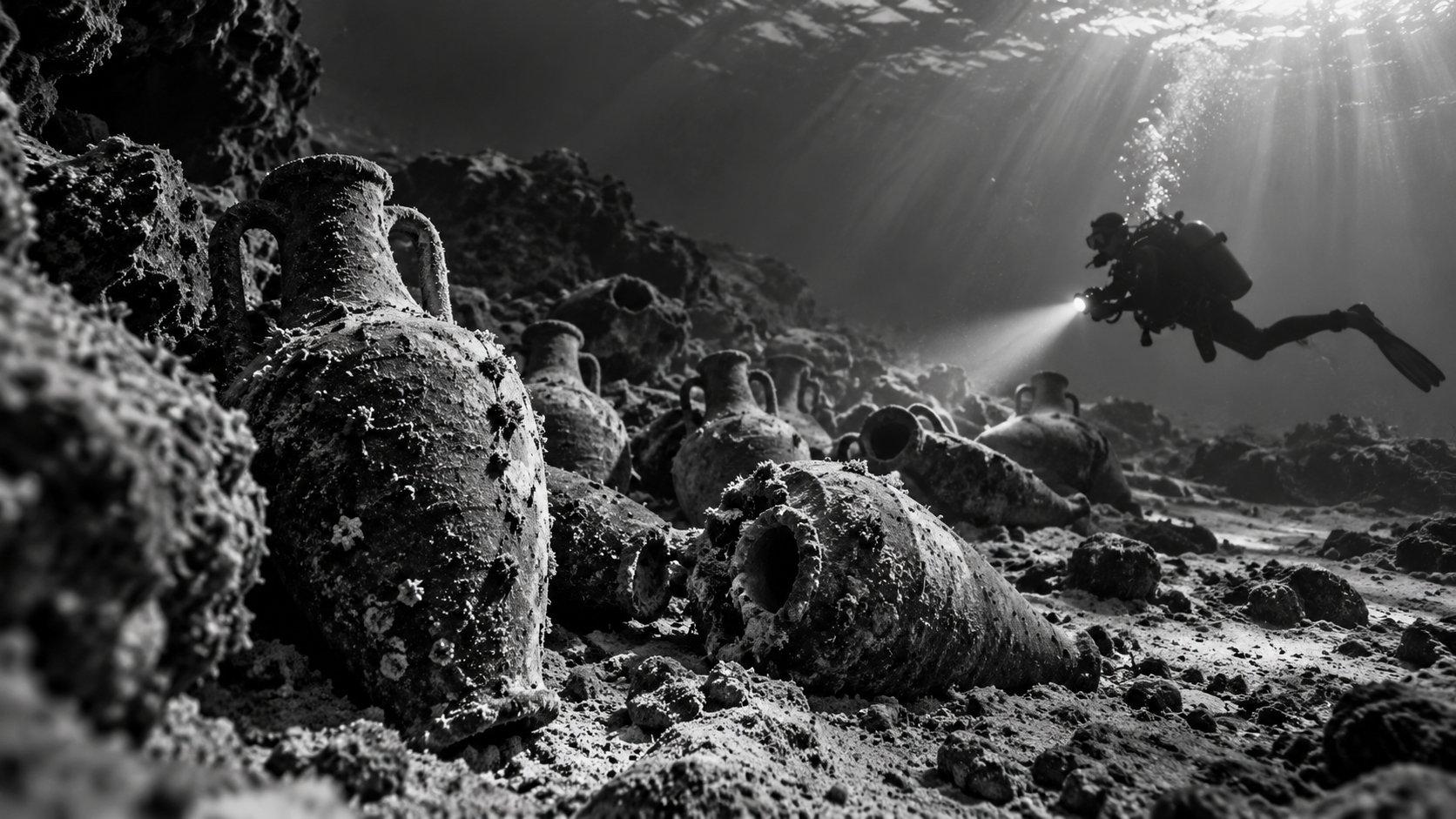
Akdeniz University researchers documented the wreck in 2024 during a survey of the Kekova region. The visible cargo consisted of amphorae, some of them broken. The jars resemble Early Bronze Age types known from the Levant: side handles and flat bases.
Two amphorae have been brought up for close study, one in 2024 and one in 2025. They are not identical. Their technical characteristics, clay composition and probable uses differ. One of them resembles the amphorae used to move farm products such as wine and olive oil. The stone anchors found nearby add another layer: the three-holed ones echo anchors known from Minoan, Cypriot, Anatolian and Levantine contexts, while a single-holed anchor matches types from Bronze Age Anatolia and the Levant.
The ship itself, researchers believe, was small.
Where it came from
Clay analysis suggests the jars were probably made in workshops in the Jordan Valley. Based on that and on the wider pattern of finds, researchers think the ship started from a port on the Levantine coast and was sailing west when it sank. A published preliminary report describes it as a small vessel travelling east to west.
Where was it going? Troy and Crete are the two destinations under discussion, and both are hypotheses. What gives them weight is that similar vessels have been found at both places, and also in Egypt, near Giza, Saqqara and Abusir.
That spread is the real story. A jar made in one region ended up, or was meant to end up, in places hundreds of kilometres away. Around the time the great pyramids were rising, goods already moved across the eastern Mediterranean through a trade network that people were running, financing and maintaining.
The jar with nine marks
Among the finds, one vessel stands apart. It has two holes in its body and nine distinct marks on its surface. Early examination suggests it may have been a churn, used to make butter or cheese.
If that is right, it changes the picture of the voyage. Sailors would not simply have carried cargo for sale. They might have kept goats aboard, milked them, and made dairy products during the trip. The vessel would then belong to the ship’s daily life rather than its commercial purpose.
That is why a cooking tool matters. Archaeology tends to celebrate treasure, but ordinary objects tell us what people actually did. A churn would be a small, human detail from a crew whose names we will never know.
It remains a possibility. The vessel’s function has not been confirmed, and further study is needed.
How you read a ship with no ship
A wreck without a hull still has a lot to say, because pottery is hard to destroy and easy to compare. Researchers study the shape of a jar, its handles and base, its decoration and the chemistry of its clay. Together these point to where and when it was made. When the same type appears in several places, it traces connections between them.
That is what has happened here. Matching the amphorae with finds in Egypt, Troy and Crete turns a handful of broken pots into a map.
The “world’s oldest” question
Türkiye’s culture minister, Mehmet Nuri Ersoy, described the discovery in a social media post as bringing to light the traces of the world’s oldest shipwreck. The claim deserves care. Since no hull has survived, how a wreck is dated and classified affects the ranking. And the title has been used before: in 2019, a wreck near Kumluca, about 3,600 years old, was presented as the oldest known. This new find would be considerably older, but “oldest” is a claim for the research community to settle, not a headline to take as given.
What comes next
The story is far from finished. Systematic excavation began in 2026 under the Antalya Museum Directorate, with Associate Professor Hakan Öniz leading the scientific work. The preliminary report says more remains of the wreck are likely to emerge at deeper points on the seabed, which is partly sand and partly rock.
Big questions remain open. Why did the ship sink: a storm, rocks, something else? What happened to the people on board? How much of the cargo is still buried?
For now, we have a small ship, a long route, a jar with a zigzag line, and one strange vessel with nine marks. The sea kept them for 4,700 years. It is only now giving them back.
Euronews