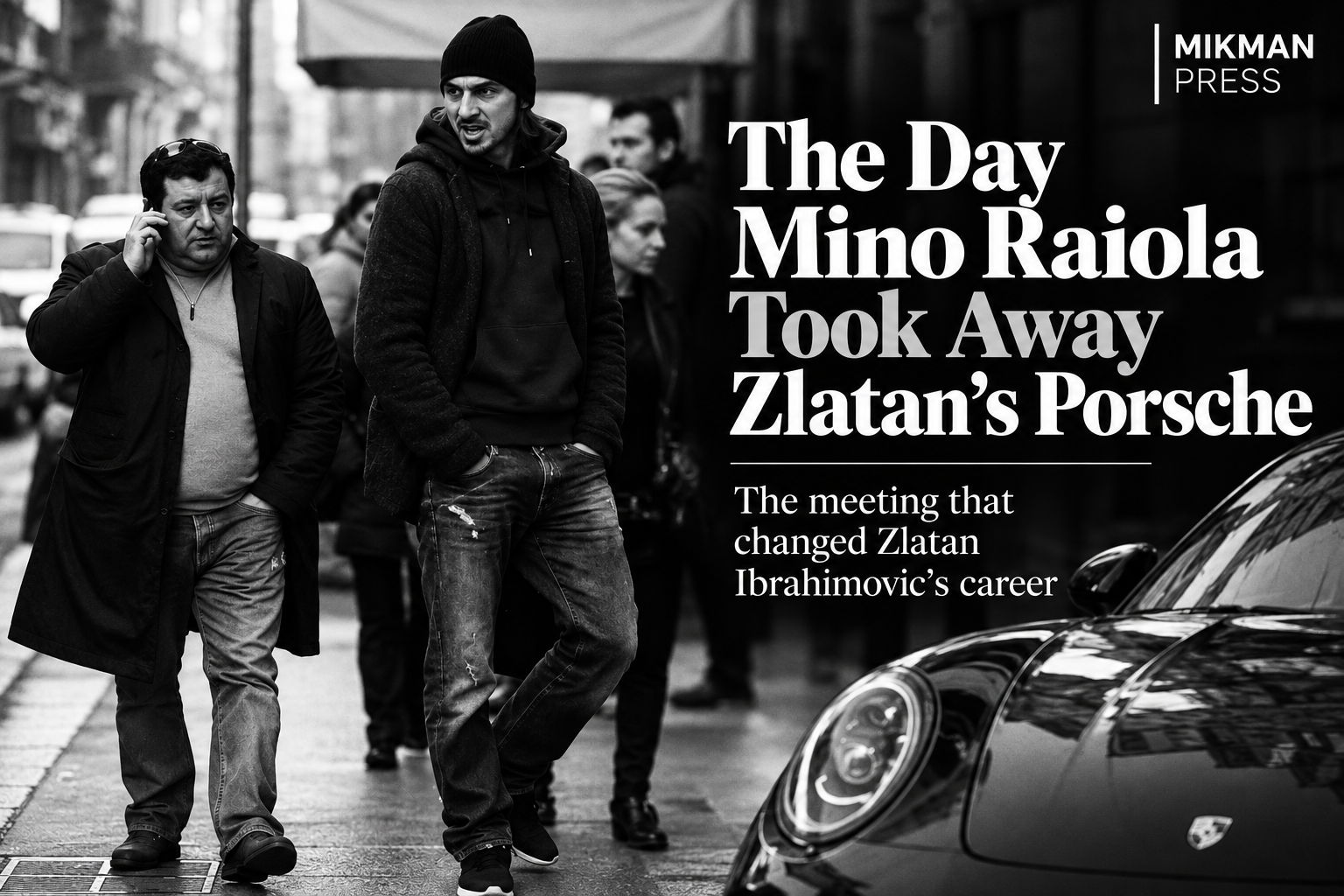
Zlatan Ibrahimović arrived in a Porsche, wearing Gucci and a Rolex. He expected to meet a powerful football agent in a suit. Instead, he met a man in jeans and a Nike shirt who ordered enough sushi for five people — and then destroyed Zlatan’s confidence with four sheets of statistics.
There are meetings that change a career.
And then there are meetings that change the way a person sees himself.
For Zlatan Ibrahimović, one of the defining moments of his career began in a Japanese restaurant in Amsterdam.
He arrived determined to make an impression.
He was young, ambitious and already convinced that he was destined for something extraordinary. He had the Porsche. He had the expensive watch. He had the Gucci jacket. He looked, in his own mind, like a future superstar.
Then Mino Raiola walked in.
Jeans.
A Nike shirt.
A large stomach.
No expensive suit.
No theatrical display of wealth.
According to Ibrahimović’s recollection, Raiola looked more like a character from The Sopranos than the kind of football agent he had expected to meet.
And Raiola was completely unimpressed.
“I Came to Impress Him”
Ibrahimović later explained that he had not initially wanted an agent.
He had moved from Malmö to Ajax without one, negotiating his own affairs. Eventually, he came to believe that he had accepted a poor contract and needed someone who understood the football business.
A journalist recommended Raiola.
Ibrahimović decided to meet him.
And he prepared for the occasion in the way a young man might prepare when he wants to demonstrate that he has already made it.
Porsche.
Rolex.
Gucci.
Raiola saw through all of it immediately.
The meeting took place at the Okura hotel in Amsterdam. Ibrahimović arrived in his expensive car, expecting Raiola to be impressed.
He wasn’t.
They sat down.
They ate sushi.
And, according to Ibrahimović, Raiola ordered enough food for several people.
Then the conversation changed.
Raiola produced sheets of paper.
No small talk.
No discussion about fashion.
No admiration for the Porsche.
Just numbers.
The Numbers That Hurt
Raiola had prepared statistics on some of the leading strikers of the time.
David Trezeguet.
Christian Vieri.
Filippo Inzaghi.
And Zlatan Ibrahimović.
In a recent retelling of the story, Ibrahimović recalled the figures as approximately 20 goals in 27 matches for Trezeguet, 20 in 23 for Vieri, and only three goals in 27 matches for himself.
Earlier accounts of the story have given different numbers, including a version in which Ibrahimović had five goals in 25 matches. The precise figures therefore vary between retellings.
But the essential point never changes.
Zlatan’s numbers were nowhere near those of the elite strikers Raiola was comparing him with.
Raiola looked at him and essentially asked:
How am I supposed to sell you with numbers like these?
It was brutal.
And Ibrahimović’s response was equally revealing.
He understood the problem.
If he had the numbers of the great strikers, he wouldn’t need an agent to convince anyone.
His performance would sell him.
Raiola agreed — but added that Ibrahimović needed something close to a miracle.
Porsche Versus Reality
This was the moment when Raiola did something that went far beyond negotiating a football transfer.
He attacked the young player’s perception of himself.
The Porsche did not matter.
The Rolex did not matter.
The clothes did not matter.
The image did not matter.
The statistics mattered.
In Ibrahimović’s later recollection, Raiola’s message was essentially this:
Your car doesn’t impress me. Your watch doesn’t impress me. Your numbers are what matter.
That distinction became one of the foundations of their relationship.
Raiola wasn’t interested in convincing Ibrahimović that he was already a star.
He wanted to make him understand how far he still had to go.
The Fiat Stilo
Then came the part of the story that has become almost legendary.
Raiola took away the Porsche.
He took the watches.
And he gave Ibrahimović a Fiat Stilo.
He also told him to wear tracksuits instead of dressing like a celebrity.
Ibrahimović later admitted that losing the Porsche bothered him.
It wasn’t simply about the car.
He had grown up in Rosengård, a working-class district of Malmö, and for him a good car represented achievement. It was a symbol that he had escaped his circumstances and was becoming successful.
Raiola saw the same symbol differently.
To him, it was a distraction.
The message was simple:
You haven’t made it yet.
“Now You Start Training”
Raiola then turned his attention to football.
Ibrahimović has recalled Raiola telling him that what he had done up to that point was not enough and that he needed to train twice as hard.
That detail matters.
Because the story is sometimes presented as though Raiola simply discovered an extraordinary talent and sold him to Juventus.
But that is not how Ibrahimović himself tells it.
Raiola saw potential.
He also saw enormous deficiencies.
The young Swede had size, technique, confidence and imagination. But potential was not the same thing as achievement.
Raiola wanted results.
And he wanted them quickly.
Three Months Later
The transformation did not happen overnight.
But the career moved quickly.
After their relationship began, Raiola helped arrange Ibrahimović’s move to Juventus, with the transfer taking place in 2004. Contemporary accounts of their relationship describe the meeting in Amsterdam as a turning point, followed by Ibrahimović’s move to one of Europe’s biggest clubs. Le Monde.fr
Suddenly, the young striker was sharing a dressing room with players he had previously watched from a distance.
Trezeguet.
Del Piero.
Buffon.
Nedvěd.
Cannavaro.
The world he had dreamed about was becoming real.
But Raiola’s message remained the same.
The dream meant nothing if Ibrahimović wasn’t prepared to work for it.
The Agent Who Refused to Be Impressed
What makes the story memorable is not really the Porsche.
It is the confrontation between image and substance.
Ibrahimović arrived saying, in effect:
Look at what I have become.
Raiola responded:
Show me what you can do.
That is a very different philosophy.
The young footballer wanted recognition.
The agent demanded evidence.
And perhaps that was exactly what Ibrahimović needed at that stage of his career.
He already possessed enormous self-belief. What he lacked was a brutally objective measurement of where he stood compared with the best.
Raiola gave him one.
A few sheets of paper.
A handful of numbers.
And a question that could not be avoided.
More Than an Agent
Their relationship eventually became much more than a professional arrangement.
Ibrahimović later described Raiola in deeply personal terms, saying that the agent had changed his life and helped him develop discipline and focus. He also described Raiola as someone who became almost like a father figure to him. Sky Sport
Raiola, for his part, became one of the most powerful and recognizable agents in world football.
He represented some of the game’s biggest names and became famous for his aggressive negotiating style, enormous confidence and willingness to challenge clubs and football executives.
But his relationship with Ibrahimović was special.
They had met when Zlatan was still trying to establish himself.
They grew together.
And their careers became intertwined.
The Lesson Behind the Story
There is a temptation to turn the story into a simple motivational fairy tale:
A young player meets a brilliant agent.
The agent humiliates him.
The player works harder.
He becomes one of the best players in the world.
Reality is more complicated.
Ibrahimović already possessed extraordinary talent. His career was the result of many factors: his natural ability, years of training, coaches, teammates, clubs, opportunities, discipline and his own relentless ambition.
But the Raiola meeting gave him something extremely valuable:
perspective.
It forced him to confront the difference between believing you are special and proving it.
That distinction is important not only in football.
It applies everywhere.
A Porsche can create an impression.
A Rolex can create an impression.
A designer jacket can create an impression.
But none of them can score a goal.
None can win a match.
None can make an ordinary player extraordinary.
Statistics cannot tell the entire story either. Football is far too complicated for that.
But numbers can expose a problem.
And that is exactly what Raiola used them for.
The Beginning of Zlatan
When Ibrahimović walked into that restaurant, he wanted to impress Mino Raiola.
Instead, Raiola stripped away the image.
The Porsche disappeared.
The Rolex disappeared.
The Gucci disappeared.
What remained was a young striker with three goals in 27 matches, enormous potential and a long way to go.
Raiola gave him a Fiat.
He gave him a challenge.
And he gave him a brutal answer to a question Ibrahimović had not yet learned to ask himself:
What have you actually achieved?
Three months later, he was on his way to Juventus.
The rest became football history.
Perhaps the most important thing Raiola ever took from Zlatan wasn’t his Porsche.
It was his illusion that he had already arrived.
And perhaps that was exactly what allowed him to begin the journey.
Michael Manukian