Denmark were not supposed to be at EURO 1992. They had failed to qualify. Their players were preparing for holidays, the coach was thinking about renovating his kitchen, and one of their key players was dealing with a family tragedy. Twelve days before the tournament, everything changed.
What followed became one of the most extraordinary stories in European football.
But behind Denmark’s famous fairy tale was another story — quieter, more painful, and far more personal.
It was the story of Kim Vilfort and his six-year-old daughter Line, who was fighting leukemia.
And it is important to tell that story without turning tragedy into mythology.
Denmark Wasn’t Supposed to Be There
Denmark had finished second in their qualifying group behind Yugoslavia and therefore did not qualify for the European Championship in Sweden.
Then history intervened.
On May 31, 1992, the United Nations Security Council adopted Resolution 757, imposing sanctions on the Federal Republic of Yugoslavia amid the wars accompanying the breakup of Yugoslavia. UEFA subsequently excluded the Yugoslav team from EURO 1992.
Denmark, as the next team in the qualifying group, were invited to take their place.
They had only 12 days before their first match. DBU
The story that the entire Danish squad was lying on beaches drinking beer when the phone rang is entertaining, but it is also exaggerated.
Some players were indeed preparing for holidays. Brian Laudrup had plans to travel to New York, for example, and coach Richard Møller Nielsen famously had plans to work on his kitchen.
But most of the squad were not simply unemployed footballers lying around on holiday. Thirteen of the 20 players in the eventual squad were playing in the Danish league, and the domestic season had only just ended.
Still, nobody had prepared Denmark specifically for a European Championship.
They were going to Sweden because another country’s absence had unexpectedly opened the door.
And almost nobody expected them to walk through it.
Michael Laudrup Stayed Away
There was another problem.
Michael Laudrup, Denmark’s biggest star, did not participate.
Laudrup had fallen out with Richard Møller Nielsen during the qualification campaign and had withdrawn from the national team. He did not return for the tournament. He would eventually come back to the national team in 1993.
So Denmark arrived in Sweden without the player many considered their greatest talent.
The circumstances were hardly those of a future European champion.
The players themselves understood that.
The expectations were almost nonexistent.
And perhaps that was precisely what made the story possible.
Kim Vilfort Had Something Much Bigger to Think About
While Denmark were preparing for the tournament, Kim Vilfort was living through a completely different reality.
His daughter Line had been diagnosed with leukemia in 1991.
She was only six years old.
Treatment had begun at Rigshospitalet in Copenhagen. For the Vilfort family, football was important — but their daughter’s life was infinitely more important.
When Denmark received the invitation to Sweden, Vilfort initially did not want to go.
His daughter’s condition had deteriorated, and his thoughts were with his family.
Richard Møller Nielsen understood.
The coach told him that he could travel back whenever necessary.
There would be no demand that football come before his daughter.
Vilfort eventually went.
Not because the situation had suddenly become less serious.
But because his family supported his decision.
The First Two Matches
Denmark opened EURO 1992 against England.
The match finished 0–0.
Then came Sweden.
The hosts won 1–0.
Denmark had one point from two matches and looked very much like a team that would soon be going home.
And Vilfort went home too.
Not for a holiday.
He returned to Copenhagen to be with Line.
The third group match was against France, one of the tournament’s highly regarded teams.
Vilfort did not play.
He was with his daughter.
Denmark, meanwhile, produced the first great shock of their summer.
Henrik Larsen put them ahead.
France equalized.
Then, late in the match, Lars Elstrup scored the winner.
Denmark won 2–1.
England failed to beat Sweden.
And suddenly the team that had not even qualified for the tournament was in the semi-finals.
The Netherlands
Waiting for Denmark were the reigning European champions.
The Netherlands had Marco van Basten, Ruud Gullit, Frank Rijkaard, Ronald Koeman, Dennis Bergkamp and Hans van Breukelen.
They were among the tournament favourites.
Denmark were supposed to be finished.
Instead, they played one of the great matches of the tournament.
Henrik Larsen scored twice.
Dennis Bergkamp and Frank Rijkaard scored for the Netherlands.
After 90 minutes it was 2–2.
Extra time produced no winner.
Then came the penalty shoot-out.
And Kim Vilfort was back.
He had returned to the team after his daughter’s condition had worsened. His family had encouraged him to go back to Sweden.
He stepped up and scored Denmark’s fourth penalty.
Peter Schmeichel then saved Marco van Basten’s attempt.
Denmark won the shoot-out 5–4.
They were going to the final.
A Story That Became Too Convenient
Over the years, the story of Kim Vilfort and Line has often been presented almost like a screenplay.
The dying child watches every match.
The father leaves the hospital.
He scores the decisive penalty.
Then he scores the winning goal in the final.
The whole hospital supposedly erupts.
The sick children supposedly forget their pain.
And football becomes a kind of miracle.
Some versions go even further.
But Kim Vilfort himself has subsequently pushed back against the way his daughter’s illness has been turned into part of the football fairy tale.
In a 2024 interview with the Danish Cancer Society, Vilfort said that his daughter’s illness and her death became connected with EURO 1992 because it was a good story for newspapers. For him, however, the two things were fundamentally separate: his daughter’s illness was his family’s reality, while the European Championship was football.
That distinction matters.
The real story does not need embellishment.
A father leaving his six-year-old daughter in hospital to play football, then repeatedly travelling back and forth between Denmark and Sweden, is already almost unbearable to imagine.
The Final
On June 26, 1992, Denmark faced Germany in Gothenburg.
Germany were the newly reunified country’s first European Championship team and had arrived as world champions.
Denmark were outsiders.
Again.
John Jensen stunned Germany by scoring in the 18th minute.
Then Germany took control.
Peter Schmeichel made crucial saves.
The Danish defence survived wave after wave of pressure.
For long stretches, Germany looked capable of equalizing.
And then, in the 78th minute, came the moment that entered football history.
Kim Vilfort received the ball, moved inside and struck a low left-footed shot.
It went in off the post.
Denmark 2–0 Germany.
The goal sealed the European Championship.
UEFA describes Vilfort’s goal as the decisive moment that completed Denmark’s extraordinary late-entry fairy tale.
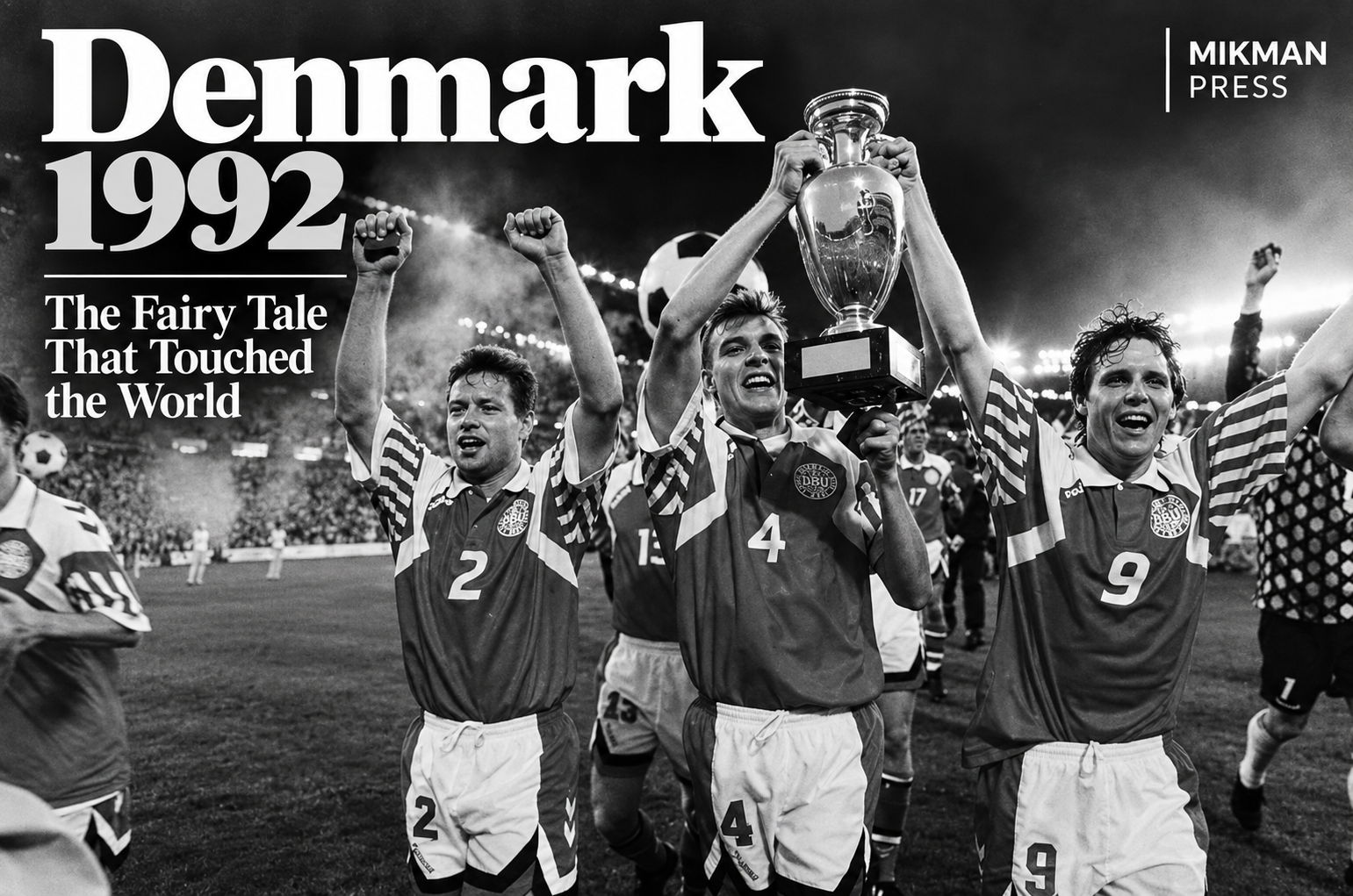
The photograph of Vilfort celebrating with his teammates became one of the defining images of EURO 1992.
But behind the celebration was a father whose mind was still partly in Copenhagen.
The Cruelest Part of the Story
Denmark had won the European Championship.
Kim Vilfort had scored the decisive goal.
The country celebrated.
But Line was still seriously ill.
And she did not have much time left.
She died a few weeks after the tournament, at the age of six. UEFA has described her death as occurring a few weeks after the final. The Danish Cancer Society confirms the severity and progression of her illness and the family’s long struggle with it.
That is an important correction to some versions of the story.
It was not simply “a few days later.”
It was weeks later.
And there is no need to invent a final dramatic conversation between father and daughter unless it can be documented.
The Real Fairy Tale
Denmark’s EURO 1992 triumph remains one of the great surprises in international football.
They had not qualified.
They were invited at the last moment.
They had only 12 days to prepare.
They drew with England.
Lost to Sweden.
Beat France.
Eliminated the Netherlands on penalties.
Then defeated Germany 2–0 in the final.
John Jensen scored first.
Kim Vilfort scored the second.
Peter Schmeichel stood behind them and made crucial saves.
And Richard Møller Nielsen became the coach who had supposedly been preparing to renovate his kitchen instead of leading a European Championship campaign.
It sounds like a story written by Hans Christian Andersen.
But the deepest part of the story is not the fairy tale.
It is what happened away from the stadium.
While Denmark was celebrating its greatest football achievement, a father was travelling between a football tournament and a hospital room.
Kim Vilfort did not become a hero because his daughter was ill.
He became a hero because he played football while carrying something far heavier than any opponent could ever put on him.
And perhaps the most honest way to remember EURO 1992 is to keep both stories separate.
There was Denmark’s football miracle.
And there was Line’s illness and death.
They happened at the same time.
They were connected by one man.
But they were not the same story.
The football fairy tale ended with a trophy in Gothenburg.
The personal tragedy continued in Copenhagen.
And that is what makes the summer of 1992 impossible to forget.
Michael Manukian